An ABC of Authoritarianism: Argentina, Brazil, and Chile
Aside from its authoritarian ambitions, the Trump administration shares few of the conditions of Latin America’s past military dictatorships. But its echoing of fearful rhetoric about an “enemy from within” remains just as dangerous today.
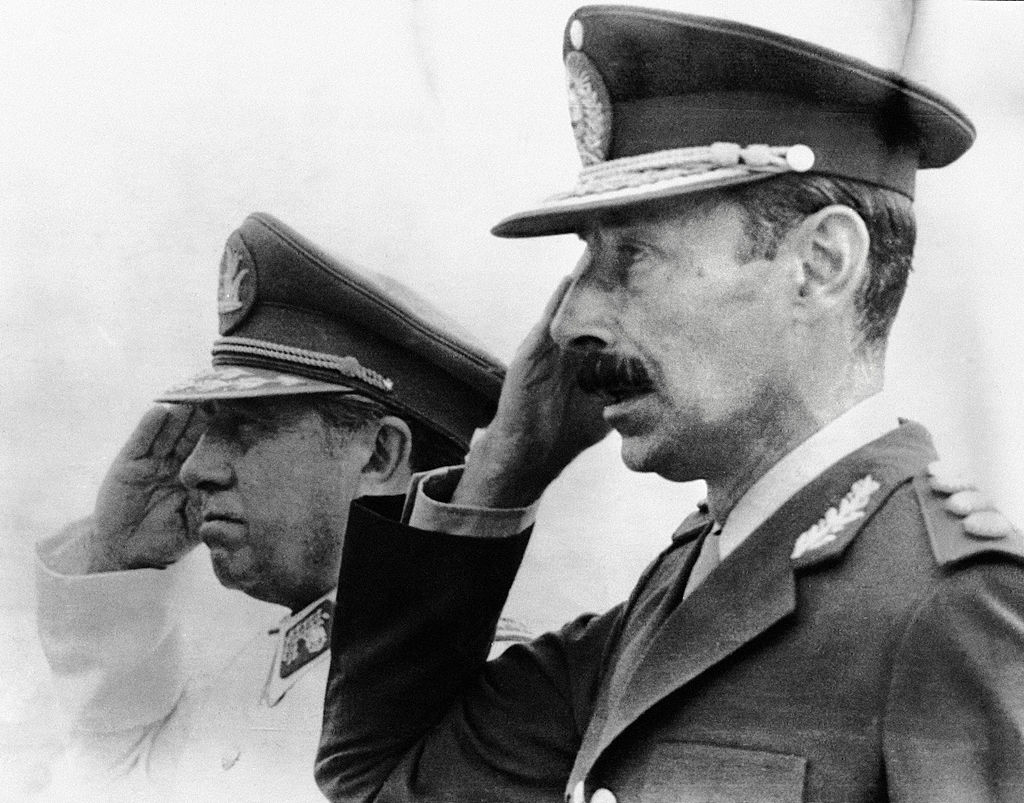
Photograph taken in Chile in 1978 of General Augusto Pinochet (L) and his Argentine counterpart General Jorge Videla. (STR / AFP via Getty Images)
Between the mid-1960s and the 1980s, military dictatorships dominated South America, epitomized by the ABC countries: Argentina from 1966 to 1971 and 1976 to 1983, Brazil from 1964 to 1985, and Chile from 1973 to 1990. Three historians of Latin America ask what, if anything, military rule in these three countries reveals about the current lurch toward authoritarianism in the United States.
These remarks, presented at the annual meeting of the American Historical Association, may be read as a primer on the different strains of authoritarianism then and now, there and here.
Across the comparisons, three aspects stand out. To start, the fearful rhetoric of combating internal enemies, common to South America’s military dictatorships, has been echoed by Trump administration officials at the highest levels. Contrasts, however, loom larger, in everything from the current administration’s source of legitimacy (elections, as opposed to military coups), to its personalistic style, to its relative ability to wield untrammeled power. Finally, the South American cases remind us that people resisted authoritarianism under far more perilous conditions than anything people in the United States have faced to this point. We are going to need more opposition to stem the rising authoritarian tide.