How to Understand Nature From a Marxist Perspective
Nobody today denies that capitalism exploits nature. The disagreement is over why. Political theorist Alyssa Battistoni spoke to Jacobin about capitalism’s complex relationship to what economists once called nature’s “free gifts.”
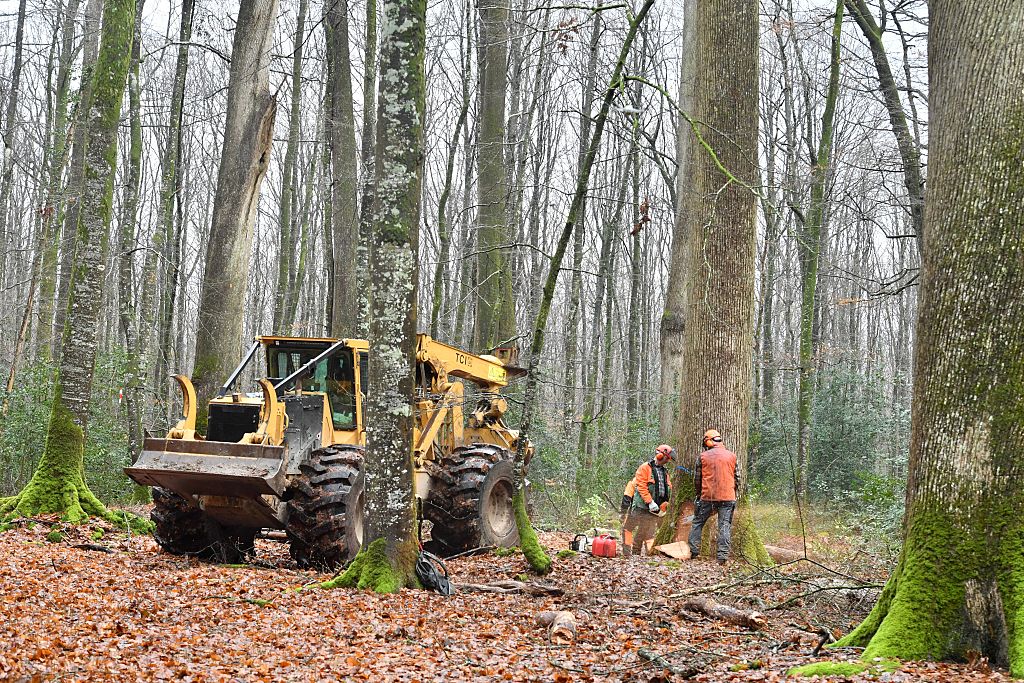
Socialists have often viewed concepts like nature and natural as too vague and ideological to be meaningfully deployed. But as the political theorist Alyssa Battistoni explains, they are indispensable if we want to understand how capitalism functions. (Jean-Francois Monier / AFP via Getty Images)
- Interview by
- Hugo de Camps
The rise of capitalism as an economic and social system has also coincided with its rapid transformation of nature. Wage labor and investment in the hope of return has dammed rivers, bored through mountains, flattened landscapes, and even transformed the relationships between parents and children, and between men and women.
In her recent book, Free Gifts: Capitalism and the Politics of Nature, political theorist Alyssa Battistoni sets out to explain how and why capitalism transforms and relates to nature. Jacobin spoke to Battistoni about capitalism’s role in shaping the relationship between the economy and social relations, and how Marxists ought to understand the way capitalism relates to ecology and the domestic sphere.
Hugo de Camps
Many people tend to think of capitalism as a system that seeks to commodify everything. However, in your book, you draw on the notion of a “free gift,” which you describe as something that capital prefers not to commodify or subject to market logic. What do you mean by this?
Alyssa Battistoni
The free gift is not originally my concept. It appears in classical political economy and in Karl Marx’s critique of it. Eighteenth- and nineteenth-century political economists, from David Ricardo to Jean-Baptiste Say, write about the “gratuitous contributions” of natural agents to production — all the things nature gives that enhance productivity.
Marx takes up this idea, but he reframes it. What classical political economy treats as a general feature of production becomes, for Marx, something historically specific to capitalism and its social relations: a social form peculiar to capitalist society rather than a universal fact about wealth production. Marx himself does not develop the concept at length, and although eco-Marxists have made use of it to describe capitalism’s relationship to nature, it has often remained undertheorized.
The “free gift” is therefore a strange but useful category — not only for thinking about nature, but for grasping a wider set of overlooked relations within capitalism. The term itself is telling. “Free gift” sounds redundant, even oxymoronic: gifts are not bought and sold. Yet gifts normally bind people into relations of reciprocity and obligation, which makes the idea of a “free gift” difficult to make sense of outside capitalism.
It becomes intelligible in a society organized around commodity exchange, where usefulness can exist without taking the form of exchange value. This is decisive for understanding nature under capitalism. Nature is productive, but what matters is that its contributions occur “for free” for capital: they are indispensable, yet they do not appear as commodities in the same way as other inputs.
In this sense, the free gift is the shadow of the commodity. It names forms of usefulness that do not appear as exchange value and helps us grasp how capitalism transforms the status of what it depends on but does not, and often cannot, fully commodify. That is why the free gift needs to be treated as a serious category and understood specifically as a capitalist one.
Hugo de Camps
The concept of nature is generally recognized to be hard to get to grips with because its meaning is so ambiguous, and it is used so broadly. Why do you think it still makes sense to use the term “nature” when analyzing capitalism and its relationship to the environment?
Alyssa Battistoni
I have struggled with the terms “nature” and “natural” precisely because they are so vexed. Raymond Williams famously described “nature” as one of the most complex words in the language, and it has been subject to extensive critique and problematization. And yet I have found it difficult to abandon the term altogether. Partly this is for pragmatic reasons: sometimes it is preferable to work with a concept that gestures toward something widely understood, even if imperfectly, rather than inventing new vocabulary that risks obscuring more than it clarifies.
Hugo de Camps
Marx’s views on ecology have been interpreted in sharply different ways. Some read him as a Promethean thinker committed to human mastery over nature while others have argued that his work already contains a productive ecological framework. You also draw on Marx to analyze capitalism and nature — what makes his framework still relevant for ecological thought today?
Alyssa Battistoni
Marx is a controversial figure in ecological debates, and there is textual material that supports both readings. But what I find most useful is not settling the question of whether Marx was “truly ecological.” What matters to me is his method, especially the critique of political economy, and his analysis of capitalism. Marx is centrally concerned with the relationship between the natural and the social — that is, between the physical world and its social forms of appearance. And these are exactly the questions at the heart of critical environmental thought today.
Capitalism has reordered the planet so thoroughly that we cannot think about nature without holding those dimensions together. Marx’s insistence on the dual character of the commodity — i.e., use value and exchange value, natural form and social form — provides a way of doing exactly that. If we take this framework seriously, we gain a clearer grasp of contemporary environmental problems, including how they operate within capitalism, how they are produced by it, and how they unfold through it as a specific form of social organization.
Marx also offers a critical standpoint toward mainstream economic approaches to environmental problems by asking what such frameworks illuminate, what they obscure, and where their limits lie. At bottom, I still think Marx is the best guide we have for understanding capitalism. Since capitalism is what we need to understand to grasp the current condition of the planet, that is why I think that Marx remains so relevant for ecological thought.
Hugo de Camps
In the book, you posit a critique of the “new materialists,” such as Bruno Latour, Donna Haraway, and Anna Tsing. At the same time, you also argue that many contemporary eco-Marxists present a “moralistic” account of nature. Could you explain what, in your view, are the limits of these two strands?
Alyssa Battistoni
One of the most influential strands of contemporary social theory to take nature seriously has been new materialism. New materialists are right to point out that much social theory has neglected the material and physical world, and in that sense, they identify something important that was missing from many critical frameworks.
At the same time, I think they often overcorrect. New materialist approaches tend to adopt a kind of naive materialism, where the material world is treated as something that can be understood almost on its own. The assumption is that phenomena can be studied as purely material processes — by tracing relations among actors, for example — without offering a sustained account of the social relations that structure a particular society or orient human action within it.
While this can reorient our perspective and draw attention to material activity, it cannot really explain what is happening unless it is paired with an analysis of social dynamics. That is what a Marxist approach provides. In this respect, my critique of new materialism is not unlike Marx’s critique of classical political economy. We can observe the effects of material entities, but to understand what drives those effects we need an account of the specific social form in which they appear. At the same time, I do want to integrate some insights of new materialism into a Marxist framework — especially their insistence on materiality — by holding together the social and the material rather than separating them.
The problem with much eco-Marxism is different. I have learned a great deal from that tradition and see myself as working within it. But there has often been an assumption that showing capitalism to be destructive of nature is, in itself, a sufficient critique. Human activity always transforms nature; that is part of our metabolic relationship with the more-than-human world. The critical question is not whether nature is transformed, but how, and under what social relations.
Much eco-Marxist thought rests — often implicitly — on the idea that the core problem is alienation from nature. What is missing is an account of how specific capitalist social relations organize and compel destructive interactions with the natural world, independently of moral intentions or attitudes. That is the task I take up in the book.
Hugo de Camps
In Chapter 5, you revisit the Wages for Housework campaign and what you call Silvia Federici’s “naturalization thesis.” You argue that this framework has certain limits. Could you explain what you see as those limits, and why you believe your perspective helps us better understand the role of the family in the capitalist economy?
Alyssa Battistoni
The book as a whole is deeply shaped by Marxist feminist thought, and this chapter is an attempt to engage seriously with what we inherited from it, especially from the Wages for Housework campaign, while also diagnosing some of the limits of that framework. A recurring move in Marxist feminist and eco-Marxist thought has been to draw an analogy between unwaged domestic and reproductive labour and what is often described as “unvalued” or “free” nature. We see this both in the Wages for Housework moment and in more recent work, including Jason Moore’s account of capitalism’s “cheap natures” and background conditions. The underlying question is why these forms of labor and nature appear to occupy a similar position under capitalism.
Federici’s answer to what has often been called the “woman question” in Marxism is that women’s oppression under capitalism is rooted in housework, and more specifically in its naturalization. Domestic labor appears as unwaged because it is treated as nature rather than as work. This has been an enormously powerful political argument and has reshaped how domestic labor is understood by making visible forms of exploitation that had long been ignored.
But I see two problems in this account: first, the argument tends to take for granted that nature itself can simply be taken “for free,” rather than interrogating the status of nature as something capital treats as a free gift; second, the naturalization thesis relies heavily on ideological critique — the idea that if we demystify this work and make it visible as labor, its status might change. While consciousness has shifted, the material organization of this labor has changed far less.
What I try to do instead is to treat reproductive labour as a set of concrete labor processes. From this perspective, it becomes clearer why capital often abdicates responsibility for these forms of work: reproductive labor tends to be labor-intensive, difficult to mechanize, and hard to make more efficient, which makes it an unattractive site for value accumulation. Capital invests where profitability is likely; where it is not, responsibility for social reproduction is displaced on to workers and their networks. This provides a more material explanation of why reproductive labor remains external to markets while still being indispensable to capitalism, and it helps bring questions of social reproduction into closer conversation with ecological concerns.
Hugo de Camps
You draw on the work of authors such as Arthur Pigou and Ronald Coase to show that externalities are not signs of market failure but rather integral to how markets function. This perspective leads you to reject the idea of addressing externalities through market mechanisms, and instead to explore Christopher Stone’s proposal of granting legal rights to natural entities as a basis for “multispecies collective bargaining.” Could you elaborate on what you mean by this idea?
Alyssa Battistoni
This chapter looks at pollution and negative externalities through the lens of mainstream economic theory. Carbon pricing and the language of externalities have shaped environmental policy for decades, and Pigou and Coase diagnose something real in identifying effects of economic activity that aren’t captured by market prices. But their frameworks remain confined to analyses of exchange, prices, and “market failure,” assuming that environmental harm can be addressed by better pricing or by creating property rights that allow markets to correct themselves. From a Marxist perspective, this misses the point. Externalities are not accidental deviations from market logic; they are produced within capitalism itself, emerging from production and from capital’s capacity to impose costs on others.
Once the analysis begins from class relations and production, environmental harm appears less as a technical problem and more as a political problem of power. This is why I find the legal scholar Christopher Stone’s proposal to grant legal rights to natural entities compelling. It can be understood not simply as a reflection of nature’s innate value but also as a political mechanism for addressing collective action problems. Pollution disperses harm across a diffuse population, making resistance difficult — much like workers face collective action problems when confronting employers. But Stone argues that if a natural entity such as a lake has standing to sue, harms borne by surrounding communities and nonhuman beings can be aggregated through a single legal subject.
I am therefore less interested in rights as abstract moral recognition than as a concrete institutional tool — one that can help shift the balance of power. In this sense, the rights of nature can be understood as a form of multispecies collective bargaining, situating ecological conflict within political economy rather than reducing it to market adjustment.
Hugo de Camps
In recent years, particularly within Marxist studies, there has been a renewed interest in republicanism as a normative framework for thinking about freedom — understood as the absence of arbitrary domination. Yet in your book, you argue that an existentialist account of freedom that draws on the work of Jean-Paul Sartre and Simone de Beauvoir is better suited than a republican one to confront market rule and the distinctive forms of unfreedom that define capitalist societies. Could you explain why you find the existentialist approach more compelling in this regard?
Alyssa Battistoni
Republicanism has certainly been productive for thinking about labor politics and domination in the workplace. Nondomination is a valuable concept, and it helps diagnose direct forms of domination by bosses and capitalists. Where it becomes less convincing is in relation to what Marxists describe as abstract or social domination — domination by markets, competition, and impersonal imperatives. This is the “mute compulsion” Marx writes about. It is not simply a matter of one will overriding another but of being compelled to act in ways one may not endorse: workers competing against one another, consumers enmeshed in markets, and even capitalists themselves driven by competitive pressures.
Republicanism struggles here because the domination involved is impersonal. There is no identifiable arbitrary will that can be singled out as “the dominator.” Instead, domination emerges from the aggregate effects of individually rational actions that confront people as a coercive social force. Existentialism — especially Sartre’s later work — helps articulate this more precisely. It foregrounds how our capacity to affirm values and commit to projects is undermined not necessarily by a person, but by collective social processes and institutional arrangements that block our ability to act on what we take to matter.
Hugo de Camps
Your book is also quite skeptical about the emancipatory potential of the “commons.” Yet given the current urgency to act against the effects of the Capitalocene, do you not think that the commons could still offer a meaningful starting point for collective action?
Alyssa Battistoni
I am critical of how the commons are sometimes romanticized — as a space outside capitalism, a refuge from it, a way of “building the outside from within.” The existing commons, I argue, have to be understood in relation to capital and the spaces capital has failed to enclose. They are not “outside” in any straightforward sense, and their internal life is subject to broader pressures, such as compulsion and competition.
That said, I do not want to dismiss commons-based projects. We simply need a sober view of what commons are and what they can do. Being outside capitalism is not a necessary condition for building political power. In fact, recognizing that one is operating inside a hostile system is often politically clarifying, because it forces the question of what can be done with the relations that structure life under capitalism.
In that sense, commons are analogous to unions. Nobody claims unions exist outside capitalism, but they can still generate collective power and resistance. Commons-based projects can matter for similar reasons: they can open concrete possibilities for self-organization and self-management and provide room for maneuver. The point is not to idealize them as an “outside,” but to situate them realistically within capitalist social relations.
Hugo de Camps
You critique approaches that focus on changing our attitudes toward nature, arguing that they are often voluntarist, ideological, and limited in explanatory power. These perspectives tend to center on Western culture; yet as you point out, similar patterns have emerged in non-Western contexts as they have undergone capitalist transformation. Could you explain why, in your view, these accounts lack explanatory power?
Alyssa Battistoni
Approaches that explain contemporary environmental problems primarily in terms of attitudes toward nature are extremely widespread in environmental thought. The core claim is that “we” — often identified with Western culture — have developed the wrong way of seeing nature, and that this conceptual or philosophical error ultimately drives ecological destruction. You see this in critiques of Cartesian dualism or in arguments that trace environmental harm back to a worldview that treats nature as inert or merely instrumental. The problem with this approach is that it is fundamentally idealist. It assumes that ideas are the primary drivers of historical action, as if philosophical traditions could explain centuries of capitalist development and industrial transformation. It suggests that if we simply came to see nature differently — through greater ecological awareness or a shift in values — these problems could be resolved.
This is not only theoretically unconvincing but also empirically weak. Once we move beyond Western Europe or North America, the argument breaks down. Capitalism today is most dynamically reproduced in regions such as China or East Asia, which do not share the intellectual traditions often blamed for environmental degradation, and yet similar patterns of ecological harm emerge as these societies undergo capitalist transformation.
Moreover, many people already hold noninstrumental views of nature and care deeply about environmental issues yet remain compelled to act in ways that reproduce the very relations they criticize. This shows that the decisive compulsion does not operate at the level of consciousness or intention, but through material pressures, institutional structures, and forms of social organization. A critique that focuses on those structures is therefore essential if we want to explain the problem adequately and understand what kinds of transformations could actually address it.
Hugo de Camps
After Free Gifts, your next project deals with state theory from a Marxist perspective. To what extent do you see it as a continuation of the first book?
Alyssa Battistoni
In many respects, it is a continuation, because the state appears throughout Free Gifts, albeit around the margins. However, the book does not develop an explicit theory of the state; what the state is doing remains largely implicit. Eco-Marxist work more broadly lacks a sustained account of the capitalist state, despite the central role it plays in structuring access to nature, controlling territory, organizing extraction and expropriation, and managing — or failing to manage — the ecological harms generated by capitalism.
At the same time, the state is repeatedly invoked in climate politics as the actor capable of acting at scale, through decarbonization, infrastructure, or regulation; yet the possibilities and limits of such action remain unclear. The next project grows out of this tension. It shifts the focus from value theory toward a sober Marxist analysis of the state that takes seriously both its centrality and its hostility.