Capitalism and the Commodification of Nature
Good books offer new arguments, while excellent books pose new questions. Alyssa Battistoni’s Free Gifts, on the unfinished commodification of nature and care, is an excellent book.
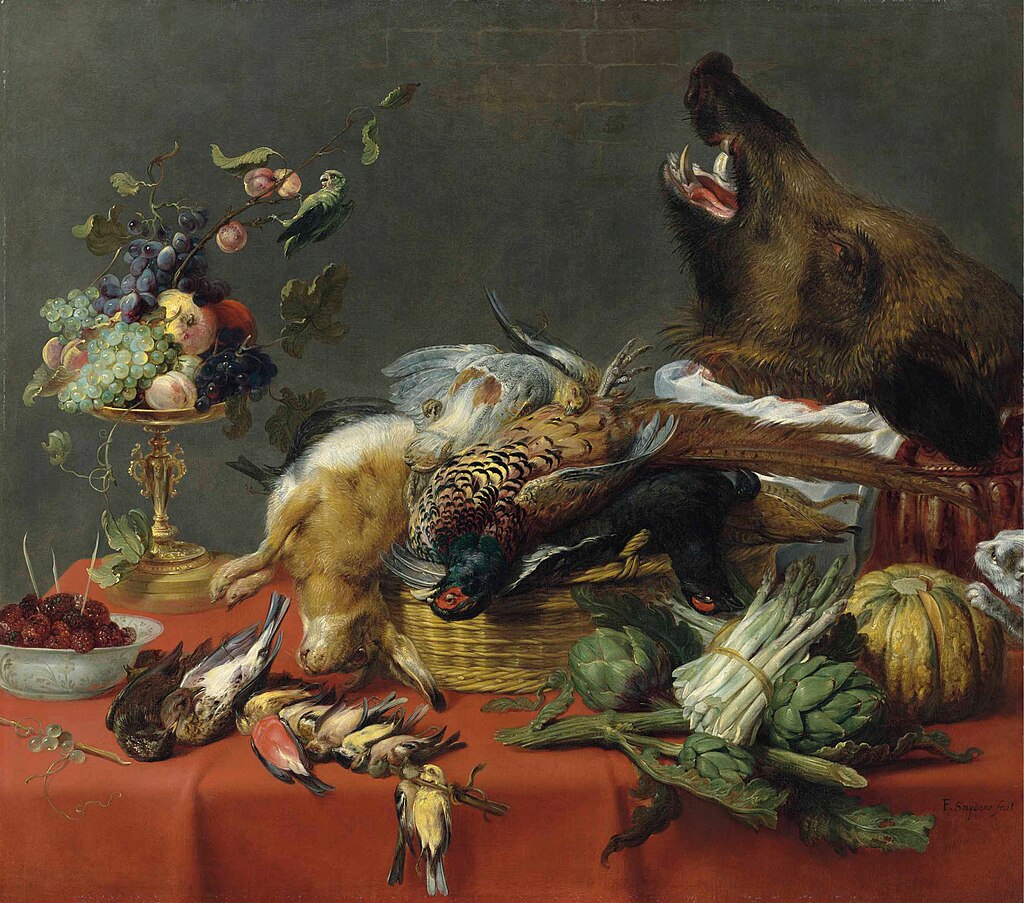
In a world of ever more polluted land, water, and air, fertile land, fresh water, and clean air become scarce and thus massive sources of wealth. The socialist case for collective ownership of these common endowments couldn’t be clearer. (Frans Snyders, A draped table laden with game, fruit, vegetables and a boar’s head)
Last Friday, I spoke on a panel at NYU on political theorist Alyssa Battistoni’s new book Free Gifts: Capitalism and the Politics of Nature. The room was packed, somewhat unusual for an academic book of political theory. But if you’ve read Battistoni’s book or know of her work, you’ll understand why.
The book is not only a remarkable synthesis of a variety of literatures on the environment, climate change, work, Karl Marx, feminism, and the politics of care — if you were just looking for an excellent account of the last fifty years of political theory, plus Marx and a lot of twentieth-century economics, this would be your book — but also a brilliant intervention in these debates. It has given me all sorts of new ways to think about the connections between how we treat the environment and how we treat the world of childcare, eldercare, and the household; between economic accounts of negative externalities and Baumol’s cost disease; Marx’s view of nature; and more. It’s a model of what political theory should be, and a sign of its renaissance in the hands of a new generation of scholars.
I’m posting here my comments at the panel, but there was so much more I could and would have said with more time. While I’m mulling over these additional topics, I hope you buy and read the book.
Good books offer new arguments. Excellent books pose new questions. Alyssa Battistoni’s Free Gifts is an excellent book. It poses one extraordinary, novel question — If capitalism impels the commodification of everything, why has it not commodified so many parts of nature? — that yields other extraordinary questions.
In answering them, Battistoni makes so many interesting moves that you might miss a few. I want to mention only two, each a book in itself.
In one move, Battistoni analyzes a body of mainstream economics that arises in the twentieth century under the rubric of externalities, social costs, and cost disease. After pointing out that each of those issues has a common element — they all arise in the spheres of nature or the body — Battistoni does something that echoes what Marx did with Adam Smith and David Ricardo. Instead of ignoring or rejecting this literature, as many of Marx’s comrades did the economics of their day, Battistoni mines it for truths that economists, ethicists, and environmentalists avoid.
To the economists, Battistoni points out that their theory of externalities follows from what Arthur Cecil Pigou called a “violent paradox”: a society that uses “the measuring rod of money” as its instrument of valuation will systematically, not contingently, produce market failures, particularly in the natural world, that cannot be resolved through the market.
To ethicists and environmentalists, who think it is immoral to put a price on toxic waste or to trade in pollution rights, Battistoni argues that waste and pollution are parts of production and exchange. They’re costs, like wages or rent. The question is how to price those costs and who should pay them. If the price is too high, maybe that’s telling us something we need to change about how we organize the economy.
Battistoni’s second move is how she brings together the environment and social reproduction. Where progressives often argue that the connecting thread of how we treat nature and social reproduction is our belief that these are female-coded spheres, Battistoni insists that our actions there are not the result of beliefs but of material realities pressed through a sieve of capitalist valuation.
Under capitalism, value depends upon increases in the productivity of labor. Whether achieved through technology or management, increases in labor productivity decrease the number of workers. Capitalists will always be drawn to industries where they can increase labor productivity or decrease labor’s numbers and thereby increase profit.
No matter how hard capitalists try, activities that depend intensively on physical and biological processes — such as agriculture or social reproduction — are not as amenable to increases in labor productivity or decreases in the number of workers as are other activities. The twin force of these limits — on increases in productivity and decreases in labor — means that nature and social reproduction will be systematically devalued by capital. Because they are devalued, they follow the path of anything with low value in a capitalist society: they’ll be disregarded or disposed of.
Now I have two questions.
First, Battistoni makes a strong case that nature only “becomes a free gift” under capitalism. “The free gift is a distinctively capitalist social form.” It arises in societies where something can be useful, even vitally necessary to life itself, yet worthless — or, conversely, drawing from Sianne Ngai’s theory of the gimmick, in societies where something can be useless, unnecessary to life itself, yet valuable.
Is that true only under capitalism, though? Since the Greeks, people have obsessed over what economists call the paradox of value: things that are scarce but useless are expensive; things that are plentiful but vital are cheap. Plato cites Pindar, the Greek poet, to say, “It is the rare thing . . . which is the precious one, and water is cheapest, even though . . . it is best.” Samuel Pufendorf cites the Greco-Roman skeptic Sextus Empiricus: “Those things that are scarce are valued: those that grow among us and are everywhere to be had, are quite otherwise. If Water were difficult to be met with, how much more valuable would it be, than the things we most value now? Or, if Gold lay in the Streets, as common as Stones, who, do you think, would value it, or lock it up?” Hugo Grotius cites Plutarch, Ovid, and Virgil to similar effect, even describing water as a “public gift.”
Battistoni may respond that it’s only capitalism that turns this theorized tension between value and the free gift into a real abstraction, but I’m not sure that we know that to be true. The question of the extent of the market in the ancient world is controversial, but minimally, there’s lots of evidence that, before capitalism, nature was understood and acted upon as a free gift. Battistoni might respond that relative to the economic systems that came before it, capitalism does to nature what later productivity enhancements in manufacturing do to household labor: make it relatively less profitable and less valued. But if that’s true, it suggests that when it comes to nature, capitalism imposes more of a change in degree than in kind.
This leads to my second question. There’s a character/idea that doesn’t get much play in Battistoni’s book but which complicates the story. That’s David Ricardo and his theory of rent. In Battistoni’s book, Ricardo’s theory of rent and its relationship to nature appears solely in the guise of Marx, who gets his argument from Ricardo but who omits one critical feature of that argument.
As Battistoni points out, Marx claims that rent arises from two factors: one is ownership, the legal fact that people own and control specific assets; the other is that the value of that asset is generated entirely by nature. Rent reflects no labor or investment by its owner. It’s just a free gift of nature that happens to be owned.
Battistoni says that that the free gift of nature is “remarkably undertheorized” by Marx. That may be true of Marx, but it isn’t true of Ricardo.
While Ricardo thinks that nature’s gifts can be free, they’re only free in the sense that Battistoni means it in a particular circumstance: where those gifts are plentiful and of equal quality. That circumstance arises in the early days of society’s development. As populations get bigger, society is pushed to farm more marginal land. Marginal lands require more labor, which drives up the value, and thus the price, of the products of that labor. Through no effort of their own, the owners of the original, more fertile lands benefit from the higher value and the higher price of that product farmed on the marginal lands. That benefit, from higher prices, comes back to the owner in the form of rent.
Like Marx, Ricardo thinks rent arises from the social fact of ownership and the free gift of nature. Unlike Marx, he thinks that free gift becomes economically relevant in the context of scarcity. Then, and only then, does it acquire a price, in the form of a rent.
Ricardo’s theory matters for two reasons.
First, it suggests that there is a tradition within mainstream economics that does theorize nature as a free gift. That tradition, with its focus on scarcity, doesn’t get as much play as it should in Battistoni’s book.
Second, while Battistoni is skeptical, for good reason, that ownership and rent can solve the problem of climate change or the environment, she doesn’t consider what I think is the darker implication of Ricardo’s argument. As much as scarcity is a product of population growth, it’s also created by ownership. When nature is owned and its gifts are unequally distributed, scarcity is created, and so is rent. People are now forced to pay for benefits that they previously enjoyed for free.
Battistoni argues that thus far, it’s been hard to get capital to attach a price to things like clean air or clean water because there’s been little to no profit, relative to other investments, to be gained from them. But Ricardo gives us reasons to think that needn’t remain true. There are scenarios in which capital could find itself in a similar position to the rentier landlord. In a world of ever more polluted land, water, and air, fertile land, fresh water, and clean air become scarce and thus massive sources of income and wealth, garnered not as productivity- or investment-based profit but as rents born of scarcity.
I don’t think this Ricardian story requires Battistoni to give up her theory. It just makes her case for collective ownership of the commons more powerful.