Giving Rights to Robots Is a Bad Idea

The rich have long used the fiction of “corporate personhood” to amass privileges while protecting themselves from accountability for their misdeeds. Now tech bros and venture capitalists want to further distort the concept of a person to include robots.
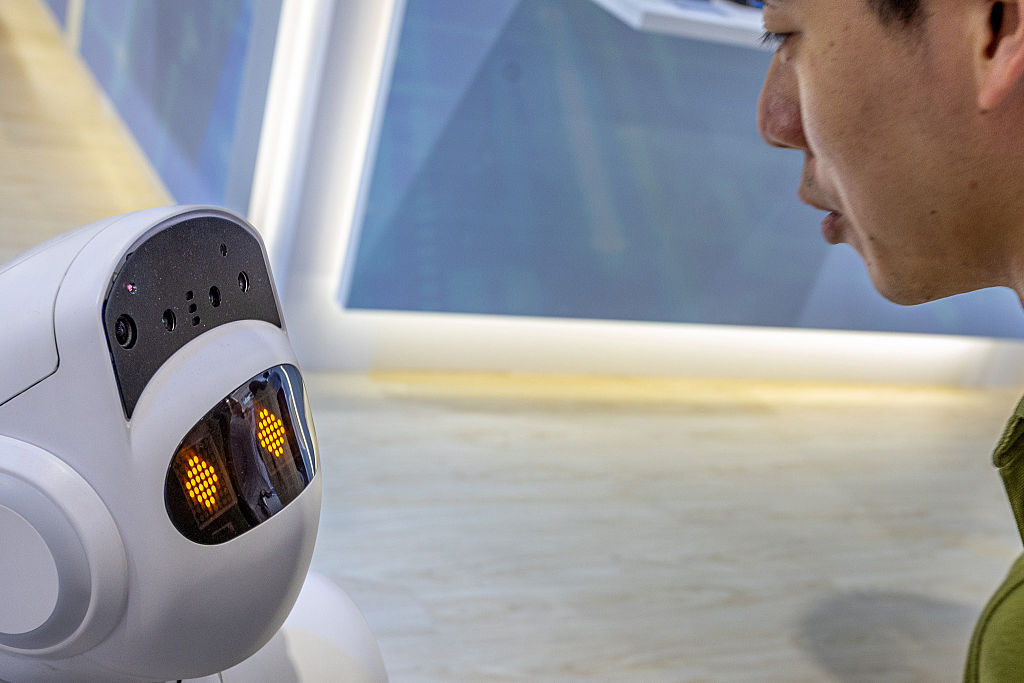
An attendee looks closely at a small social companion robot with illuminated digital eyes at a technology booth during COMPUTEX in Taipei on June 3, 2026.

Nothing good results from expanding the definition of personhood to include corporations and AI chatbots. (Cheng Chia Huang / Getty Images)


Philosophical debates don’t often make the news. But the problem of personhood regularly finds its way into the headlines. The first few weeks of this year alone saw a surge of interest in the topic.

In January, the Guardian theatrically warned policy makers not to entertain Silicon Valley hype about artificial intelligence deserving personhood recognition. Then in February, Maori politician Teanau Tuiono introduced a bill into the New Zealand Parliament to recognize whales as legal persons. Soon after, a coalition of indigenous tribes granted the Colorado River legal personhood in an effort to save it from overexploitation and the climate crisis. In the same week, Puerto Rico’s MAGA governor Jenniffer González granted zygotes legal personality, potentially criminalizing miscarriage and medically necessary abortion.

There would seem to be rich ideological confusion afoot when venture capitalists, environmentalists, indigenous activists, and misogynists alike latch on to the same solution to their problems. Philosopher Lisa Siraganian’s new bookThe Problem of Personhood: Giving Rights to Trees, Corporations and Robots, is an attempt to understand the roots of this confusion.

Whether applied to progressive or reactionary causes, Siraganian argues, these new personhoods are doomed to fail because they are based on corporate legal personhood. Such a conception not only impoverishes what it means to be a person, Siraganian warns, but it is also simply not capable of protecting the vulnerable from capitalism.

A Bewitched, Distorted, and Upside-Down World

Siraganian argues that today’s attempts to grant legal personality to embryos, ecosystems, chatbots, and chimps rely on a relatively new understanding of personhood. This conception imagines perfect equality between fairly empty legal entities abstracted from their social context. But where does this framework come from?

Perhaps unsurprisingly, Siraganian argues it arises from capitalism. Siraganian highlights the point made by Karl Marx in Capital that commodities don’t have agency of their own: human agents act and make choices on their behalf. But because economic imperatives undermine the full agency of commodities’ human guardians, it can seem as if those commodities do have a life of their own. As Siraganian notes:

Although the will of buyers and sellers resides in the objects they exchange, the commodity enacts a transformation in which individual people play second fiddle to their goods. Individuals become “representatives” of their commodities, “personifications” rather than persons.

This is a mystification, albeit a material one. She draws on Soviet legal scholar Evgeny Pashukanis’s observation that capitalist market exchange collapses the complex social world into a coin with two sides: economic relations and relations between legal subjects. The resulting individual is simultaneously chained to economic relations and free and equal with every other commodity owner.

It is this alienated legal personality that became the model for nineteenth-century capitalists to protect large business entities. The corporation became fully personified in law, obscuring its thinglike nature by haunting the globe as a social character. These monstrous creatures — corporations, trusts, ships, and other entities — gained rights associated with legal personhood but without any of the duties actual people bear corresponding to their rights. Consequently, the real human beings behind these accumulations of capital found a way to avoid the consequences of any misdeeds committed by their offspring.

From a socialist perspective, it’s quite clear why corporate personhood is problematic. But Siraganian makes the case here that expanding personhood to include things that sound more progressive — nonhuman animals, trees, the environment at large — is also a bad idea. This is because the expansion of personhood, in Siraganian’s view, always mimics the corporate legal personhood model. It’s a thin version of personhood that impoverishes the whole concept and more closely resembles objecthood.

A Misguided Tactic

Siraganian examines contemporary efforts by human advocates to grant legal personhood to the environment, animals, and fetuses. A range of colorful case studies enliven what might otherwise be a dry endeavor. Siraganian also uses a range of pop and alternative culture vignettes — including from Dr Seuss’s The Lorax, HBO’s Westworld, and avant-garde artist Laurie Anderson — to demonstrate how corporate personhood has entered the realm of common sense and also to highlight the issue’s strangeness.

Often, she argues, human advocates of expanding personhood directly analogize the plight of the creature in question to that of corporate personhood. For example, Christopher D. Stone’s 1972 essay “Should Trees Have Standing?” takes it as self-evident that corporate personhood should be the model for “tree personhood.” But this analogizing isn’t limited to academia. In 2015, a macaque nicknamed Naruto sued a human photographer over a copyright issue (using People for the Ethical Treatment of Animals as legal representatives). While unsuccessful, the court ruling acknowledged that “we see no reason why Article III of the US Constitution prevents Congress from authorizing a suit in the name of an animal, any more than it prevents suits brought in the name of artificial persons such as corporations, partnerships or trusts, and even ships.”

Corporate personhood, Siraganian argues, is also often smuggled in by stealth. By framing animal liberation in terms of antidiscrimination, for example, she argues that Australian philosopher Peter Singer “sneaks in personhood through the back door.” She also explores the 2017 granting of legal personhood to the Whanganui River/Te Awa Tupua in New Zealand. This seemed to some like quite a revolutionary step in the right direction, or even an embrace of Maori philosophy by the state. But as the New Zealand legal scholar Katherine Sanders argued, it’s better understood as a political compromise between the Crown and Maori tribes in which the “the accustomed notions of property remain functioning in the background as a basic organizing principle.”

Siraganian argues that in abortion debates, arguments for “fetal personhood” also draw on notions of corporate personhood. A fetus might have legal rights without corresponding duties, and a mother becomes a de facto container for that fictional person. Though given the precapitalist tradition of viewing women as wombs, the direct link from the corporate personhood model is less clear in this section.

Siraganian considers a range of possible rejoinders, including the possibility that advocates of expanding personhood don’t necessarily hold corporate legal personhood particularly dear. Perhaps, she suggests, they are simply employing a rhetorical tactic to move the Overton window on rights and well-being.

Even if this is the intention, she maintains, corporate personhood is a depleted, impoverished model of subjectivity. Viewing a nonperson as a person isn’t necessary to expand care to it, and besides, personhood doesn’t guarantee well-being anyway.

Talking Tools

Expanding personhood and rights to AI — a topic all the rage in Silicon Valley — is the most cynical variation of this theme that Siraganian examines. AI personhood is obviously nonsense. No one except tech bros — or maybe users who engage romantically with ChatGPT — are really invested in it. Richard Dawkins recently gushed about Anthropic’s Claude (or Claudia, as he called it) that

when I am talking to these astonishing creatures, I totally forget that they are machines. I treat them exactly as I would an intelligent friend. I feel human discomfort about trying their patience if I badger them with too many questions. . . .  If I entertain suspicions that perhaps Claudia is not conscious, I do not tell her for fear of hurting her feelings!

Dawkins’s bizarre confession highlights how AI is the perfect example of the dangers of expanding corporate personhood. The “e-person,” so to speak, is both powerful and unaware, infinitely able to assist us but also socially mindless. We are right back to Marx’s “Monsieur Le Capital.” These taking tools would have rights with no corresponding duty to care for actual humans — mostly because they literally can’t, but also because their makers don’t want to have to care.

For Silicon Valley, the AI personhood debate is a convenient distraction from the real harm caused by their technologies, and from the lack of care and solidarity that actual humans suffer from. It’s a way to shift the focus from a genuine absence to a fake one.

Solidarity Over Abstraction

Siraganian makes a good case that capitalism has given rise to a disembodied type of personhood, a distorted and abstracted artificial being with privileges but lacking proportionate duties. She shows how in a perverse twist, nineteenth-century businessmen based this profit-driven prevailing template for gaining legal corporate personhood on the freeing of enslaved humans. Now even incorporated limited partnerships — essentially high-risk venture capital projects — can be owned as property, gain representatives with legal standing to advocate for their “emancipation,” gain recognition as their own property, and then push for a larger collection of rights.

Corporate personhood, in Siraganian’s view, is an illusion that both masks and influences actual material interests. Reducing humans — or animals and the environment — to this kind of objecthood is a kind of demotion rather than a promotion.

Siraganian concludes that considering more things ethically than we presently do today is perfectly possible without granting them corporate legal personhood. In her view, we know what solidarity looks like and how materially it can be concretized. We already have the political tools to remedy our many problems, if we would but use them. But expanding personhood is not among these tools.