Capitalism Was Built on the Ruins of the Commons

Peter Linebaugh

The Industrial Revolution's chief product was not goods, but a new class of laborers who owned nothing and worked to survive. Historian Peter Linebaugh traces the creation of this working class through the violent enclosure of the commons they once relied on.
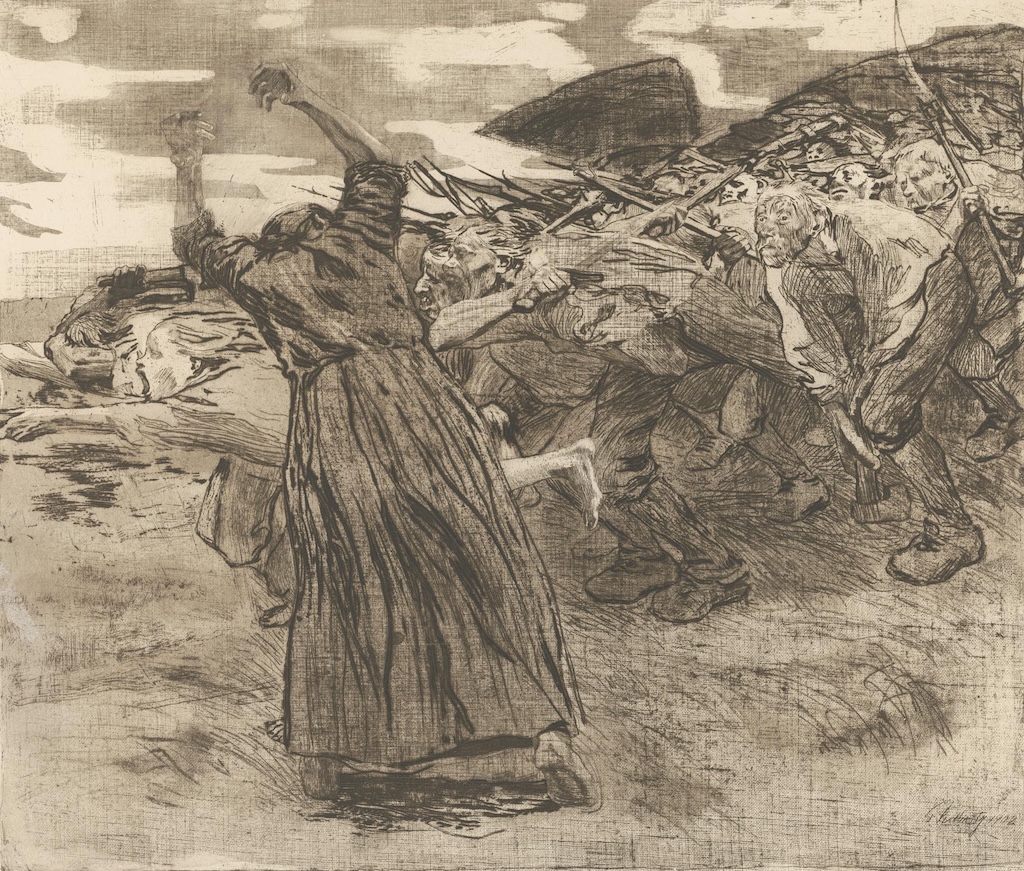
Käthe Kollwitz, "Charge," sheet 5 of the cycle "Peasants’ War," 1902/1903

Before capitalism, common people had customary rights to the land. These had to be violently destroyed to create a working class with no way to survive but to sell its labor. (Käthe Kollwitz Museum Köln)


Interview by
Daniel Denvir

In precapitalist England, a person could gather wood from the forest for fuel and shelter, graze cattle on common pasture, or glean the fields after harvest to gather what the reapers left behind. These uses of the land are hard to imagine from today’s vantage point, where our movement is constrained by private property. But up until the early nineteenth century, these were customary rights for many, built into the fabric of daily life. Their destruction through enclosure, criminalization, and violence was the precondition for capitalism. Indeed, the purpose of the Industrial Revolution was to create a new class of factory laborers by removing their means of subsistence, which was only possible through enclosing the commons.

Peter Linebaugh has spent more than five decades tracing this history, following the commons and their destruction across the Atlantic world: from the forests of the Rhineland that drew the young Karl Marx into political economy, to the London dockyards where customary takings were rebranded as theft, to Yorkshire factories where Luddites smashed the industrial looms that would eventually develop into computers.

A student of E. P. Thompson, Linebaugh is among the foremost historians of the commons, enclosure, and the making of the Atlantic working class. He is the author of many books, including The London Hanged: Crime and Civil Society in the Eighteenth Century; The Magna Carta Manifesto: Liberties and Commons for All; Stop, Thief! The Commons, Enclosures, and Resistance; and Red Round Globe Hot Burning. With Marcus Rediker, he coauthored The Many-Headed Hydra: The Hidden History of the Revolutionary Atlantic, and he is currently finishing a book titled Thanatocracy: Capital Punishment and the Punishment of Capital.

This conversation between Peter Linebaugh and Daniel Denvir was recorded for the Jacobin Radio podcast The Dig over the course of two episodes, edited and condensed here for brevity and clarity. In it, Linebaugh ranges across centuries and continents to argue that the commons is not an archaic curiosity but the suppressed foundation of modern life, and that its recovery is inseparable from any serious challenge to capitalism.


Daniel Denvir

Your overarching interest is the history of the commons. What is the commons?

Peter Linebaugh

You’re asking for a definition as if it’s one thing, but the contrary is the case: it’s many, many things. The principles involved are mutuality, or sharing, and the goal is the production of subsistence — food, water, shelter, clothing — and how human beings can attain those goals by working together.

I want to right away separate the notion of the commons from natural resources, as if it just refers to the inanimate parts of creation. On the contrary, commoning is a deeply human activity in relationship to one another and to the world around us. And that relationship begins with — now I’ve got to use a four-letter word — work. How we work together is the basis of the commons. And since work changes depending on who and what we’re working with, the definition of commoning will be different for the hunter, the farmer, the cobbler, the software engineer.

Daniel Denvir

In England, the enclosure of the commons was a prerequisite for capitalist private property and the Industrial Revolution. How were common lands used and managed before they were expropriated?

Peter Linebaugh

They’re managed by those involved. Within that management, however, let me introduce a sour element. The commoners are quarrelsome. Imagine going on an airplane and you want to put your elbow on the elbow rest, but so does the person next to you. How do you negotiate that? It’s typically negotiated without the intervention of a third party, often without words. I think this helps us understand commoning. A principle of reciprocity is also inherent. Your strip of the common field will not be the same next year as it was last year. It will rotate. Take a village in the West Bank of Palestine — how the water flows and the character of the soil will differ, and so built in is a means of rotation of plots.

This is not a dream state, not romantic idealism. These peasant and artisan commons in medieval England didn’t exist in a communist utopia — they existed under feudalism, and they continue to exist in the world today under capitalism. But notions of sharing are deeply embedded. I think they’re within the human bones. And the family is a center where these modes of sharing are first learned and first taught. Few families are run on neoliberal principles. The child’s needs come first, not exchange.

The commons consists of two Latin principles: co, meaning with, and munis, meaning obligation or duty. So the notion of the commons has to do with what we owe each other, as an aspect of mutuality, rather than what we own.

Daniel Denvir

English enclosures took place in two big waves, the first in the sixteenth century and the second in the eighteenth and nineteenth centuries. Who seized common land in the sixteenth century, and why?

Peter Linebaugh

The mass expropriation took place at a time of mass expansion of Europe across the Atlantic. Let’s put that straight away on the table: these two things go together, the enclosure of land at home and the conquest of lands abroad.

This happens at the same time as the German Peasants’ Revolt, at the same time as Henry VIII starts killing his wives, which accompanies the dissolution of the monasteries. In the 1530s, the enclosure of lands by direct force produces a huge vagabond population. The origin of the proletariat is wandering people who have lost the means of subsistence.

The enclosures were greeted with tremendous riots. You had the Pilgrimage of Grace in the West Country in 1536. You had Kett’s Rebellion in 1549, the largest revolt of the sixteenth century in England. Tudor disorder was premised on enclosure and the consequent growth of the proletariat.

New laws were passed about larceny, burglary, and all forms of theft, and the way they were managed was by hanging. Seventy-five thousand people were hanged under Henry VIII alone.

The two main points are that enclosure went together with imperialism, and it was violent. Combine these features, and you have settler colonialism.

In the aftermath of Kett’s Rebellion, the Church of England issued its Thirty-Nine Articles. One declared that “the riches and goods of Christians are not common.” Another says that Christians may put violators to death. Capital punishment and the abolition of the commons were thus established, every English person had to swear to them to participate in civic life.

But what one finds in Paul’s letters is that the first Christians had all things in common. That comes to a conclusion with the Levellers and the Diggers of the English Revolution of the 1640s.

Daniel Denvir

Where did the Diggers and the Levellers fit into the English Civil War?

Peter Linebaugh

The English Revolution occurred at the same time as the founding of the Massachusetts settler colonies. Oliver Cromwell could not have defeated king and church without his New Model Army of commoners who had their own ideas — who would mutiny if not given pay, mutiny if forced to serve in Ireland. The demand to elect their own officers became a key part of that army and its victories over the king, the aristocracy, and the forces of feudalism.

The Levellers were very active within the ranks. Their debates were recorded. Those records were discovered in the 1890s and became a basis of German socialism under Eduard Bernstein, as well as a basis of the English Labour Party movement. The Levellers called for an equality of persons; one soldier said, “For truly, sir, I do believe that a man that hath a life to give is an Englishman.” The women, too, petitioned to be included in this new democracy.

But as soon as the king’s head was removed, Cromwell turned on the Levellers, expelled them, ran them naked through the streets, sent them to prison. It’s from this persecution that the Quakers emerged — the Quakers, of course, being Thomas Paine’s ancestors. So much radical history can be traced back to this counterrevolution against the Levellers.

The Diggers were somewhat different. They were against private property. They thought it was the curse. The leading Digger was Gerrard Winstanley, who, in my opinion, ranks with Thomas Paine as one of the great democrats and communists of world history. He opposed the execution of Charles I because he opposed capital punishment. He thought life was sacred for everyone. He was in favor of taking away kings’ crowns and their thrones, but not killing them.

Cromwell put an end to the Levellers and Diggers at the same time that he conquered Jamaica, at the same time as he began to conquer Ireland. The people who made out like bandits were the new money people. Their theorists were Isaac Newton and John Locke, the twin theorists of the counterrevolution, reluctant as one is to say that. So many people are taught only good things about them, but they brought not only money but also demography, statistics, and terror throughout the world.

Daniel Denvir

How did the second wave of enclosure, in the eighteenth and nineteenth centuries, reshape the English landscape?

Peter Linebaugh

When you fly into England today and look out the airplane window, you see hedges. Those hedges are largely a creation of the enclosure acts. They look old — the heritage industry is built around them — but really, they were imposed property lines. You cross them, and you are trespassing.

Enclosure happens parish by parish, over 150 years, from about 1690 to 1840, hundreds of enclosure acts for hundreds of parishes. And the forms of resistance were sometimes peculiar. The main form of direct action in Lincolnshire was football; before the pitch had its boundaries, you could run across the open fields and uproot the hedges in a football game. The whole world plays football now. It’s one of the permanent gifts of the English working class to the world, along with the tea break.

The great victory commoners won despite the enclosure acts was the creation of custom. For example, they would collect estovers — wood needed for fuel, tool repair, house construction, etc. — in the woods, and if they could establish this as a custom in a particular area, they were immune from prosecution. E. P. Thompson’s magnificent Customs in Common describes how these customs were part of a class deal: the lands were enclosed, but some customs remained.

Let me tell you about Mary Houghton. After General Charles Cornwallis was defeated at Yorktown, he returned to his estates in Suffolk, interested in enclosing them to make more money. Mary Houghton was the gleaner’s queen; she led the children and women of the village into the fields after harvest. Cornwallis charged her with trespassing, and the high courts ruled in his favor that English common law does not recognize the right to glean — even though gleaning is part of the Book of Ruth, one of the oldest forms of subsistence in human history. Cornwallis’s defeat at Yorktown, just to be a provocateur, pales in significance to his victory over Mary Houghton.

We need to see the factory as part of enclosure, along a continuum. The factory system and the enclosure of the fields were often propelled by the same people for the same purpose: money, profiteering, and the creation of a landless, foodless, shoeless proletariat. John Clare, the poet, was an agricultural laborer and he didn’t have shoes. Karl Marx wasn’t the first person to see or name this. It was seen and named by those who suffered it.

Daniel Denvir

The Irish Rebellion was crushed in 1798, the Act of Union imposed in 1801. In Scotland, the Highlands were cleared. Why was the mass enclosure of Irish and Scottish peasants so central to making the United Kingdom?

Peter Linebaugh

We need to be embarrassed when we forget where we come from. Our Scottish ancestors, our English ancestors, our Irish ancestors, our West African ancestors are expropriated from different forms of the commons, and that expropriation has a history.

England of the eighteenth century was just one among several European powers interested in enslavement, conquest, and empire. Spain, France, the Netherlands, Denmark, Sweden — they all needed to command the seas, and they made alliances with Scotland or Ireland. In 1745, French troops joined Scottish Jacobites in an invasion of England.

Great Britain is formed in 1707, and the United Kingdom is not formed until 1801, on the backs of the Scottish Highlanders and the Irish. What they say to the defeated is: “You’re finished. Subsistence is no longer possible. What we can offer you is that you can move to the city and work all day under new conditions where you don’t own anything, or you can join the navy or the army” — that is, near certain death by land or water. That’s what’s offered to the Scottish and Irish proletarians for the loss of their common subsistence.

Daniel Denvir

How did enclosure shape colonization of the Americas?

Peter Linebaugh

To maintain settler colonialism, you must prevent European proletarians who’d lost their subsistence from joining up with Native American people. That’s why the frontier is a border of fire — a zone of maximum violence, of maximum torture.

In 1626, there’s a startling episode: Thomas Morton from England and his companions celebrated May Day with the Native Americans in what’s now Quincy, Massachusetts. This rainbow coalition was suppressed by invasions from Boston led by the Puritan commanders, who came and took down the maypole. That’s the Maypole of Merry Mount.

White supremacy has to be taught, and continually taught. It goes under the name of civilization versus savagery, but this flies in the face of the experience of those on the ground. As a matter of practical subsistence, an alliance is often possible between indigenous people and the proletarians of Europe. Capitalism will always organize its institutions to say that its rule is inevitable and eternal. So to say that another world is possible, you need some knowledge of other worlds.

Marx studied Iroquois commoning practices near the end of his life, drawing on the anthropologist Lewis Henry Morgan. The Haudenosaunee — the People of the Longhouse — lived in common, farmed in common, hunted in common. But sailors had this insight long before anthropologists. That’s where Thomas More in 1516 got his knowledge for Utopia — from sailors in Antwerp who had been to Brazil and described indigenous practices of having all things in common. And 1516 is at the very birth of capitalism, just a few years after Christopher Columbus, one year before the Protestant Reformation.

Daniel Denvir

You identify four “entrepreneurs of enclosure”: the demographer Thomas Malthus, the utilitarian Jeremy Bentham, the agronomist Arthur Young, and the policeman Patrick Colquhoun. How did each lay the groundwork for enclosure?

Peter Linebaugh

These guys were part of the ruling class, policy wonks who wielded the levers of power and redefined them.

Malthus redefined demography. He leads directly to Garrett Hardin and the “tragedy of the commons.” In 1803, he writes that not everyone is invited to nature’s table — his phrase for understanding, permitting, and excusing starvation.

Arthur Young traveled England county by county, describing enclosures in each parish on behalf of enclosure acts. He believed it would enhance productivity, but it meant thousands lost their foothold in the land.

Patrick Colquhoun was a Scot and the founder of the first police force in England — police defined as armed, uniformed officers of state. He led the attack on the dockers and sailors of London whose so-called criminality was based on their custom of taking perquisites from their labor. What Colquhoun did was enclose the docks — the London docks, the West India docks — behind high walls between 1798 and 1803 so that customary takings were criminalized.

And this process of criminalization extends across all the trades. A tailor takes cabbage — that’s his word for the leftover cloth. A sailor takes chips. A docker takes sweepings. A tobacco worker takes stockings. You can go through every trade and see how there’s a transition during this process of expropriation where the worker persists in taking some of the fruits of his labor, even though according to new statute law it’s theft. You have to find old dictionaries, even specialized ones, to explain these terms. Better yet, talk to tradesmen today to find out about the actualities.

Bentham is the utilitarian, believing in the greatest good for the greatest number. The panopticon came from the enclosure of shipyards that his brother Samuel organized. The idea of an all-enclosed, all-surveilled space of labor arose as a matter of class struggle.

All four were active around the Despard Conspiracy of 1802–3 and deeply opposed to the French Revolution’s ideas of liberté, égalité, fraternité. These four are the founding fathers of the Industrial Revolution. They are the architects of the structures of capital and empire.

Daniel Denvir

The Luddite machine-breaking rebellion broke out around 1811–12 in the Midlands and Yorkshire. Who were the Luddites, and what did they do?

Peter Linebaugh

The Luddites were machine breakers, named after Captain Ned Ludd, a mythic figure. They were trying to preserve forms of subsistence, to preserve workers’ control over the quality of goods produced. The machines were coming in for the purpose of diminishing their income, not for enhancing life or reducing the hours of toil.

People would attack the factory at nighttime, or in daylight if the crowd was large enough, and smash the machines with huge sledgehammers. These sledgehammers were made by a company named Enoch. “Enoch shall make them, Enoch shall break them” was one of their slogans.

Nowadays the Luddites have such a rotten reputation. The label is synonymous with ignorance, but nothing could be further from the truth. These artisans would appoint one among themselves to read aloud to the others, much as the cigar workers did in Tampa, Florida, a hundred years later. Some of the Luddites were studying ancient Greek. I’ve always admired them because I don’t know Greek. And when we talk about the Luddites, it’s not that far away. The computer was already imagined in the loom of the weaver. The Jacquard loom becomes the basis of the computation machine, the ancestor of the computer. So there’s a direct line from the Luddites to now.

What we call the Industrial Revolution was really the creation of the working class. It was undertaken to produce a new form of boring, repetitious, soul-destroying, body-wrecking labor: factory labor. Despite the name, this revolution was far from bringing out the industrious qualities that the artisan would admire, where industry means resourcefulness and determined application. Instead it replaced industriousness with mechanical repetition.

Daniel Denvir

E. P. Thompson famously wrote about wanting to defend the Luddites from the “condescension of posterity.” Today, the term is still generally pejorative. What do you think about people beginning to reclaim Luddism as a form of resistance to tech capitalists?

Peter Linebaugh

What I think is of little importance. What’s of importance, and what we learned from Thompson, is: What do the workers think? What do those who are losing their jobs to AI think? What did those who lost their jobs to the steam engine think? And their thinking was extremely creative. The people who developed and praised ideas like socialism, communism, romanticism — they came from the working class of the time.

It’s not so much what you or I think; it’s what the workers think at Amazon or at any of the giant corporations where mechanization is coming in to speed up work, to lengthen the hours of toil, to remove any kind of security. So-called gig workers like at Uber, where the technology is deployed by the capitalists to fine-tune workplace domination to obscene degrees of exactitude.

Daniel Denvir

You write of the Americas: “Its enclosures were conquest of Indian lands, and its Luddites were insurrectionary slaves.” The destruction of farm implements on American plantations, you argue, “belongs to the story of Luddism.” Your work always connects seemingly disparate peoples and forces. What does that method elucidate?

Peter Linebaugh

When I read that the Luddites were active in 1811 at the same time as the largest slave revolt in the Americas — in Louisiana, the port for cotton — I wonder what connections there were. Not just of the capitalists, but of the dockers and sailors. Between Louisiana and the West Riding of Yorkshire, there’s a huge geographic and cultural distance. But that distance can be overcome, and it was overcome. That becomes the hypothesis for seeing workers as workers wherever they may be.

Daniel Denvir

You’ve long studied capital punishment in relation to the making of capitalism. How did you come to see the relationship between crime, punishment, and enclosure?

Peter Linebaugh

My understanding of the enclosure of the commons was preceded by my study of those who were hanged. I left the United States and Columbia University in 1965–66 and went to England because the cities in America were in revolt. African Americans were revolting in one city after another, and this gave birth to what I thought was a false discourse of violence, a false discourse of law and order. So I looked to other traditions that saw that crime always has a social context.

Then when I read about the working class and began to understand that the revolutions of the working class in Europe were able to create new social forms, I thought the possibilities for the future lie with this working class. That’s what Thompson taught me. Even England, the birthplace of capitalism, was also the place where capitalism’s ending was imagined and fought for by the very workers whose exploitation enriched the imperial class.

There was an idea at that time of social crime: the social bandit, the idea of situating different forms of crime as the predecessor to the trade union, to working-class collective consciousness, to working-class political parties. According to Friedrich Engels and others, social crime was what preceded the making of the working class. So we had to study criminal records. I began to do this with a collective of scholars: Cal Winslow, J. M. Neeson, Douglas Hay, a series of us who learned from E. P. Thompson.

It was in that work that I began to see that enclosure, not just of the land but also of crafts, was really enclosing other forms of subsistence. Only after that did I begin to see the commons. So if not historically, then personally, crime preceded the commons. Historically, of course, it’s the other way around: the commons is destroyed, and then people have to steal to live.

Daniel Denvir

How is capital punishment used in the consolidation of capitalist class rule?

Peter Linebaugh

Capital punishment is older than capitalism. We can look back to Jesus Christ, crucified way up high, or to Socrates and the hemlock. But under capitalism, it becomes far more intensified. You could not enter a city in Europe without going through a gate. Hanging on that gate would be the skulls of those who had been hanged. It was a constant presence in the growth of the state, and the growth of the state was necessary to the growth of capitalism.

What’s significant are new laws concerning private property — burglary, larceny, housebreaking. These laws were created at the same time as the mass hangings. And it was this very problem that first drew Marx into political economy. The timber of the forests of the Rhineland became the basis of the housing stock of Liverpool. But to take that wood out of the Rhineland meant to take it from the fireplaces of those who had lived in the forest.

Marx grew up on the rivers feeding through those forests. He began to see people arrested for stealing wood and wondered why. This led him into his great theoretical articles, and at the basis of all of them was the theft of wood — or as the English would say, the estovers. Marx said it was this struggle over the law of the theft of wood that caused him to begin thinking about political economy.

John Locke said political power is making laws punishable by death. The boss is trying to reduce wages to zero; slavery is the tendency of capitalism. But capital can’t do this of its own will. It has to overcome resistance, and the principal resistance to hanging was the family members of those being hanged. They would go to the public hanging and try to prevent it. Some people, like Henry Fielding, the novelist, or Adam Smith, thought deeply about how to make death more terrifying. It’s not enough just to kill somebody at a public hanging; they might be exalted. You have to do it in such a way as to terrify people. They studied this as a technical matter. And in that study they began to develop new forms of enclosure, namely the prison. The carceral system develops as the public hangings diminish.

I try to see the death penalty in relation to many other forms of state-sponsored violence, including ecological disasters, so-called work accidents, and war. Marx describes in chapter ten of Capital, “The Working Day,” how in 1863 a young woman named Mary Anne Walkley, only twenty years old, labored more than twenty-six hours straight at sewing in a sweatshop and died as a result. It helps us see the death-dealing nature of the state in relationship not so much to law as to capital, to machinery, to the whole structure of reproduction.

And beyond capital punishment, think of all the institutions of human confinement that arose in this period: the hospital, the factory, the prison, the ship, the insane asylum, the old-age home, the school, the barracks. These became sealed capsules where the commanding principle, as Bentham termed it, prevailed. They all want to produce a working class that’s submissive. The habit of obedience, the habit of “yes sir, no sir,” starts early on. Michel Foucault developed the theme of confinement — the hospital, the school, the asylum. What I’ve been interested in doing is showing that the same process applies to craft, to skilled labor.

Daniel Denvir

You ask in your work: “Does communism belong to the field of politics while the commons belongs to the field of economics?” What is the relationship between the commons and communism?

Peter Linebaugh

Let’s forget that communism in the Soviet Union is really a form of state capitalism, in my opinion and in the opinion of C. L. R. James and many others. Communism has been one of the ideologies opposing capitalism because it calls for having all things in common. This word “commons” is inescapable throughout anglophone history.

Some of the first communists — those willing to contemplate insurrection to overthrow an oppressive, incarcerating, taxing state — were also commoners, meaning they were common people, not aristocrats, but also that they had rights to the commons, customary rights of subsistence. Whether we’re speaking of Gerrard Winstanley in the English Revolution, or Gracchus Babeuf in the French Revolution, or Karl Marx in 1848 — all of these communists had grown up in situations of the commons.

In light of the five hundredth anniversary of the German Peasants’ Revolt, I’ve been thinking about its twelve articles. The first article was for each community to choose and appoint their own pastor — that is, to choose their own governance. It’s similar to “we the people.” But that sovereignty already exists in the commons, where sovereignty is not a political activity but a practical one about how food is to be raised and distributed.

These are open questions, and it’s more important than ever to study them as part of the organizing we do going forward. I don’t want to see an organizer without a book in their hand.

Daniel Denvir

In The Magna Carta Manifesto, you explore two thirteenth-century charters: the Magna Carta and the largely forgotten Charter of the Forest. What distinguished them?

Peter Linebaugh

The Magna Carta’s thirty-ninth chapter says there is to be habeas corpus, no torture, trial by jury, and due process of law. These principles still survive in the US Constitution. But the Charter of the Forest — that abolished the death penalty for the theft of deer. It recognized people’s right to herbage, to put cattle in forest lands; to pannage, to put pigs in the forest to eat the acorns; to go get honey from the bees. It’s very practical about subsistence, about life.

Both documents became a basis of the Peasants’ Revolt of 1381, and eventually the English Revolution of the 1640s. That’s how we get the expression “we the people” — right out of the Levellers. Thomas Paine told Thomas Jefferson, “We need a Magna Carta in America,” and that led to the Declaration of Independence.

Daniel Denvir

Why did the Magna Carta become fundamental to liberal democracies worldwide while the Charter of the Forest fell out of memory? And what does that tell us about the present?

Peter Linebaugh

Class analysis is helpful here. The capitalist class finds resources useless unless it can employ labor. And it cannot form a working class if that working class has alternative means of subsistence. Take away those resources, and then they’ll do your bidding. That’s an essential part of exploitation: expropriating people from the means of subsistence. That’s why the Charter of the Forest did not make it across the ocean with the colonists, but the Magna Carta did.

The history of civil liberties — protection of the person against the state — is separate from the subsistence of the person against the employers, against the billionaires. And as we see clearly today under Donald Trump, the civil libertarian tradition without economic grounding is vulnerable to authoritarianism. The message of the two charters is plain: political and legal rights can exist only on an economic foundation.