Why America Never Got a Labor Party
In Europe, labor unions and socialist parties marched together and won massive reforms. In the United States, they were divided. Vivek Chibber explains how that split still shapes US politics today.
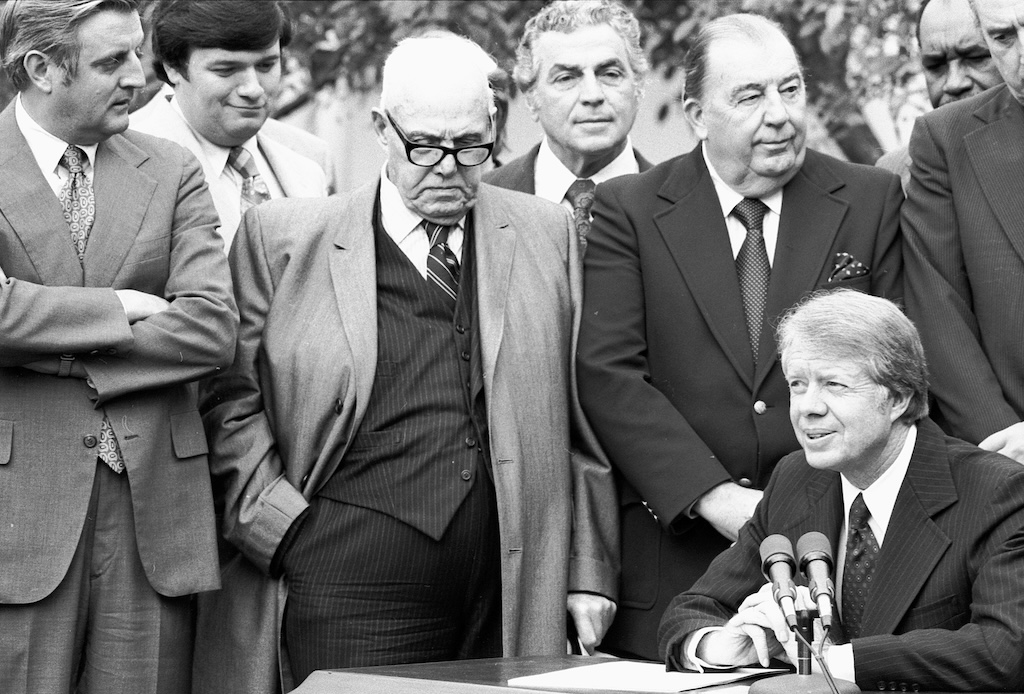
President Jimmy Carter signs the Minimum Wage Bill in Washington, DC, on November 1, 1977. Among those standing behind him (second from the left, in glasses) is George Meany, president of the AFL-CIO. (Diana Walker / Getty Images)
While European labor movements established foundations for their welfare states in the late nineteenth century, it was not until the New Deal that the United States began instituting policies like unemployment insurance and old-age pensions. But although working-class struggle was also key to this success, several unique factors in American history proved an impediment to more egalitarian policies.
In this episode of the Jacobin Radio podcast Confronting Capitalism, Vivek Chibber and Melissa Naschek continue their deep dive into the history of social democracy. Together, they look at the impacts of craft unionism, mass immigration, racial tensions, and employer violence in explaining American exceptionalism.
Confronting Capitalism with Vivek Chibber is produced by Catalyst: A Journal of Theory and Strategy and published by Jacobin. You can listen to the full episode here. This transcript has been edited for clarity.