What Was the Golden Age of Social Democracy?

Vivek Chibber

For 40 years, social democratic parties radically improved life for workers. The labor movement and worker militancy made it possible.
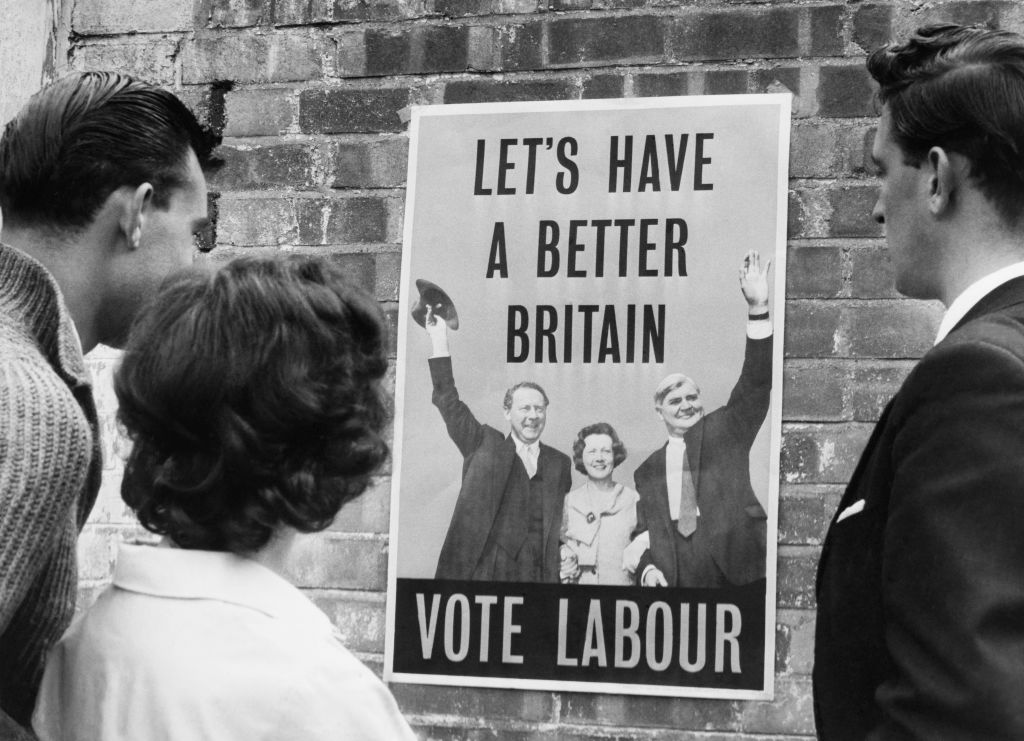
The golden age of social democracy brought a level of prosperity to workers unimaginable just a generation before. But as trade union militancy declined, so did social democracy. (Keystone-France / Gamma-Keystone via Getty Images)

Interview by
Melissa Naschek

After World War II, political parties championing redistribution, full employment, and egalitarianism gained power across the globe, especially in Western Europe. But why did these social democrats give up the ambition to transition to socialism?

In this episode of the Jacobin Radio podcast Confronting Capitalism, Vivek Chibber explains why the golden age of capitalism was a rare period of triumph for the Left, even though the movement faced serious challenges from class enemies, state structures, and tensions within its own coalition. Any leftist trying to change the balance of class power would benefit from understanding why social democracy achieved such lasting success even as it remains in the political minority today.

Confronting Capitalism with Vivek Chibber is produced by Catalyst: A Journal of Theory and Strategy and published by Jacobin. You can listen to the full episode here. This transcript has been edited for clarity.


Melissa Naschek

We previously talked about social democracy in broad terms as a decades-long project to pursue political power through the state on behalf of the working class. Now we’re going to focus on the postwar period, when social democratic parties were at the height of their power — in particular in Europe, but also around the globe.

Vivek Chibber

Last time, we looked at the origins of social democracy, what its ideological underpinnings were, and what its general political strategy was. This week, we’ll look at how it achieved power, what it did with that power, and what some of the contradictions were once it achieved it.

Melissa Naschek

To start us off, let’s situate ourselves historically. What was the state of Europe following World War II?

Vivek Chibber

In many ways, it was really propitious for something like a social democratic project, and we can think of it as having both a political and an economic element. Politically, it is really important that after World War II, you see two developments, both of which make the ascension of a social democratic power much more likely. One is that the historic forces that had been lined up against social democratic parties were gravely weakened by 1945, and we’re now talking about the ruling elites, especially the capitalist class.

It’s not just that the war weakened them. War, per se, doesn’t weaken capitalists; in the United States, it actually strengthened them. But they were politically weakened. The reason for that is that all across Europe, large chunks of the established order — capital and some of the political elites — were collaborators with fascism.

Melissa Naschek

The most commonly talked about example is what happened in France. Could you describe that?

Vivek Chibber

After Adolf Hitler invaded France, there was a puppet regime set up, which was called the Vichy regime. French capital participated in it, and large chunks of the French political establishment did as well. After the war, therefore, when France was liberated, any kind of right-wing ascension or right-wing project at that time was going to be very hard to do, because all the people active in it would have been associated with Nazism.

Melissa Naschek

Is it the Right that was discredited as a result of coordinating with fascism, or was it the capitalist class? Or is that not [a] meaningful [distinction]?

Vivek Chibber

Both. Because you have to remember that in the classic fascist regimes, Italy and Germany, the capitalist class may not have catapulted the fascist parties into power — though there’s debate on this — but at the very least we can say that it actively cooperated with them once they achieved power. So in Germany, in Italy, in France . . . but also, you have to remember, in the other parts of Western Europe, even though the class as a whole didn’t cooperate with Nazism, it was very sympathetic to it. Right up until 1939, large chunks of the European ruling classes saw Joseph Stalin and the Soviet Union as a bigger threat to them than Hitler.

In fact, there was a very concerted effort to point Hitler toward the Soviet Union, hoping that he would invade and rid them of the problem. So there was a historical memory of this. And when Hitler and the Axis powers lose, when it’s time to rebuild Europe, who’s going to take charge of the rebuilding? Who’s going to set the political terms? Capital was really flat on its back politically. It was in no position to do so.

On the other side of the ledger, the trade union movement had grown by leaps and bounds across Europe since the 1920s and ’30s. And in particular, the leadership of the trade union movement, which is the communist parties on the Left, grew exponentially after 1944 and 1945, especially in countries like Italy and France. The reason for that was that it was the communists who had led the resistance to Nazism, the partisan forces. So their prestige and status were sky-high politically.

Melissa Naschek

It sounds like there’s a positive and a negative historical opening here. On the one hand, the Right and the capitalist class were heavily discredited by the events of World War II and their association with fascism. And then, on the other hand, you have this explosive growth in the trade union movement.

Vivek Chibber

There’s a third factor: remember that democratic rights had only recently been achieved. As soon as they were achieved, right after World War I, you got a right-wing backlash against them. That was really a lot of the conflict that underlay the shift toward fascism in Europe.

The ruling classes were unhappy that the trade union movement had grown so rapidly in the 1920s. And the push for working-class voting rights brought the unions into alliance with social democratic parties, making the Left a real force for the first time.

So in 1945, the political defenders of the traditional order were weakened. And the economic class that presided over that order was weakened. At the same time, you have the rise of the Left, you have the trade unions, and you have a massively energized and charged electorate, all of which are workers, who say, “We will not go back to the prewar order.” This combination is exactly set up for a massive advance of the parties representing the working class.

The Golden Age of Capitalism

Melissa Naschek

You mentioned there’s a political landscape and an economic backdrop to this. What was going on economically at that time?

Vivek Chibber

As everyone knows, the Great Depression began in 1929. And really, for about the first five years after it started, Europe recovered only partially. It is only when the war starts that you see the recovery taking root.

The war ended up being quite a boost to economic production because, in real wars — not in drone wars, the kind you have now — there is a big boost to industrial production and productivity due to the extraordinary demand that military equipment and armaments place on it. So by 1945, you have the beginning of the longest economic upswing we have seen in modern capitalist history, really from about 1939–1940 all the way into the mid-1970s. This is the largest, most rapid expansion of both the economic pie and productivity.

This is important because the parties that come to power to push for social democracy can’t succeed unless the economy is also expanding.

In a contracting economy, if you want to redistribute and have social programs and pensions and things like that, there’s not a whole lot of money to go around to give to people. What happened during this time was that, because productivity is going up so fast and the economy is expanding, wages have more room to expand, because profits are going up and so unions can deliver real goods to their members; but also tax revenues are going up on the back of expanding employment and expanding profits. Those tax revenues can be used to fund things like pensions, unemployment insurance, free medical care, more schooling, and so on.

So you have this extraordinary confluence of political conditions that allow labor parties to rise to power and take office and economic conditions in which the goals that they have, of putting into place for the first time ever, things like a national health care system, free public transportation or at least national public transportation, taking over the utilities and nationalizing them, childcare, education . . .  the resources for all of that are also now available. It is the ideal situation for the dreams of the social democratic parties of the early twentieth century — the Bernsteins and the Kautskys — to come to fruition.

Melissa Naschek

We’re talking about the postwar period in the context of social democracy, but this time is also known as “the golden age of capitalism.” Do you think that it’s a coincidence that we get a strong period of social democracy at the same time as the golden age of capitalism?

Vivek Chibber

No, it can’t be a coincidence. I’m hesitant to say it’s the enabling condition, but it’s definitely part of the cluster of key enabling conditions. It’s just a lot easier to institute social programs and redistributive programs when the economy is growing fast; not just because revenue is increasing in the government coffers or the budgets are expanding, but also because in high-growth economies, it’s a lot easier for people who have jobs to join unions and to take risks.

If you have high unemployment, it’s very difficult for people to take on their employers because they’re afraid of getting laid off. But if you have a rapidly growing labor force, jobs are plentiful, and it’s easier for people to take the risk of joining a union — even if their boss gets pissed off, because if the boss fires them, they’ll just get another job.

But what also happens is that, because the economy is growing really fast, employers make lots of profits. Because they’re making lots of profits, when trade unions demand higher wages or when the government is taxing them to be able to fund its programs, those costs, like higher wages and higher taxes, are easier for employers to absorb because their own profits are expanding so fast. So this lessens employer resistance to both social democratic and trade union demands.

In fact, not only do they say, “We think we can actually afford to pay for this”; they’re willing to pay for it because if they refuse to, the labor movement, if it’s well-organized, can react by going on strike, [causing] economic disruption. And now, profits that were being easily made are actually forgone. So, not only are they willing to absorb the costs, they’re very hesitant to absorb what’s called the “opportunity cost.” That is the profits they’ll miss out on if they rock the boat. So they go along to get along.

This means that the condition that’s enabling all this is the growing economy. So the golden age made social democratic advances a lot easier because it muted the conflicts between labor and capital. It muted them because the demands that labor was making were able to be absorbed by capital.

This disappears once growth slows down in the 1970s and ’80s. And that’s why all the welfare states, all the social democracies, started to become more embattled starting in the ’70s.

Melissa Naschek

Right. And there’s a flip side to what you’re saying, which is that we do not control the economy; the capitalist class does. That is something that’s going to pose a persistent challenge to any social democratic strategy, which is that you’re trying to use the state to bestow economic rights and increase equality. But at the end of the day, the state does not control the economy.

Vivek Chibber

That’s the fundamental dilemma. We’ll get into it more deeply as we go along.

Melissa Naschek

Let’s start talking about the parties themselves. What were the goals of the social democratic parties beginning in the postwar period?

Vivek Chibber

The main goal was to deliver to their constituency. This meant two or three things.

They needed to have full employment. They wanted everybody to have a job. Because in capitalism, if you don’t have a job, that basically means you can’t get much of anything else. So the first goal was full employment.

The second goal was to have some kind of ambitious support outside the market for people. The way capitalism works is that it basically says you have no real economic rights of any kind. What you get is what you earn. So as long as you’re in the labor market, whatever you earn, that entitles you to whatever you can afford. But that means that the goods in your life that you’re able to have access to depend on a) having a job and b) the quality of the job you have.

This has two really important implications. One is that you have no real economic guarantees before you start working and after you stop working. So people who are not in the labor market are screwed, which means children and older people. So aside from full employment, the other thing they wanted was social supports for childcare and then pensions.

The other thing about childcare was that if you didn’t have childcare, it meant somebody had to stay home to take care of the child, which typically meant the wife, the woman. And that became a basis for domination within the household. So automatically, the neutral social democratic goal of having childcare ended up, in practice, being a very advanced feminist goal as well.

So two goals: full employment and social supports. And the third goal was to try to take over as much of the economy as possible, interestingly — and we’ll get into this — not so much for ideological reasons. They just thought it was a way of making capitalism more efficient. So things like transportation, utilities — you nationalize them.

The core of the social democratic project, then, was to secure employment inside the market and to secure social supports outside the market to the extent that you can. And then, through that, you reduce both insecurity and inequality.

That was the basic goal. Then the question was, how do you do it? That’s a different matter.

Social Democratic Achievement

Melissa Naschek

How successful were social democratic parties at achieving their goals?

Vivek Chibber

Phenomenally. It was a historic success for about forty years. It not only completely changed human civilization all across Europe, but as we talked about in the last episode, the welfare state was also institutionalized in the Global South. And while it lasted, it had an extraordinary effect on people’s lives, even in Latin America, Asia, and the Middle East. It was a global phenomenon. It was incredibly successful.

We saw inequality go down. We saw extraordinary stability in employment rates without negatively affecting productivity, a tremendous expansion in life expectancy, a tremendous expansion in overall health, and declines in child mortality. It was the best period in capitalism that we’ve seen yet. So by any standard, it was an extraordinary success, and all the libertarian and right-wing calumniating of it should be stoutly resisted. The welfare state was a tremendous success.

Melissa Naschek

One right-wing critique of social democracy is that these parties and trade unions were effectively a drag on capitalist economic development. Is that true?

Vivek Chibber

No, it is not true. This is a right-wing talking point, as you’re saying, and it’s untrue. It gained some plausibility because they play around with the facts a little bit.

First, in the period of social democratic rule and ascendance, if you look at key macroeconomic facts like productivity growth, wage growth, economic growth in GDP, or labor force participation — if you look at all these things, the facts are that, in the golden age of capitalism, even the most generous social democracies tended to do as well or better than the United States. They did really well. You can easily go to World Bank and OECD [Organisation for Economic Co-operation and Development] data to look up all this stuff.

On all these major metrics — productivity growth, profits, wage growth — the social democracies did as well or better than the US. It’s simply not possible to say that where you see social democratic institutions, they’re inversely related to the economic growth of a country.

Now, it’s true that in the 1980s and ’90s, you see decline setting in, but you also see it in the United States as well. So when decline sets in, it’s hard to pin it on egalitarianism, wage growth, or greater security. It’s because the global system as a whole started to slow down. And I don’t see any way you can attribute that to social democracy.

But now, once you have that slowdown in growth, it does cause tensions and strains in the overall political economy. There’s no doubt about that. But that’s because economic growth is straining at social democratic institutions. It’s not because those institutions are causing a slowdown in the growth.

The Centrality of Labor

Melissa Naschek

Can you talk about how the labor movement contributed to the success of the social democratic movement, and then, in turn, what the social democratic movement did for the labor movement? Then we can let the audience sort out the chicken and the egg there.

Vivek Chibber

No, without sorting out the chicken and the egg, we are falling down on our duty. Analysis is all about figuring what causes what.

I think the labor movement is the engine that drives social democracy. The parties have some power of their own, and they can achieve some ends. But overall, without the trade unions, the project flounders.

On the other hand, we have seen remarkably successful social democratic advances without a social democratic party, as long as there were active unions. Think of the United States and the New Deal. Who was fighting for the New Deal? There was no labor party or social democratic party. There are two bourgeois parties — one less unfriendly to labor than the other, but they’re both unfriendly. But Franklin Delano Roosevelt nevertheless passed all the New Deal legislation, largely because of pressure from an activated trade union movement.

So what we’ve seen is that labor unions without a social democratic party can be successful. But when we look at social democratic parties without labor unions, I don’t know of any instance in which they were very successful.

Melissa Naschek

It’s also worth noting that, even though labor unions in America achieved many successes without a social democratic party, if you compare the state of our welfare state to those of other states, it’s far inferior.

Vivek Chibber

Yeah. This is why I was careful to say you can achieve some success without a party. But having the party is ideal, because if you don’t have a social democratic party and the unions put pressure on the state, they have to drag the parties kicking and screaming toward redistribution. But if you have your own party, the party, instead of being forced to institute these policies, tries to actually capitalize on labor’s power to push it as far as possible.

The difference is, in one instance where there’s no party, labor has to do all the work itself to force the parties to respond to its demands. But if you do have a party, that party will actually try to maximize and capitalize on labor’s mobilization and power, and therefore push much harder. That’s what happens in Europe. The United States is the only advanced country in the twentieth century that doesn’t have a socialist or a labor party.

All across Europe, you get social democratic parties by the 1920s. So the labor movements have a friend inside the state, and that’s why they’re able to take advantage of labor’s movement and labor’s organizing and therefore push a lot faster and a lot better than in the United States.

Melissa Naschek

You’ve explained that you see labor movements as fundamental to the success of social democratic movements. Can you talk about what the labor unions did in this era that made them so crucial?

Vivek Chibber

The fundamental thing labor movements do is they give labor parties the only leverage that’s possible against the class of employers, against capitalists. In any capitalist economy, the state basically has to prioritize employers’ interests over everyone else’s because employers control investment. And through investment, they control the economy.

Any government that wants to pass any kind of legislation or run any type of programs, right-wing or left-wing, needs a healthy economy to do so. And if capitalists choose to hold back on their investment — if they’re pessimistic, if they’re unhappy, if they take their money and move it to another country — they end up slowing down economic growth. This directly undermines whatever governments might be trying to do.

It also pisses off voters because, if economic growth slows down, people lose their jobs. They blame the government and then vote them out of office. This is what Joe Biden found out the hard way. So if you want to pass all these progressive reforms, you need to get them instituted over the likely objections and resistance of employers.

Now you have a problem. If employers dominate the state and they get to call the shots, how are you going to change their minds?

What the labor movement did was essentially give itself a weapon against employers, which is to say, “If you don’t abide by these new laws, we can actually stop your flow of profits. We can have strikes; we can shut down production, and through that, you’re in the worst of all possible worlds. It’s not that you have a government that’s passing laws you don’t like, but where you might still make your profits; now you can’t make any profits at all because we refuse to work.” That is what brought employers to the table.

So, the first thing labor movements did for social democracy was give governments a counterpower against the economic power of employers. The second thing was that they actually got people to the hustings. They brought them out to vote.

You would have meetings right before the elections. The trade unions would tell their members, “Go and vote for this party.” They would make sure they went out and got to the voting booths. They would provide them with information to counter the propaganda of bourgeois media. They would provide them with transportation. They would provide them with halls and meeting places where they could discuss and articulate an agenda.

They did what today we call the “ground game.” Trade unions were the free boots on the ground. In today’s elections, the ground game is done by volunteers, NGOs [nongovernmental organizations], or people you hire.

Melissa Naschek

The history of astroturf was built on the backs of people who really did have genuine community organizations where they could get together, discuss things, influence large groups of people’s views, and advance coherent political missions. This is totally missing in our society right now.

Vivek Chibber

This is the third thing, Melissa. Trade unions maintained working-class identity through all their noneconomic functions. They provided a sense of community. They provided social groups. They provided entertainment. They provided summer schools and summer camps for the kids. They created a real community so people felt the union was their organization and the party attached to it was their party, and they stuck with it. It’s remarkable.

If you look at data from the 1920s through the 1980s across Europe, the working-class vote consistently went to labor parties, through thick and thin. It modulated; it went up and down a bit, but [workers] remained steadfastly committed to them.

There were two reasons for this. First, the parties actually delivered wages, health benefits, and pensions to a class that had been despised and treated like crap before. Second, there was a very active social and cultural life around the party, and the trade unions were absolutely essential to that. You should think of the social democratic movement as a culture and a world unto itself.

It’s not like the Democrats who every four years say, “Shut up and line up and vote for us, and now go back home; you’ve done your job.” After the elections, month to month, year to year, the parties kept the people together. They provided them with a sense that they mattered. They took their platform and their agenda from the people. The election itself was just one event in a monthly, yearly, continuing connection that the parties had to their base.

Melissa Naschek

This is why we so often critique the Democratic Party as well as the Republican Party as hollow institutions today, because they are totally lacking in a real organizational life, like the one we’re saying social democratic parties had.

Vivek Chibber

Yeah. In fact, that’s happened across Europe as well. What we’ve seen since the 1970s is the hollowing out of all these left-wing parties. That has a lot to do with the decline of the classic social democratic parties, which are becoming sideshows across Europe right now. It’s not the only reason; there are other reasons, all of which they’re responsible for. But one key reason is that they’ve become organizations that speak to their voters from 20,000 feet. They have no real connection to them. And the classic base of these parties now feels despised by those parties.

Unhappy Bedfellows

Melissa Naschek

It’s important to talk about not just the good parts of the relationship between the social democratic parties and the labor movement, but also some of the challenges that they faced. These challenges have not gone away for people pursuing a strategy like this today. What were some of the tensions between the labor movements and the social democratic parties?

Vivek Chibber

There’s a lot of variation here, so I’ll generalize [across] cases. It applies to all of them, I think, but not equally hard to all of them.

There was a basic tension inside the social democratic movement. Some of that tension comes explicitly from the trade unions and their relationship to the party. Some of it is transmitted from the party into the trade unions. The main tension is that the social democratic party, to continue its programs and ambitions, has to, as I said earlier, ensure the economy is moving at a healthy pace.

Now, as you pointed out, the state and the parties don’t control the economy. What we mean by that is, the state doesn’t control what the rate of investment is going to be. They don’t control where that investment’s going to go or what the quality of it’s going to be. That remains in the hands of capitalists.

The social democrats have to make sure that the people who actually control the investment, which is the capitalists, feel that there’s profits to be made because that’s all they’re in it for. Capitalists are not in it for charity or for good press. They are fundamentally committed to the bottom line.

What the parties say to the capitalists is, “If you agree to abide by our programs, we will reciprocate by guaranteeing you labor peace, because the unions are with us. At any moment” — I’m stylizing it here — “the unions could rock the boat and could make your life difficult. But if you play by the rules, if you agree to certain things, since we have a friendly relationship with the unions, we can make sure that they calm down on industrial conflict and industrial unrest.” And if capitalists agree to this labor peace, social democrats will prioritize profits.

So, what the party slowly internalized was a kind of ethic: if there’s no profit being made, we can’t deliver to our people. So the first order of business is to take care of business and make sure that capital is happy.

Notice how this is very different from the earlier years of the social democratic movement, when the first order of business was keeping labor happy. They were still mobilizing; they didn’t really have power. In order to wage class struggle, to actually threaten capitalists, and to achieve power, they needed to mobilize their base. So their first priority was their own base.

By the 1950s and ’60s, their base was now in the house. The working-class base wanted the goodies, and parties know that, to get them this, they have to ensure profits. So their priority gradually shifts from mobilizing labor to managing labor and, frankly, pleasing capitalists.

Melissa Naschek

Can you give a concrete example of this? The one that comes to mind for me is the wage policies the UK Labour Party dealt with and the back-and-forth between employers and labour unions.

Vivek Chibber

All across Europe, the parties essentially ended up coming up with policies to make life easier for businesses. The British example plays out like this. It’s a bit complicated, but let me lay it out.

In England, there was a fundamental problem, which was that, from 1945 onward, increases in overall productivity were very slow. That meant there was a ceiling on the profit margins companies were making. Now, that meant there would also be a ceiling on wage growth in this country.

So the Labour Party, whenever it was in power, had this problem that if wages expanded too fast, they would do one of two things. Either wages would start eating into profits, or employers would respond to higher wages by raising prices to pass on the costs to consumers, which results in inflation. So you had a recurring cycle in which unions would make demands and employers would either slow down investment because these wages were eating into their profits, or they would raise prices, which would drive inflation up.

In both cases, because they had no real power over employers, governments responded by exercising their power over the only people who could actually control: the unions. So they kept going to the unions and said, “Tamp down on your wage demands. Don’t make high wage demands.” But they said nothing to the employers.

From 1945 all the way into the early 1970s, the unions agreed to hold back their wage demands. But nobody was telling employers that they also had to reciprocate — they had to ramp up investment in leading technologies and boost growth. And they in fact failed to reciprocate like that. Productivity continued to stagnate, and growth continued to be anemic, even though profits were rolling in. So the unions saw that whatever profits employers are making, they can do whatever the hell they want with it. They may or may not invest it. They may or may not keep it in the country. They may or may not put it in their pockets. They had no responsibilities, while the unions were delivering on their end of the bargain and providing peace as well as wage discipline.

So a tension developed between the unions and the Labour Party in which the unions asked, “Why are you asking us to make all the sacrifices? Capital is doing nothing. Productivity remains low, growth remains low. We’re in this permanent no-win position where our wages don’t grow very fast. But whenever we do make wage demands, you tell us to tamp down on them.”

The reason this tension existed was that the Labour Party genuinely could not get capital to respond to whatever it did. It could get labor to respond, but after a while labor became resentful that the party was prioritizing business over them. Now, this creates a lot of tension, but it’s a structural problem.

Melissa Naschek

I wanted to emphasize this point because we talked in our last episode about the notion of traitors and how it’s often a misguided way to understand historical developments. But here again, the emphasis is on structures and the choices they impose on actors who are themselves constrained by the powers they can wield in a capitalist society. The power you have in a capitalist society itself can be contested, but then we’re talking about confronting these structures themselves. What we’re talking about with the dilemmas of social democracy here are how they navigated within those structures, not how they tried to challenge them.

Vivek Chibber

You’re absolutely right. First of all, you have to understand that if you’re going to push for some kind of progressive legislation inside capitalism, capitalism sets the rules. You’re going to have to live with that.

And the fundamental rule in capitalism is: capitalists call the shots. And you’re going to have to find a way of reducing their power. But as long as you’re in the system, all you can do is reduce the power. You can’t eliminate it, and you can’t neutralize it. So you have to figure out a strategy to deal with that that’s consistent with your long-term goals. That’s point number one.

Point number two is, because they call the shots and because their goals are different from yours, there’s always going to be a tension between what a left-wing movement is trying to do inside capitalism and what it can in fact do, given the power of capital. These are structural things. You ignore them at your own peril.

If you want to be successful, you have to be very clear-eyed that just ignoring those structures means one of two things. You go down in flames, or you fly into these ultraleft fantasies where your political program is this wish list, ignoring that the program has to be conditioned by what the actual balance of power is between you and capital.

Socialism Abandoned

Melissa Naschek

In the last episode, you talked about how leading socialist figures like Eduard Bernstein rejected revolution but still wanted socialism. Is that also what the social democratic parties were trying to do?

Vivek Chibber

It’s quite remarkable that they gave up on even that very quickly. We talked about this in the previous episode, and I said there’s a real break between the interwar social democratic parties and these postwar parties.

In the interwar era, that is, from the 1920s into the 1930s, even among social democrats, a large chunk of people saw electoral politics as a strategy for socialism. The disagreement was about how you get to socialism: through revolution or through reform. It’s of course true that there were plenty of social democrats even in the 1920s who had said, “All this talk of revolution is nonsense. We should just stick with trying to reform capitalism.” But the key thing is, it was contested.

By 1945, what you see is, if there are actual Bernsteinian evolutionary socialists within these labor and social democratic parties, they’re a pretty tiny minority. There’s no better example of this than Germany. Germany was, of course, the flagbearer of socialism for over a quarter of a century. But by 1945, certainly into the early 1950s, there’s virtually no trace of it. German social democracy became a party of social democrats struggling within capitalism.

Melissa Naschek

Why did socialists lose so much political stock?

Vivek Chibber

I think it’s going to depend country to country, but certainly in Germany, the answer is easy. Fascism and the war just eliminated so many of the socialists. The second thing is, a lot of the most left-wing social democrats went off into East Germany. So the West German party is hived off and becomes much more right-wing than its historical predecessor. And then, the Cold War strengthens its case against a more militant orientation.

In the English case, the British Labour Party was always a working-class party. And Clause Four in its constitution did call for nationalization. But as I said in the last episode, it didn’t really have much of a Marxist core to it. It was a very strongly pro-labor and you might even say anti-employer party, but it wasn’t an anti-capitalist party. It just never had that kind of orientation.

And by the 1940s and ’50s, those trade unionists and leftists who saw themselves as anti-capitalist ended up going into the communist parties. The communist parties at that point were monopolizing that element of the trade union movement.

So, through a combination of the costs of the fascist era and the emergence of communist parties as a magnet for the most militant trade unionists and activists, the existing social democratic parties no longer had the same vision they had in the 1910s and ’20s.

Melissa Naschek

What was the relationship like between the social democratic movement and the communist movement?

Vivek Chibber

Mostly hostile. And this is largely a consequence of the war.

The labor parties really did see the Soviet Union as a genuine threat to the freedoms they wanted to preserve. They also saw the communist parties as being unreliable because they were committed to a global movement rather than a national movement. And it’s important to say, social democracy was from top to bottom a nationalist phenomenon. They had something like a socialist international, but it was in name only. It did very little coordinating.

Whereas the history of the communist movement had been of strong international coordination and indeed, for a period anyway, subordination to the Soviet Union, after 1945, Stalin basically kills all that. The Comintern is killed off. It becomes the Cominform, and the Cominform really does very little.

Stalin’s main contribution to global communism after 1945 was to tell all the communist parties to cool it and not make any trouble, because he was basically trying to appease the West. So there is real tension between the communists and the social democrats. The communists, for their part, see the social democrats as essentially tools of Western capitalism.

You see this everywhere. The Swedish Social Democrats are openly anti-communist. The British Labour Party has people who are sympathetic to communism, at least see it as potentially [a force] they can ally with — especially in the wake of the experience of the war in which they’d fought on the same side — but it doesn’t go very far.

Everywhere social democrats retain their egalitarian commitments. They retain their commitments to full employment, redistribution, pensions, childcare, and all that. But they essentially de-link from their earlier tradition of trying to go beyond capitalism. And they see the lineal descendants of the Bolshevik moment, which are the communist parties, as basically — I don’t want to say their enemies, but certainly not their friends.

So by 1950, what you have are social democratic parties that are basically trying to reform capitalism, not legislate their way to socialism.

The Nationalist Question

Melissa Naschek

One of the critiques that gets thrown out there is that, because social democracy is a primarily nation-based movement, this means it must also be chauvinist. In other words, the argument is that these parties were completely preoccupied with their own problems in a limiting way. What do you make of the charge that the social democratic movement was chauvinistic?

Vivek Chibber

I wouldn’t call it chauvinistic. Social democratic parties were certainly nationalist, but they were also very enlightened on a variety of supranational issues. And it is a fact that they tried to have a much more humane immigration policy. They tried to have much more open borders than before, but that’s within a broadly national agenda.

Chauvinism is a very strong word. I think today we would call the far-right parties chauvinist. “Chauvinist” means you essentially see your people as privileged, not just as an object of policy but as a cultural and social phenomenon. I don’t see that in the social democratic project.

Now, even though they’re not that, it is a fact that they’re no longer internationalist. They were no longer trying to coordinate a transnational trade union movement. And that means. because you’re trying to have a wage policy that’s suited to your conditions, you’re trying to prioritize your capitalists’ profits, you’re trying to save your social programs, you do end up prioritizing your working class against neighboring working classes. That’s a fact; that happens.

And that is the challenge that we’re going to have, I think, in the future, as we try to revitalize the social democratic project here. How do you do so without pitting your working class against that of others? Because here’s the thing: capital is much more cosmopolitan.

Capital routinely cooperates across borders. The notion that capitalists of each nation-state are fighting against capitalists of other nation-states is just false. Capitalists compete with other capitalists in their sector, but there’s political coordination going on all the time at a much, much greater rate and level than [what is going on in] the labor movement. So if capital is coordinating, labor is going to have to find a way to cooperate.

How you do that, though, within a social democratic agenda that’s fundamentally geared toward the national economy and managing the national economy, is something we need to figure out.

The only attempt to break out of that was the European Union. The EU is a fundamentally neoliberal project. It was touted by the Left when it was started, as social democracy and the Left finally breaking out of national borders and being cosmopolitan. But it was cosmopolitanism on capital’s terms. Now, you want to preserve that cosmopolitanism, but the EU is no model for that.

Melissa Naschek

What did the capitalist class think of social democracy? Did capitalists embrace it? Did they fight it? Or did they just accept it and work within it?

Vivek Chibber

It was a grudging acceptance. Here’s how we know it’s a grudging acceptance: the first chance capitalists got to break out of it, they did. They put up with it as long as it was too costly for them politically and economically to try to break it. But as soon as the circumstances allowed them to break out of it, that’s what they did.

The best test case of this is Germany. There were radical and even mainstream political scientists and scholars who said in the late 1980s and early 1990s that once you have social democracy, it has this great virtue that social democratic parties make it their business to solve problems for capital. Because, again, what the social democrats were doing was prioritizing the interests of capital and its profit-making as the precondition for their own agenda.

So you try to figure out ways of devising win-win situations, where labor gets something and capital also gets something. That keeps a partnership intact. If that’s the case, capital should come around. After a while, capital should say, “Social democracy isn’t so bad. Our growth rates are great. Productivity is increasing. Profits are happy. There are no severe economic downturns. We have nothing against it.”

If that were true, here’s what should have happened. As East Germany joined West Germany to form one country, all the welfare and social democratic institutions of the West ought to have been exported into the East, because the East was in shambles after communism.

What we see instead is that West German capitalists used East Germany as a union-free zone and started using lower East German wages as a way of hammering away at the higher West German wages. So instead of harmonizing upward, what capital did was say, “Cool! Here’s our chance to break the West German model.” And it tried as hard as it could to do so.

You see the same story in the United States. The New Deal implanted unions and social democracy in the Northern states across the Great Lakes and the Eastern Seaboard. The South was a union-free zone. What does American capital do? It’s doing fine; remember, from 1945 to 1975, American capital ruled the roost globally. And it ruled the roost in all those Great Lakes and Eastern Seaboard regions where it’s implanted.

What does it do? It doesn’t try to preserve those institutions. It flees to union-free zones in the South to try to break the institutions of the New Deal and all those unions. That means that capital learned to live with social democracy as long as it had no choice. But the first chance it got, it broke it.

The Limits of Social Democracy

Melissa Naschek

You’ve described how successful the social democratic movement was at enacting policies that increased redistribution, secured full employment, and generally created a more egalitarian capitalism. Why did the social democratic movement start to decline, and when?

Vivek Chibber

It’s in different registers at different tempos, but it started to decline really by the mid- to late 1970s. This is when you’re seeing real dilemmas, real problems across the board, including in the Nordic countries, where it was the strongest. But of course, we know about England and the United States with Thatcherism and Reaganism, respectively. Germany follows suit, really, about ten years later. It happens everywhere.

Before we get into why it happened, let me say this: it went into decline, but it has not died. This is really important. If social democracy had been completely dismantled, you would really have to ask, what’s the point here? Because it takes incredible work to build it. If it can be easily dismantled within a span of a decade or two, then the Left appears to be undertaking a Sisyphean task of pushing a boulder up a mountain, having it roll all the way back down, and then starting again. That would be very dispiriting.

It’s important to register that, while it has been pushed back, thinned out, and contracted in its generosity, the welfare state still exists. In many parts of Europe, it still does quite a lot of good compared to the pre-welfare-state era. That’s important, because it means if we can get the Left going again and get labor moving again, it isn’t starting from zero. It’s going to be able to build on what’s left and what is still quite significant from its past achievements.

That said, why was it pushed back? Largely because all of those things we talked about as its enabling conditions had dramatically changed by the 1970s.

First of all, what you called the golden age of capitalism, the period of extraordinary growth lasting from 1945 to about 1975, came to a close. This means that after the mid-1970s, the rate of economic growth and productivity growth began to slow down. Of course, as that’s slowing down, the economic pie isn’t expanding as fast. That means employers now stiffen up. They’re going to become more combative and more resistant to what labor is demanding of them. That’s point number one.

Point number two is, the parties overseeing social democracy had become much more hollowed out and managerial in orientation. By the 1980s, all these social democratic parties had become mainstream capitalist parties with a labor contingent attached to them, which meant their commitment to fighting for and retaining social democracy was weakened.

So, you have this situation where capitalists are becoming more angular, more combative, more resistant to demands, which means you’re going to have to fight harder if you want to keep your system going. But precisely at that moment, social democratic parties are reluctant to fight harder because they had actually been cozying up to employers for a very long time. That then weakens the resolve of the social democratic base.

Third, capital is not only more resistant but also stronger. In 1945, it was politically weak and only starting to gear up economically. But now, for thirty years, it’s been able to reconstitute itself politically. It has gotten its confidence back. And what have social democratic parties done for thirty years? They have tried to make their capitalists as productive, as badass, as competitive as possible, which automatically means they’re also going to have more political power.

So they’re not only economically more confident; they’re politically more powerful and now taking a stance against the welfare state. Meanwhile, the parties are weaker.

Finally, a couple of things happened to the labor movement. One is that deindustrialization sets in everywhere. I should mention that this deindustrialization is not a policy choice. There are parts of the Left that say that Europe and the United States chose to deindustrialize because of their policies. But no, it really is hardwired into capitalism that there’s a point when, because of growing labor productivity, the percentage of the labor force located in manufacturing is going to decline.

What deindustrialization does is, first, place labor in venues that are harder to organize. So the political power of labor takes a beating because the union movement can’t expand into those sectors as quickly as it did in manufacturing.

But the other thing is that the percentage of the labor force that’s in unions is going down. There’s a decline in unionization all across the West. So more and more workers are outside the union movement.

This makes the unions themselves not only smaller but also more conservative. They’re more worried about holding on to what they have and less committed to expanding outward. This, in turn, creates a tension — what’s called an “insider-outsider tension” — between workers who are more temporary and can’t get union protections, and those who are protected in the more formal sectors of the economy. The historic solidarity across occupations that the labor movement enjoyed is now a lot weaker.

The final setback is that the electoral base of these labor parties changes. They used to be parties that were overwhelmingly based in the blue-collar working class in manufacturing sectors. But as the base changes, as more and more workers are exiting manufacturing, and so on, what you get is these parties more and more relying on more skilled, more educated, culturally upwardly mobile parts of the population.

The parties are happy with it. Why? Because these parts of the population are less committed to egalitarianism. What they are drawn to is what you might call “social liberalism.” They like the rights orientation. They like the culturally progressive orientation. They like the social liberalism of the parties. They are much less bothered by the economic conservatism of these social democratic parties.

So the parties find they’re losing their traditional working-class strength and their working-class base, but they don’t fight hard to regain it because, since they have themselves become more and more managerial in orientation, they’re happy to get a new electoral constituency that is less demanding of economic and organizational changes and is happy with more of a cultural progressivism.

Anybody on the American left knows this scene. That’s the American left right now. All of these things combine to give a massive upper hand to the capitalist class in dismantling that welfare state. And that’s where we’ve been the last fifteen or twenty years.