The Revolutionary Roots of Social Democracy
Why was the revolutionary road out of capitalism abandoned for an evolutionary one? Vivek Chibber explores how socialist parties moved from revolution to reform, but why real progress will always mean a conflict with capital.
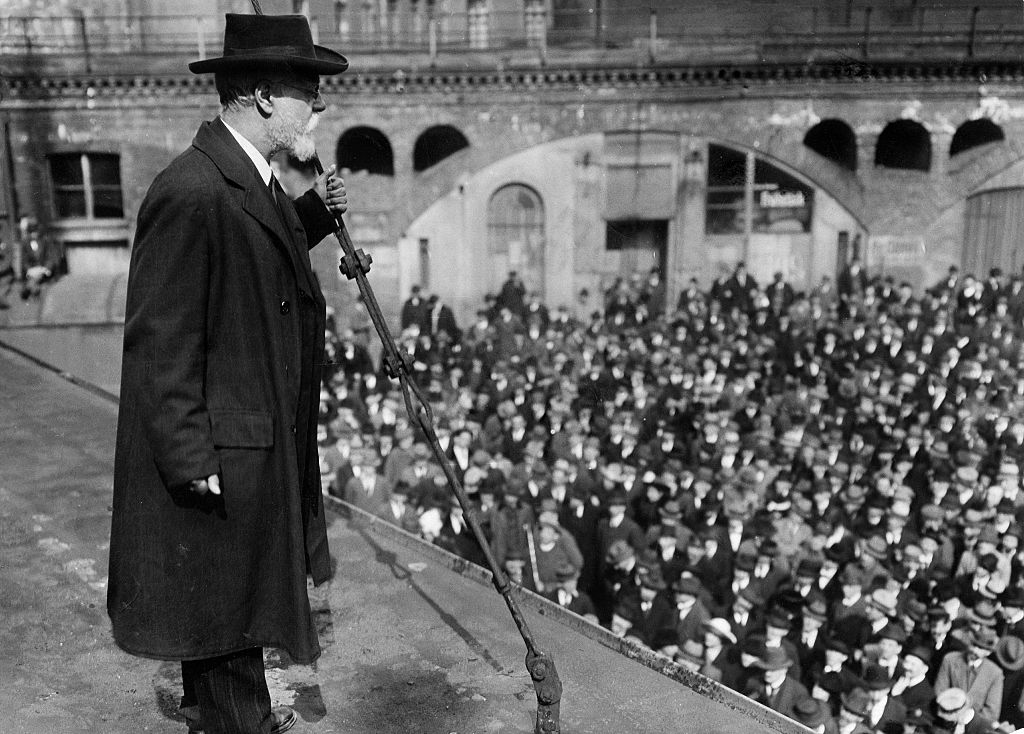
German social democratic theorist and politician, Karl Kautsky, gives a speech in front of the Circus Busch in Berlin, Germany. (Gircke / ullstein bild via Getty Images)
- Interview by
- Melissa Naschek
Social democratic politics have been part of the socialist movement for over a century. Some features, like the commitment to pursuing economic rights for the working class via the state, have remained consistent over time. But when did social democratic ambitions to overthrow capitalism turn into efforts to reform the system?
In this episode of the Jacobin Radio podcast Confronting Capitalism, Vivek Chibber takes a broad look at the early agenda of social democratic parties. Through an examination of their views on the state, class, and socialism, he unpacks social democracy’s relationship to the Left’s politics today.
Confronting Capitalism with Vivek Chibber is produced by Catalyst: A Journal of Theory and Strategy and published by Jacobin. You can listen to the full episode here. This transcript has been edited for clarity.
Melissa Naschek
So, from the nineteenth to the twenty-first centuries, there have been many different parties and political figures labeled “social democratic.” Starting in roughly the 1860s, we had the German Social Democratic Party, or SPD. In the twentieth century, we had European social democratic parties like the UK’s Labour Party and the Swedish Social Democratic Party (SAP). And in modern times, figures like Jeremy Corbyn and Bernie Sanders have taken up the mantle of social democratic politics.
What do all these organizations and politicians who identify themselves as social democrats have in common?
Vivek Chibber
What all these parties have in common at rock bottom is a critique of and an opposition to unbridled capitalism. Now, that’s a very, very low common denominator. Above that, there’s a variety of aspirations and ambitions that these parties had.
If you take the German Social Democrats, this was a party founded in the late nineteenth century by people who called themselves social democrats because, at that time, most everyone did. But they were in many ways what we would today call communists. They were, in fact, not only critical of capitalism, but they wanted to overthrow it.
Now, that’s the highest aspiration that any of these parties ever had. But the part of the Left that retained that aspiration soon branched off into what was historically known as communist parties or Bolshevism or things like that. Of course, that transformation occurred after the Russian Revolution.
Until the Russian Revolution, everyone was called a social democrat. After the communists branched off in 1917, there was a divergence between social democrats, on the one hand, and revolutionary parties, on the other. These social democrats were, you could say, the ancestors to the mid-century social democracies that we saw in Germany, England, and, you might even say, the New Deal in the United States.
What these social democratic parties had in common was either a grudging acceptance, or in some ways even an embrace, of capitalism as a framing of their politics, but also a commitment to, within capitalism, trying to achieve greater equality, more security for workers, pensions, and more rights against the market.
So you could say that social democracy, as it evolved over the course of the twentieth century, was a desire and an attempt to modify capitalism so that it is not as corrosive and not as hostile to the interests and the needs of ordinary people, and to harness the engine of economic growth that comes with capitalism to a desire to have a more secure, humane, egalitarian existence for ordinary people.
All of these social democratic parties — whether it was the Swedes, or the Germans, or the British Labour Party, or the Austrians and the Belgians — they all had this in common. They assumed different institutional forms and, you could say, different degrees of ambition as well.
Melissa Naschek
So when we’re talking about social democracy, are we mainly talking about a political movement or phenomenon that happened primarily in Europe and to a debatable extent in America?
Vivek Chibber
No, the broad umbrella that we’re talking about — of trying to harness capitalism and, within capitalism, have more equality, more egalitarianism, more security — was something that became a global phenomenon. So you could think of social democracy’s chief institutional form as the welfare state.
What we today call the welfare state is really a product of the social democratic movement, and that has existed in the Global North and South. In a country like Brazil, we can regard Luiz Inácio Lula da Silva, for example, as an inheritor of the social democratic tradition. Others, such as Jawaharlal Nehru or Gamal Abdel Nasser — all these mid-century third-world leaders who were kind of left-wing — all built on the same ambitions as what we today call social democracy.
So, you can think of the twentieth century as “the century of the welfare state,” which is the gift given by social democracy to the world, to capitalism, and to laboring people all over the world. It’s a global phenomenon.
Melissa Naschek
It’s interesting you say that because, as with a lot of historical debates, there are different purported origins of the welfare state. For instance, there are attempts to trace the welfare state back to the church or to other institutions that predate capitalism.
But it sounds like you’re saying that the welfare state is really the direct product of social democracy. Am I interpreting you right?
Vivek Chibber
That’s correct. I think it’s a mistake to trace the welfare state back to the church and such things, because then you’re just associating social democracy or the welfare state with charity, or with good deeds or something. And that is absolutely not the case.
Modern social democracy explicitly went against the notion of charity.
Charity is essentially handouts. The idea was that people should, of their own volition or out of the goodness of their hearts, try to do better for others. Social democracy rejected this because it regarded jobs, incomes, security, medical care, and pensions as rights.
Social democracies believed people should not depend on the goodwill of certain individuals or handouts. And that’s why it’s horrible that part of the American lexicon is to associate the welfare state with handouts or with charity. You’ll hear people say, “I don’t want a handout.” It’s not a handout! It’s something you’ve earned.
You work your whole life, and you create the revenue. That revenue goes to the state in the form of taxation, and it comes back to you in the form of social services. This is the opposite of charity. It was an extension of citizenship.
The early-twentieth-century left was saying, “It’s not enough to have political rights. It’s not enough to have the idea that I should participate in the state or in the making of laws, as a right. I should also have certain economic securities as a right that comes with my being a productive member of society.”
Charity is the opposite of that. Charity is: “You don’t deserve anything. I’m going to give you something if it’s out of the goodness of my heart.” So you cannot associate the welfare state with the church.
Now, underneath it, there is some moral commonality. When Friedrich Engels wrote Socialism: Utopian and Scientific, he argued that Christians and socialists share certain things in common. Both of them want to see the poor treated as human beings. Both of them want to see a sense of an organic community. Both of them want to see another orientation on the part of individuals toward their fellow citizens and fellow residents.
But the difference is the following. Christianity, and all religions, come down to trying to change the world through individual acts — being nice and being charitable. But all of it comes from the voluntary contributions that individuals make to other individuals. So when I take a charitable contribution, it’s being treated as a privilege for me to be the recipient of that charity. But socialism, Engels said, is based on the idea that society has to be changed collectively and that the advances that we make, the economic security that we get, should be given as a right and not as a privilege.
So while there’s an underlying commonality to the morality and to the moral visions of Christianity and socialism, there’s a very different perspective as to how it’s to be achieved and whether or not it should be seen as a right or as a privilege. Those are two very different things.
Now, that’s why I think the welfare state has to be traced to the birth of the modern labor movement. Technically, in the historiography, the first welfare schemes are attributed to Otto von Bismarck, who was the chancellor of Prussia in the late nineteenth century. That makes it seem like the welfare state came from the Right. But the only reason Bismarck extended welfare payments, redistribution, and social insurance to workers was that he was afraid that, unless he did so, the newly formed and growing Social Democratic Party would keep gaining in popularity and power.
Melissa Naschek
Right, and that’s a consistent theme in this history. Even when reforms do come from the top, they only do so because of pressure from below, from working-class movements.
Vivek Chibber
Yeah. For Bismarck, even though it looks like it’s originating from a kind of scion of the Right, he’s doing it because he’s trying to take the steam out of the pressure that’s building under the leadership of the Social Democrats. And it failed, of course, and the party kept growing.
But the point is that this is recognized as the first real step toward the welfare state in modern Europe. And it’s no coincidence that it comes right after the birth of the German labor movement and the German Social Democratic Party. So the welfare state really is a creation of the working class, not of the church and not of the Right.
Reform or Revolution?
Melissa Naschek
Who were some of the most important figures in the early social democratic movement, and what were their perspectives?
Vivek Chibber
I guess you would say that the first real intellectual debate around social democracy and the possibility of reforming capitalism to make it more egalitarian occurred within the German Social Democratic Party. And it was really a debate that still resonates today on the Left, about how to get toward a better society, if you take socialism to be that better society. On one side was a man named Eduard Bernstein, and on the other were many leaders of the SPD, including Karl Kautsky, Rosa Luxemburg, and August Bebel.
And that debate occurred because Bernstein, in the 1890s, was saying, look, we’re finally starting to get real democratic rights. And the working class, for the first time, is getting the right to vote. Through that, it might be possible to use the vote and these newly won political rights of the working class to transform the bourgeois state so that it’s less of a naked instrument of class oppression. And therefore, the state can, in fact, be brought under the leadership of the working class if it utilizes its vote and puts into office its own parties. We can use that to reform, to humanize, and, you might say, to civilize capitalism.
Nobody denied that. Kautsky, Luxemburg, and all the rest were in agreement. The real point of disagreement came down to: What do you do once you’re in the state?
Bernstein maintained that the social democrats could actually have an aggregative, incremental process in which they kept heaping reform upon reform. This meant moving from humanizing and civilizing the bourgeois state to transcending it altogether.
Melissa Naschek
Right. And sometimes that’s called “evolutionary socialism.”
Vivek Chibber
Exactly. The idea was to legislate your way to socialism. You keep weakening the power of capital, you keep using your votes, you keep legislating to strengthen the power of labor, and you can actually use the bourgeois state to pass laws one after the other, which, at a certain point, will cross a threshold where you’re no longer in capitalism.
Now, this is a long-term incremental strategy toward socialism. And this is where the other members of the German party said, “This is a fantasy. You cannot use the state to transcend capitalism. You’re going to have to have a rupture of some kind. You’re going to have to have a sharp break, which will come about through revolution.”
So the contrast became between a revolutionary transcendence of capitalism and an incremental transcendence of capitalism. Now, at that time — it’s important to note — all parties in the debate regarded themselves as socialists and anti-capitalist, in the sense that they all agreed on the need to go beyond capitalism.
So, the vision of justice and the goal were shared by Bernstein, Luxemburg, Kautsky — all of them.
The disagreement was simply about strategy: Is it realistic to say we can use our legislative power and our votes to gradually weaken capitalism until we can just kind of tip it over and go into socialism? Or is there going to have to be a sharp, perhaps military rupture in which we have to rise up and overthrow the government, and then institute socialism through a revolutionary act? That was the disagreement.
Melissa Naschek
Right. And what you’re talking about is known as the reform or revolution debate, after Rosa Luxemburg’s seminal essay, Reform or Revolution?, which was published in 1899. And as you’re saying, Luxemburg was on the side that argued that what was needed was some sort of revolutionary break, and that it was not possible to just come to power in the state and use the state to transform capitalism into socialism.
When did social democracy start to really diverge from a revolutionary model? And what was the significance of that shift?
Vivek Chibber
I think by the 1920s, you’re starting to see a real divergence. And that’s largely because up until, say, the failed German revolution of 1918 — and maybe even the Hungarian Revolution of 1919 — it is a fact that states in Europe, whether in Western Europe or Eastern Europe, are pretty vulnerable. It is still possible to imagine overthrowing the European ruling class. And the process of state formation is by no means complete.
So it’s not crazy at that time to treat reform versus revolution as a menu of options, because revolution is actually on the cards. And really, I would say, from 1905, which was the first Russian Revolution, all the way into the mid-1930s, when the Spanish Civil War happened, Europe was in some kind of revolutionary process. There were actual openings for revolution. And it was a viable position to hold that the state’s weakness meant there were real openings and possibilities for overthrowing it, and that we should try to build power toward that end.
But even though it continues all the way into the Spanish Civil War, really, between the second failed German revolution and the mid-1920s, it’s starting to become pretty clear to many members of the European left that the possibility of rupture, the possibility of revolution, is receding really fast. And they had to start to deal with the reality that, if they want socialism, or even if they want to change capitalism for the better, it’s going to have to be done through incremental reforms or through some process of legislation and aggregation.
The Objective Conditions
Melissa Naschek
So, what were the main conditions that were causing this change? Because we were just talking about a certain set of conditions in which revolutions seem viable. And I think it’s not just the fact that the revolutions were changing, but that structures were changing as well, which were impacting the possibilities for these revolutionary attempts to succeed.
Vivek Chibber
Yeah. I think there are two or three changes that are absolutely key to the fact that revolutions were receding at this time. And I should say, people on the left today still treat it as if there’s just this menu of options and you can choose one or the other.
But there’s a reality that you have to understand, which is that, while there were enormous numbers of real revolutionaries on the Left in the 1910s, ’20s, and ’30s, all the way into the 1940s, those revolutionaries were not able to bring about revolutions.
Now you can have two explanations for this. One is that they were all traitors, or they weren’t serious, or they made all sorts of mistakes. But that would be weird because it would mean socialism and Marxism have to be pretty mysterious and baroque institutions and ideologies if nobody understands them. This is the voluntarist explanation, in which everyone failed to be an appropriate Marxist or an appropriate socialist.
Melissa Naschek
Right.
Vivek Chibber
I think a more convincing approach is to say, these people were all very committed — far more committed than anybody on the left in the past two or three generations. They were very, very serious, and they spent untold energy and time trying to bring about revolutionary change, but they were unable to do it. And not because they were insufficiently committed or they weren’t smart enough to do it.
So something happened in the world around them that took revolutions off the table by the 1940s. Now, what was it?
I think two things were really important. One was the achievement of democratic rights across Europe, which made revolution much less necessary for social change than it had been in the 1890s and 1900s. It’s important to remember that the European working class as a whole did not achieve democratic rights until around World War I. Only some segments of it had democratic rights before 1910. There was a kind of qualified franchise that allowed wealthier workers to vote in some countries, but in many others, even that wasn’t allowed.
Melissa Naschek
Right. And we’re also primarily talking about the male vote at that point.
Vivek Chibber
Yeah, exactly. I mean, even working-class men were not allowed to vote right into the twentieth century. So in that situation, if you want to express dissent or force a change, the normal avenues we take for granted in a democracy don’t exist. And so, that pushed the impetus for reform toward revolution.
The lack of access to democratic institutions pushed people toward extra-democratic avenues of change. But once they got democracy, of course, people had other avenues to press for social reforms that were not even possible in an undemocratic situation.
So once you get democracy, people can actually struggle for reforms effectively through institutions and other legal channels, which makes the risks, the hard work, and the explosive uncertainty of revolutions seem like an unwarranted leap in the dark. They don’t want to do that. But that’s just one issue.
The second thing that happened was that once the ruling classes made it out of the initial revolutionary opening of 1917–1919, they moved really, really quickly to suppress the labor movement and weaken it, and to a large measure, were successful through two channels. One is, don’t forget, fascism. We get fascism from the early 1920s all the way into the 1930s. And the European fascist movement was directed toward smashing the labor movement, particularly its revolutionary wings. And it was largely successful in doing that.
So on the one hand, you get a weakening of those revolutionary elements, the sharpest edge of the revolution, which made the task of trying to overthrow capitalism even more unappealing to those who remained. But the flip side of the rise of fascism was the consolidation of the bourgeois state. It was a consolidation of the military, its repressive apparatus, and also its fiscal and monetary apparatus, which enabled it to weather economic crises, including monetary crises. And it’s these crises that had weakened the state in the early part of the twentieth century.
Economic crises preceded all the revolutions in the West. But now, the ability to ride out a crisis — in particular through central banking and fiscal policy — had made the state much more stable. So the Left was handed this situation, where much of the steam for revolutionary change was taken out by the rise of democracy.
On the other hand, the state had been strengthened economically and politically through the development of new instruments of economic governance. And it is a fact that fascism took its toll on the most militant elements within the working-class movement.
These were all real changes in capitalism. They made revolution both unlikely and unappealing to many people who had previously been committed to it. So it’s not that you had a kind of reformist takeover or revisionism or something like that, which you sometimes see in the historiography by some of the Left. The reality is that capitalism itself changed, so that the chances for revolution objectively receded.
And by the 1940s and ’50s, you had to be a left that was accommodating to the reality that you’re going to have to find nonrevolutionary ways of moving toward socialism if you still remain committed to it.
Melissa Naschek
Right. And the interesting thing is — going back to our comments about Bismarck and the origins of the welfare state — this version of the state only existed because of previous wins by the Left for expanded democratic rights and access to the state. This wasn’t necessarily the direct intention of advocating for those reforms, but they ended up creating a more stable capitalism. It sounds like that was one of the unintended consequences.
Vivek Chibber
Yeah. For instance, look at the German Social Democratic Party’s Erfurt Program, which was fashioned in 1891 as a key founding document of the party when it launched itself as a modern socialist party. That program had two parts to it, and they were published as two parts of a book.
One part said, “We’re going to fight for reforms because it is through fighting for reforms that we win over the working class — we make their lives better, we show that we’re not just ideologues, and that we’re actually interested in their welfare day to day. And so, we’re committed to reforms.” Then the other part said, “We’re going to build on those reforms and use their popularity and our growing power to then push for revolution.”
So the first part was, you might say, kind of the Bernsteinian part, which said, “We are a party that will use every political victory that we experience to improve the material welfare of the working class. We’re going to fight for their material interests.” But then the second part said, “We are not, however, going to be content or limited to improving capitalism. We’re fully committed to having socialism.”
So the early social democrats didn’t see any contradiction between fighting for reforms at that moment and also trying to wage a revolution. There was no intention of, as you might say, consolidating capitalism or making it stronger, or some such thing. But you’re right. In the end, what they did every time they humanized capitalism was, in fact, take away some of the impetus toward, and the necessity of, a revolution, because people were making enormous gains.
You have to remember that the people who die in revolutions are mostly workers and peasants. So in today’s left, which is a campus left, there’s a romance of revolution, but they were bloody affairs. And it’s the people who are trying to wage revolution that take it on the chin. So when you look around the world and see that it’s possible to improve your life without revolution, most people are going to say, “Yeah, then let me just try to improve my life without it.”
Melissa Naschek
Yeah. And this reminds me of modern-day accelerationist arguments, such as when people say, “Well, Donald Trump getting elected is great because it’s going to make everything worse, and that means that people are going to be more inclined toward the Left and toward revolutionary arguments.”
I don’t think the social democrats of the nineteenth or twentieth century would have argued for things like that.
Vivek Chibber
Accelerationism has no connection to reality — none whatsoever. It’s tomfoolery on the left, and it shouldn’t be taken seriously at all. It’s just one of the many symptoms of a complete and total lack of connection with everyday people when you see ideologies like this taking root.
The fact of the matter is, when things get really, really awful for working people, they cling ever more fiercely to what little they have. They don’t decide to take leaps in the dark. It’s just never happened.
Unfortunately, you would think that it would be people on the left who would be most attuned to the conditions in which revolutions occur or how to bring them about. But there’s a level of fantasy and magical thinking in today’s left that has no connection to reality when it comes to these issues.
The State and Revolution Reform
Melissa Naschek
I want to get back to what you were saying about the state. Did social democrats have a strong theory about the relationship between the state and capitalism, especially since they’re placing so much strategic emphasis on using the state to make changes in capitalism, and also to use those changes as a way to build a working-class socialist movement?
Vivek Chibber
We have to divide the social democratic movement into prewar and postwar. And by war, I mean World War II, not World War I. I think, in the prewar period, that is, the social democratic movement of the first half of the twentieth century, there was a very robust understanding of the bourgeois state and the limits it puts on the chances for progressive change and progressive legislation.
It was not the kind of theory you see written in academic texts today, or since the 1980s and ’90s, when Marxists developed what we call modern state theory. But modern state theory — as developed by people like Nicos Poulantzas, Ralph Miliband, Fred Block, and Claus Offe — really built on the insights or the assertions that early twentieth century social democrats made, assertions which were very sharp and very smart, but weren’t articulated into a full theory.
What the Left did in the latter part of the twentieth century was turn those earlier assertions and affirmations into a theory, making explicit what was implicit.
What was implicit in the early parts of the twentieth century among social democrats was the understanding that the state — even a democratic state, which was in some way beholden to the voters, most of whom were workers — gave greater power to capitalists, even though workers had greater votes. That was essential to their understanding.
This is not as well encapsulated in Lenin’s State and Revolution, but the State and Revolution is not a representative text of how social democrats thought about the state. That book was forced down the throat of the global left because when the Bolshevik party became the most important and most famous communist party in the world, it became kind of a religious text. But it doesn’t express the entirety of what social democrats thought because its own theory of the state is actually quite impoverished. It isn’t a very well-worked-out theory of the state.
The more common understanding of the state was that it is not a naked instrument of class rule because once you got the democratic vote, capitalists couldn’t rely on the state just to be a naked instrument of rule. You had to have a more sophisticated mediation, a more sophisticated approach, to keeping the working class in line. You couldn’t just keep using the military or the cops against them because they had the right to vote.
The more sophisticated perspective essentially said that, even though the state’s class bias can be somewhat mediated or weakened through the vote, it will still remain a class state. Because it’s still a class state, it’s going to take real struggle, real power, and real threats of economic disruption from the working class to get legislators and to get parties to give us reforms, to give us legislation that’s going to make our lives better. So they did, and we know they understood this because that’s the strategy they used.
All social democratic parties — regardless of whether they were fighting in their own minds for socialism or whether they were fighting in their own minds for merely a form of capitalism — all of them had one thing in common, which was a very, very deep anchor in the working class, a very close relationship to trade unions, and a commitment to using the power of trade unions and of workers in their neighborhoods and in their other institutions to press their interests onto the state.
In other words, even though they were committed to using the power of the vote, they never exclusively relied on it because they knew that the vote would never be enough to bend the state to their interests and to their needs. It would have to involve class struggle. It would have to involve actually taking on power where it really exists in capitalism, which is not inside the state. It’s inside the investment prerogative of capitalists. They all knew this.
They didn’t articulate this perspective as well as the later left in the 1970s and ’80s did, but they all knew this. That was the theory that informed their practice. And that theory deepened and grew as their experience with the state grew.
Later on, it got, in many ways, weaker, not better. But in this part of their history — the first half of the twentieth century — they had a pretty robust understanding of the bourgeois state. The sad thing is, the current left is not even at the level of the early left, of the social democratic left of the 1920s, ’30s, and ’40s.
Melissa Naschek
If they saw the state as a fundamentally bourgeois state, why did they also think that the state could be used to expand economic rights?
Vivek Chibber
I mean, in reality, they didn’t see any choice. This is a really important point here. Once they accepted the fact — and it was a fact — that revolutionary openings were receding really fast, the chances for actually overthrowing bourgeois states were becoming pretty remote. We’re talking now about the 1930s into the ’40s. Once you see that, you have a choice. Either you give up the game, and you say, “Well, we can’t do revolution, so let’s just leave the field and hand it over to the forces of the right-wing parties and mainstream parties.” Or you say, “Alright, revolution is out of the question. We’re going to have to figure out a way of advancing our interests in nonrevolutionary ways.”
Now, if you’re just a college student, or you’re in a little study group, or you meet in your friends’ basements, and you say, “Let’s have revolution,” and then suddenly it occurs to you that we can’t have revolution. You can go about your life . . .
Melissa Naschek
Damn, I feel called out.
Vivek Chibber
But when you’re a trade union leader or a party leader with millions of people who come to your organization and whose lives are connected to your political decisions, it’s not so easy or simple to give it up and say, “Well, we can’t have revolution, so let’s just abandon politics.” You kind of have to say, “We’re going to have to figure out how to deal with the situation as we find it.”
So they understood that they were not in a position to overthrow capitalism, but they also understood that there was a real possibility of making enormous changes within capitalism if they played their cards right.
And that’s why their understanding of the state was important, because they saw that if you actually have real organization in the workplaces and in neighborhoods, businessmen see that, unless they give you something, you can make their profit-making really difficult, almost impossible. Economic disruption in the workplace and the macroeconomy not only shuts down establishments but also halts profit-making. And capitalists have little choice but to come to the table and talk to you about what it’ll take to bring you back to work. And what they’re willing to do is give you real concessions and allow real changes in exchange. The social democrats saw this through experience, and they were committed to building through it.
Now, they didn’t know how far they could take it. Many of them still hoped that they could use this to eventually tip over into socialism.
So, you could say that, by the 1940s, you had two wings of social democracy. There was a Bernsteinian wing, which used reforms and sought to use them as a step toward socialism. And then there was a more bourgeois wing that said, “Look, all this talk about socialism is really kind of a sideshow. We have to come to terms with the fact that we’re stuck. Capitalism is going to be the name of the game, certainly for the foreseeable future, perhaps forever. And what we should think of is a way of simply having a better capitalism rather than trying to transcend capitalism.”
These became the two wings of social democracy after the Spanish Civil War, I would say by the 1940s.
Social Democracy and Marxism
Melissa Naschek
What was the relationship like between social democracy and Marxism? Were these social democratic parties “Marxist parties”?
Vivek Chibber
Some of them were. Let me just say, it was a very, very deep connection.
Marxism was the lingua franca. It was the language of everyday political analysis that all the social democrats employed through the first half of the twentieth century. But even though it was the common sense of Marxists, the parties themselves — to use your language — weren’t necessarily “Marxist parties.”
So you can think of it as a continuum. There were some parties, like the German Social Democrats and even, really, the Swedes in their first years, that were explicitly Marxist or Marxist-inspired. The Germans, of course — Kautsky, Luxemburg, Bebel, Karl Liebknecht — these were the great Marxists of the first half of the twentieth century. So there’s no doubt that they were Marxist.
But even though the Swedes, historically, are remembered as a very pragmatic party that sort of gave up the Marxist mantle very early on, the fact is that from the 1890s into the 1920s, it was one of the more Marxist-inspired parties of the entire social democratic pantheon. And they saw themselves as an explicitly socialist party informed by Marxism. So that’s one end of the spectrum.
Well, on the other end of the spectrum, you have the British Labour Party. And in the British Labour Party, key people, like Keir Hardie and Ramsay MacDonald, were not Marxists. In France, it was something in between because Paul Lafargue was an important figure in the French socialist movement. And you had a lineal relationship to Marx himself.
Melissa Naschek
Lafargue was his son-in-law, right?
Vivek Chibber
Yeah, his son-in-law. So on the one side, you have the Germans and the Swedes. Somewhere in the middle, you have the French. And then you have the Brits on the other side, with very few Marxists.
In Britain, the influence of the Webbs and Fabianism, and of various kinds of non-Marxist socialism, was there — but Marxism, not so much. However, even though they were not Marxist directly, even the non-Marxists were very deeply influenced by the analysis that Marx brought into the socialist movement.
So you could really say that, all the way into the 1920s and ’30s, whether you’re a revolutionary or whether you’re a social democrat, you’re in some way or form connected to the ideas of Karl Marx and deeply influenced by them. I would say it’s really only after 1945 that you see a dramatic change in this, where Marxism becomes much more marginal to the social democratic world. But in the first part of the twentieth century, they’re all, in some way or form, traced back to the ideas of the Marxist movement inside socialism.
And let me just say, finally, even where they weren’t directly or indirectly connected to Marx, they were all socialists. So even in the British Labour Party, you don’t have a lot of Marxists, but they identify their strategy as one that today’s socialists would see as a Marxist strategy.
So the British Labour Party still saw nationalization as a key goal, even though it didn’t call itself a Marxist party. Every single one of the left-wing social democratic parties saw socialism as a desired end, and they were going to bring socialism about. How? Through class struggle.
All of them were class-struggle parties, and class struggle comes straight out of the Marxist lexicon and strategic perspective. So that whole world, the entire world of the Left, was shaped by Marxism. And the socialism of the early twentieth century was overwhelmingly a socialism with a Marxist inflection — a Marxist cast, which is very different from, say, the 1850s, the 1870s.
The last quarter of the nineteenth century saw Marx become the strategic saint, you might think, of the Left, whether or not they were Bolsheviks, whether or not they were in the communist movement.
Social Democratic Class Analysis
Melissa Naschek
We talked a bit about the state, but we didn’t really discuss class much, except to mention that the social democratic movements were primarily based in the working class. How did social democrats understand class, the class structure within capitalism, and how did that affect their politics?
Vivek Chibber
Well, I think it evolved over time. In the early years — that is, say, the 1890s to the 1920s — they very much saw politics as class against class, and this comes straight out of Marx. They saw the socialist movement as a movement devoted to class struggle.
Again, this is true whether you’re in the British Labour Party or whether you’re in the German Social Democratic Party. There was a kind of difference in intensity and pitch, but they all saw politics as politics of class against class. And we know this because all the social democrats based themselves in the trade union movement.
In some cases, the social democratic party essentially created the trade unions. The Swedes are a good example where, very early on, the party was creating unions. But in other cases, like England, the trade union movement created the Labour Party.
Melissa Naschek
Would you call it a kind of marriage between the party and the labor movement?
Vivek Chibber
No, really, the party was the creature of the labor movement. In the British case, the unions retained their hegemonic position within the Labour Party all the way into the 1970s and ’80s, using a variety of means. The trade unions initially viewed the Labour Party as an instrument of their own.
The point is that, whether the impetus came from the party or the unions, every social democratic movement was anchored in a partnership between these parties and the working class. And that was because all of them saw their lifeblood as coming from the power, the strength, and the organization of workers.
So in this iteration, at this moment, they are not thinking especially hard about the middle classes. There’s a reason for that. Until the 1920s, they didn’t really have to worry about elections very much. So if you’re not worried so much about elections, you’re really just thinking, “How do we build the power of our constituency?”
Once you get democracy, you start worrying about the vote, about winning elections. And as soon as you start worrying about elections, you realize, “Well, we just don’t have enough workers in the population to exclusively rely on them to win even electoral office.” This is because across Europe, the working class never accounted for more than 45 percent or 50 percent of the electorate.
So the social democrats had to have outside alliances in order to actually vie for power. And that outside alliance would come from only two groups: peasants, that is, the agricultural sector, or from the urban middle classes — shopkeepers, professionals, and groups like that. So you had to start worrying very hard about recruiting or attracting those forces to your side.
And at that moment, the exclusive class-against-class view became somewhat less appealing. Mind you, right up until the 1960s and ’70s, all the social democratic parties still had their main anchor in the working class. But their vocabulary and their language started changing. It changed from exclusively a class language and a view of themselves as class parties to seeing themselves as parties of the people.
Melissa Naschek
Right. And this is why debates about what class is and who constitutes the working class become so important and have proven so lasting. We talked about this a lot in our PMC episode, you know, just how much ink has been spilled over the question of who counts as a worker. And I think it’s important to emphasize that it’s not an academic terminological debate, but really a debate about who is actually controlling these movements and who these movements are working for.
Vivek Chibber
Absolutely. It’s impossible to overemphasize this point. You sometimes see in today’s left this idea that if you spend your time worrying about who is or is not a worker, it’s some kind of arcane, academic thing. People like Russell Jacoby sniff at class analysis when you really do analysis like this, because they say, “Well, this is just some kind of professorial thing.”
The truth is, if you want to see real debates over who is and is not a worker, go back to Mao and to his analysis of the agrarian class structure in pre-1949 China. Look at Lenin and his analysis of the Russian agrarian class structure, where he’s trying to understand, “Well, is it the middle peasants who are the primary part of the agrarian population, or is it poor peasants?” Why were they worrying about this? It’s because they want to know, “How big is our constituency? How big is the working class? Who do we go in and organize?”
People don’t walk around with labels on their shirts saying, “I am a worker” or “I’m a middle class person.” There’s a huge section of the population with what appears to be a mixed life. You have to be able to say, “Well, are these basically workers or are they basically not?”
Melissa Naschek
Right. And I think this goes to one of the fundamental differences between a liberal conception of the electorate and a Marxist conception of the electorate. In the sort of liberal-pluralist view, everybody is just a voter. Everybody represents one vote, and we all get together, and we express our opinions and the majority rules.
But in a Marxist conception — and this is what these social democrats recognized as well — it’s clear that we’re not all equal. We’re all coming from a certain economic position. Unfortunately, that means some people’s opinions are more powerful than others. And that means we have to account for it in our political strategy.
Vivek Chibber
Yeah. I would say it’s not just a difference with the liberals. I do believe that a great deal of twentieth-century liberal discourse recognized the existence of class and recognized real differences between people who were economically located differently within the system. But sure, a lot of liberals have made that mistake.
Today, I would say, it’s the populist movement and the populist elements within the Left who are the least interested in thinking about class, because they tend to clump everybody who’s not super wealthy into the same basic group of people, which is the 99 percent or the people or something like that. Yeah.
And that’s a drawback, because what attracts differently located people to a socialist program is going to be quite different. What’s going to attract workers to it is very different from what’s going to attract salaried people or professional people. And we actually know this.
We’ll talk about this later, perhaps in the next episode. The way in which professionals responded to social democratic parties and programs in the twentieth century was very different to the way, say, manual workers responded to it or blue-collar workers responded to it.
Technically, they’re all part of the 99 percent. But they’ve had very different connections to the social democratic parties and very different demands that they brought to the parties. And unless you are ready for that, unless you anticipate it, unless you plan a program that acknowledges these differences, you’re not going to last very long as a left-wing party. You’re going to end up becoming hegemonized by people who repel the key constituencies that you would like to have as your anchor, which is workers.
A Neoliberal Left
Melissa Naschek
Looking at today’s left — and let’s just talk about the American left — do you think that it’s a social democratic left?
Vivek Chibber
No, I would say it’s a minority. A minority of the Left is a social democratic left. The bulk of the American left is what I call a neoliberal left.
So if we define a social democratic left the way I did earlier in this episode, which is a left that seeks to reform and humanize capitalism, but understands that reform is going to come through taking on the real centers of power, taking on capital, and understands that it’s going to require bringing together workers in the same organizations and fight alongside them against these centers of power, that’s still a pretty small minority.
Most of the Left in America still sees antidiscrimination and multiculturalism as its horizon, which, I mean, every single neoliberal in the world wants to see a less discriminatory capitalism. Every libertarian wants to see labor markets that reward people on talent and not on race or on gender. Every libertarian would love to see a truly multicultural ruling class, a truly multigendered political elite.
These are all progressive demands, but they’re progressive within the worst kind of capitalism we have seen in the last 120 years. So yeah, they’re good things to have, but the idea that this has any connection to social democracy as a historical phenomenon is just ludicrous. I don’t think there’s any connection.
But as I’ve said before, I think we are in a process of learning, of rediscovering some of these roots, of trying to recapture their energy and their power, and of trying to devise a politics around them. That will only happen if this neoliberal left, the identitarian, intersectional left, is at some point in the near future displaced by something of a class-struggle left, of a left that’s committed to the material interests of working people and doesn’t actually reject the very idea of material analysis and material interest. We’re still having these debates, which means, I think, we’re not even at the beginning of a genuinely effective left for the working class.