The Genocide in Gaza Has Not Ended
Jerusalem-based historian Lee Mordechai has spent the last two years documenting Israeli violence against civilians in Gaza. In an interview, he explains why the genocide has continued even after the supposed ceasefire.
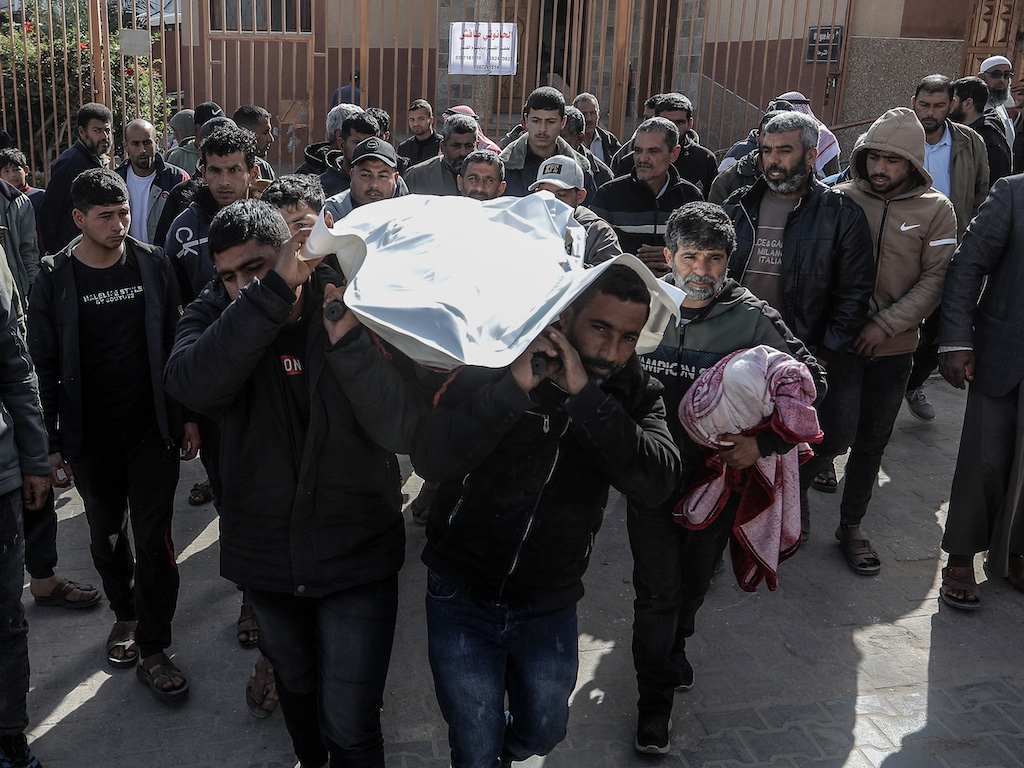
In Gaza, the violence has not ended despite the ceasefire between Israel and Hamas announced in October. (Abed Rahim Khatib / Anadolu via Getty Images)
- Interview by
- Elias Feroz
The destruction of the Gaza Strip that has unfolded since October 7, 2023, is unparalleled even among past Israeli crimes. Some estimates say that over 80 percent of material infrastructure has been destroyed, and even Israeli forces admit a death toll of over 70,000. Since the so-called ceasefire began, the Israeli military has continued bulldozing entire neighborhoods, prompting some rights organizations to accuse it of destroying evidence of its crimes.
One Israeli who has refused to look away from these atrocities is Lee Mordechai, a historian of the Eastern Roman Empire and a senior lecturer in the Hebrew University of Jerusalem’s History Department. He has spent the past two years documenting the war in Gaza through his project Bearing Witness. The initiative systematically collects testimonies, media reports, and other evidence of the violence against civilians, aiming to preserve a factual record of what he calls an ongoing genocide.
In his view, the violence has not ended despite the ceasefire between Israel and Hamas announced in October. In an interview for Jacobin, he told Elias Feroz how institutional indifference, media silence, and societal normalization allow the atrocities to continue largely unchecked. Explaining his own research, he explains why Israeli academics remain mostly silent and why documenting these events is essential for ensuring historical accountability.
You were among the first public voices in Israel to describe Israel’s actions in Gaza as genocide, and you are the founder of Bearing Witness, a project documenting Israel’s war crimes in Gaza. Given that Israel-Palestine is not your primary field of research, what compelled you to undertake this work?
Yes, I was not trained in the history of Israel-Palestine. When October 7 happened, I was on sabbatical in the United States. Observing events from the outside — especially by consuming non-Israeli media and in particular alternative, nonmainstream sources — was extremely influential for me. It made me realize the horror of the events I was witnessing.
At that point, I felt I needed to make other people aware of what I was seeing, particularly a broader Israeli audience. I tried different ways of doing that. I spoke with friends and family, and I attempted to publish op-eds and opinion pieces in Haaretz. None of this seemed to have much impact.
Then, in December 2023, South Africa filed its [International Court of Justice] case. I read the full document — the eighty-plus-page submission — and I remember thinking that this was something I could actually do myself. The sources and methods were not fundamentally different from the kinds of materials I work with in my academic research as a historian.
Already before October 7, I had been thinking about my obligations as an academic to the society that pays my salary. After October 7, I tried to understand what role I was supposed to play in this reality. I was also influenced by the political scientist John Mearsheimer, who made the point that even if no one listens, you still have an obligation to speak and to put the argument out there, publicly, for the record of being on the right side of history. I started compiling evidence and publishing it on my social media, which at the time was essentially nonexistent. At first, hardly anyone paid attention, but I continued anyway. Eventually people did start to care. I began publishing in early January 2024.
Your project went viral a couple of weeks later.
Exactly. The first major wave was around mid-March 2024. It started as an individual project. After I returned to Israel in the summer of 2024, a lengthy Haaretz profile led dozens of Israelis — mostly Jewish, some Palestinian — to reach out to me and ask to volunteer. We now have around a hundred volunteers with Israeli citizenship, with about two-thirds based in Israel and the rest mainly in Europe and the United States. We have been working for over a year to document, catalogue, and preserve evidence.
We are publishing our work in Hebrew, English, and, hopefully, Arabic. Although we represent a small minority, I have learned that even a relatively small, well-coordinated group can have a meaningful impact — especially when digital tools are used responsibly.
How did your experience in the United States affect you? Was being outside Israel necessary for you to reach these conclusions?
I don’t think I could have started this project had I been in Israel at the time. Both the reality on the ground and the surrounding public discourse here tend to drag you into short-term issues, so it becomes extremely difficult to concentrate on a single task over an extended period of time. Had I been in Israel, I would probably have joined demonstrations, volunteered with an NGO, or helped displaced Israelis in some practical way.
Being in the United States, none of those options were available to me, so I had to find another way to respond. I am a historian, and writing is what I know how to do. In that sense, writing was the most natural outlet. At first, it was not intended for any specific audience. I was writing for myself but also hoping that this work might eventually speak to a broader public.
What kind of personal repercussions, if any, have you faced in Israel because of your project or your actions more generally?
The repercussions have been minimal. No one from the police, the security services, or government authorities has contacted me. In practice, I can say whatever I want. There has been some academic pushback, but nothing more serious than the occasional hate mail. I have not been threatened or meaningfully harassed, which frankly surprised me. I expected a very different reaction. My sense is that people see me as something like a village fool — someone saying uncomfortable or inconvenient things. It is easier to ignore me than to engage seriously with what I am saying.
How do your students react when you talk about Gaza?
I taught two courses directly related to the subject. One was a course on the history of Gaza, from prehistory to the present, which I taught in early 2025. More recently, I taught a seminar specifically on the war itself. Both courses were very full — well beyond the usual size. There were tensions, of course, but that was to be expected. Overall, students engaged seriously with the content of the courses, and I believe they were important for them. No one questioned my right to teach these courses, and no one asked me to stop.
The first course was attended exclusively by Jewish Israeli students. The second included a small number of Palestinian citizens or residents of Israel. [Note: Palestinian residents of Jerusalem mostly don’t have Israeli citizenship but instead hold an Israeli ID confirming their permanent residency in the city.] In both cases, the discussions remained largely within an intra-Israeli framework, which is understandable. Overall, the experience was positive, and I plan on continuing to offer these courses in the coming years.
How present is the situation in Gaza within Israeli academic discourse today, particularly at the Hebrew University where you teach?
It is largely absent. Both in academia and in broader Israeli society, it is relatively easy to ignore what is happening in Gaza and return to a sense of normalcy. Daily life in Israel continues more or less as usual. Gaza rarely appears in everyday conversations and is often missing from the media. A journalist friend recently told me he had gone through an entire issue of Haaretz without finding a single article about Gaza. The same is often true for Ynet, the most widely read news website in Israel.
As a result, most people here neither think about nor engage with Gaza. The media plays an active role in sustaining this lack of awareness. Unless someone deliberately seeks out information, there are always other, more immediate concerns that take precedence.
When it comes to Gaza, are the government and academia aligned?
Largely, yes. Many academics may feel uncomfortable with what is happening in Gaza, but they justify their silence by framing this as a time of emergency. Criticism of Israel’s policy on Gaza is easily portrayed by the Right as support for Hamas. This threat deters politicians, judges, and academics alike.
Since Israel and Hamas agreed to what was presented as a ceasefire, hundreds of Palestinians have still been killed. How would you characterize the current stage of Palestinian suffering?
I do not believe that the genocide has ended. What we are seeing is a continuation of the same process in a different form. Most Israelis are largely unaware that the violence continues. Ongoing air strikes, the destruction of schools, and civilian deaths — often including women and children — are either not reported or are framed almost exclusively in terms of “terrorists.” This dynamic is not new. Even before October 7, Gaza was treated as something distant — an issue best ignored, to be handled by others, without demanding sustained attention or moral engagement from Israeli society.
What, in your view, would need to happen for the genocide to be considered over? Are there concrete indicators you would look for?
A genuinely agreed-upon political solution, combined with a clear and sustained cessation of hostilities, would be essential. There are, in theory, different possible outcomes. One would be an openly violent solution, such as mass expulsion, i.e., ethnic cleansing. That would end this particular phase, though obviously not in any positive sense. Another alternative would be a political arrangement that stabilizes life in Gaza and addresses the basic conditions of Palestinian existence there, perhaps through a state.
Shortly after October’s ceasefire, you wrote about Israel’s collective amnesia and the rapid erasure of Palestinian suffering from public consciousness. Has this process accelerated now that the last Israeli hostages have been returned?
It is difficult to measure acceleration in this regard. What matters more is the process itself. An hour away from where I live, roughly two million people are living amid a humanitarian catastrophe. Most have lost their homes and livelihoods. Hunger and deprivation are widespread. Yet daily life in Israel feels normal.
Even closer to Gaza, life can appear normal as well, punctuated occasionally by explosions — air strikes, demolitions, or detonations whose nature is often unclear. Unless someone actively chooses to pay attention, it is remarkably easy to forget that any of this is happening. As a historian, I find this deeply instructive. It resembles situations I have read about for years: people living in close proximity to mass suffering, later claiming they did not know. The reality is that not knowing, or choosing not to know, is easier than we like to admit.
Settler terror in the West Bank, from attacks on Palestinian civilians to home demolitions, often receives little public attention. How does this omission fit into the broader pattern of collective forgetting you describe in Israeli society?
The situation in the West Bank is somewhat different. There is less forgetting there, partly because the West Bank remains relatively accessible to Israelis. Numerous NGOs operate on the ground, documenting abuses and attempting to bring them to public attention. That does not mean the situation is good — it is not — but individual incidents in the West Bank do receive media coverage. This is not the case with Gaza. That was true even before October 7 and remains true today.
Organizations such as B’Tselem can operate in the West Bank. Activists and journalists can travel there, collect testimonies, distribute cameras, and build long-term networks. Gaza has been far more isolated. From where I live, I can reach many parts of the West Bank within half an hour. Gaza is entirely different — it has been completely closed off to Israelis. There is also a political dimension. Certain center-left political actors are occasionally willing to criticize settlements and settler violence, at least when it aligns with their political interests. That space for criticism does not exist with regard to Gaza.
There is almost no meaningful critique of Gaza policy even within the Jewish liberal-Zionist opposition.
In recent months, Israel has suspended dozens of aid groups from operating in the occupied Palestinian territories — a move that UN experts call a clear violation of international law — and destroyed the UNRWA (United Nations Relief and Works Agency for Palestine Refugees in the Near East) headquarters in Jerusalem. What impact do you think they will have on Gaza and the future of Palestinian civil society?
I should be clear about the limits of my expertise. I am not an expert on international law or NGO governance. What I can offer is a broader interpretation. What we are witnessing is the breakdown of the post–World War II international order, particularly the framework that emerged after the Cold War. States are increasingly able to do things that were once considered unacceptable.
The destruction of UNRWA facilities is a clear example. A state is not supposed to seize and demolish UN property. That this can happen reflects the weakness of international institutions. Power now routinely overrides former norms. The countries that were meant to uphold this international order — especially the United States, but also Western European states — have largely allowed it to collapse.
[US Secretary of State] Marco Rubio recently stated in Munich that the interests of the US and the West should be placed above the global order. Some Western governments have announced restrictions on arms sales to Israel, only to quietly reverse them. Germany is one recent example. Continued military, economic, and diplomatic cooperation with Israel signals that these actions are ultimately tolerable.
Within Israel, this produces a sense of normality. If international relations continue as usual, people conclude that nothing exceptional is happening. And if nothing exceptional is happening, there is no reason to change course. Constraints only matter if violating them carries a cost.
In German-language media and politics especially, the BDS (Boycott, Divestment, Sanctions movement) tactic and more specifically calls to boycott Israeli universities draw criticism even from the Left, as it is argued that such boycotts will isolate the progressive section of the Israeli intelligentsia and drive them into the arms of the nationalists. As an Israeli academic opposing the genocide in Gaza, would you agree with that assessment?
I do not find that argument convincing. The progressive academic community in Israel is very small. Invoking it often functions as a way to avoid taking action. An academic boycott would be inconvenient for me, but I would understand it. I believe that genuinely progressive academics would also understand the rationale behind such measures.
The liberal academic community in Israel is much larger than the progressive academic community. Many liberals would strongly oppose a boycott, but I do not see evidence that such pressure would push them toward nationalism. More broadly, within Israeli academia, academic isolation is taken seriously. International academic recognition confers legitimacy, and many scholars are deeply invested in maintaining those connections. The government is less concerned with academic BDS, and in fact, it often views Israeli academia as a political adversary. But that does not mean academic pressure is meaningless for the government. It targets a sector that still values international norms and status.
You travel frequently to the United States. Have you personally faced calls for boycotts or professional isolation?
Not explicitly, as far as I know. But at this point, it does not matter much to me. I will continue doing what I believe is necessary. Whether that leads to boycotts or not is for others to decide.
As a historian of the Byzantine Empire, what do you see as the value of studying and teaching history in general? Isn’t it frustrating to witness the present — especially the destruction in Gaza — and see that the lessons of history do not seem to prevent recurring tragedies?
I do not believe that history offers simple or direct lessons. It is not a manual for preventing catastrophe.
That said, historical study has value in at least two ways. First, knowledge has intrinsic worth. Understanding the past matters in its own right. Second, history trains skills that are essential for the present: critical thinking, independent judgment, and the ability to synthesize diverse sources into a coherent interpretation of events.
History also makes one very aware of how the past is constantly manipulated for present political purposes. We see this, for example, in attempts to portray Gaza’s history as inherently Jewish. There are numerous books claiming that Gaza was always Jewish, that a Jewish community has always existed there. It’s a way of manufacturing historical claims. These are not neutral accounts of the past; they are political tools.
I ended up in a position — geographically, professionally, and historically — that allows me to observe these events closely and to document them in a systematic way. My responsibility, as I see it, is to record, analyze, and organize this material as clearly as possible for those who may come later, whether they choose to engage with it or not. If we look at previous rounds of violence in Gaza, very few people followed them closely at the time or returned to them later. That may happen again. But that possibility does not change the necessity of doing the work now.
How do you think future historians will look back on what has happened in Gaza since October 7?
There are two possible answers. One is optimistic: that future historians will look back in shock and ask how so many people allowed this to happen, and perhaps use that judgment to hold their future societies morally accountable.
But that answer may be naive. If we look at broader global trends, many norms that once seemed stable no longer are. Actions that were previously considered unacceptable are now carried out with little resistance. International institutions, whether national or global, have shown themselves to be weak, or at least easily bypassed.
There is no guarantee that time will bring clarity or moral reckoning. It is entirely possible that we are moving toward a more violent international order, one less constrained by international law and shared norms. In that scenario, there may never be a moment of collective realization or accountability.