Israel’s Deliberate Destruction of Palestinian Academia
Gaza used to have twelve higher-education institutions. Over the last two years, Israel partly or totally destroyed every one of them in its campaign to crush Palestinian public life and ruin its chances of recovery.
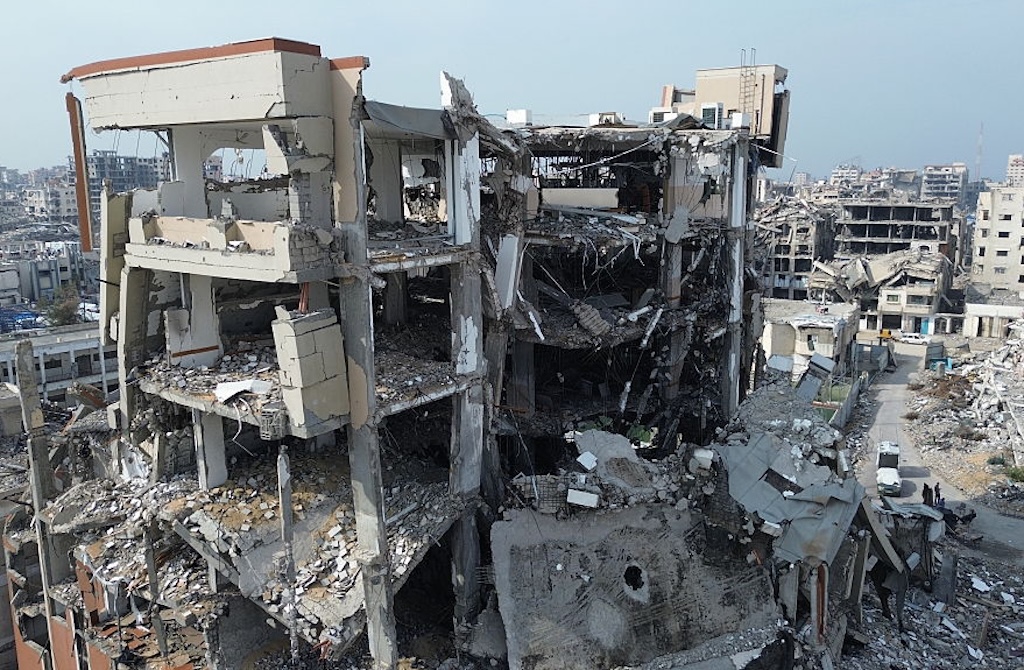
An aerial view of demolished Al-Aqsa University, after the Israeli army's direct target, forcing thousands of students to suspend their studies in Gaza City on November 29, 2025.(Mohammed Eslayeh / Anadolu via Getty Images)
- Interview by
- Alberto Mazzoni
Ties between the Israeli army and universities are well-documented — for instance, the dedicated training programs for soldiers, like Talpiot and Brakim, explicitly aiming at developing novel technologies for the military.
Not all universities follow suit. In Europe, and even more so in the United States, college students and researchers have played a significant role in movements in support of Gaza. Even some Israeli-affiliated scholars have spoken out. In turn, college-based activism has been a pretext for governments around the West to curb freedom of speech and research on campus.
Yet, while the spotlight often turns to universities abroad, Palestinian academia has rarely been a focus of attention. If this might seem a minor concern amid such massive atrocities, it also fits into a broader media dehumanization of Palestinians, in which their lives must appear as unlike Western ones as possible. Understanding Palestinian academia not only cuts against this oversimplification of Palestinians’ lives but may open up possibilities for future political and scholarly cooperation.
Neuroscience PhD student Ibrahem Hanafi recently discussed these issues at a “Science in Palestine” conference held at Pisa’s Sant’Anna School of Advanced Studies. After the event, Alberto Mazzoni interviewed him about the struggles of Palestinian academia.
At the event, you introduced yourself as a “third-generation Palestinian refugee.” What does that mean for you?
It means that exile is not an episode but the architecture of my family’s life. My grandfather was expelled from Haifa, Palestine during the 1948 Nakba, becoming one of more than seven hundred thousand Palestinians forced from their homes. Since then, displacement has been our only constant. Four generations later, today my family is dispersed across four continents. None of us chose this geography; it was imposed through war, occupation, and the slow violence of bureaucratic erasure.
My mother’s family was also forcibly displaced in the 1967 Naksa from the Syrian Golan Heights, so my parents met in Damascus as people whose connection to their homeland had already been disrupted long before they were old enough to understand what was taken from them. I was born in Al Yarmouk refugee camp near Damascus, which was the largest refugee camp for Palestinians. This made it — despite its establishment as a nonofficial refugee camp — a vibrant center of Palestinian life outside Palestine. It was later besieged and largely destroyed during the Syrian revolution (2013), when most of its inhabitants were displaced from their existing site of displacement.
As a refugee, I was issued a temporary residency permit to live in Syria and a passport-like travel document to be used as a proof of identity outside Syria. With these documents I graduated from the school of medicine in war-torn Damascus and planned to pursue further education abroad. It was then that I realized that the formal term used for my legal status abroad was “stateless.” When I applied for graduate studies in the United Kingdom, Germany, and China, I was denied visas repeatedly despite having unconditional admission offers and guaranteed funding. Then, when I managed to reach Germany to do a master’s degree in neuroscience, my documents listed no nationality, or sometimes marked the field of nationality with “undefined” or “XXX.” With time, I learned that statelessness is not just a legal condition, but rather a global stigma that follows you through airports, embassies, and border crossings. I recall dozens of times standing for hours at the Syrian-Lebanese border, waiting for permission to enter Lebanon, often for no more than twenty-four hours, just to attend a visa interview or sit for an international exam that was not offered in Syria. The uncertainty at those checkpoints, the arbitrary denial of entry, the stacks of documents we carried like fragile proof of our existence — all of it was a reminder that movement, even for the simplest academic step, was never a right for us but a matter for negotiation. Here, I feel compelled to mention a Japanese immigration officer I encountered earlier this year when I visited Japan for a congress. He was agonizing over whether to classify me as Syrian, Palestinian, or simply a bureaucratic anomaly. After two hours of questions and consultations with his seniors, with some uncertainty he stamped the word “Palestinian,” not knowing that this small recognition meant more to me than he could have imagined. It was the first time in my entire life that I saw the word Palestine on my documents not paired with “refugee.”
Ironically, the further I am forced from the land of my origin, the deeper my connection to Palestine becomes. Since I moved to Germany, I have volunteered for two organizations supporting Palestinian scientists, mentor junior Palestinian medical students, and form instant kinship with any Palestinian I meet in our diaspora. I think we cling to one another because our scattered lives are the fragments from which we feel our belonging to one nation. I remember a mentor in Germany once asking me why I insist on calling myself Palestinian when neither I nor any member of my family — or, for that matter, any Palestinian refugee — has ever been allowed to set foot in Palestine, the land of our roots. I didn’t answer immediately. Perhaps because in Palestinian families, the second thing we teach our children, right after their names, is their belonging to that close but faraway land. It is not simply a personal identity; it is a collective inheritance, a political burden, and a responsibility to carry the memory forward.
As a third-generation Palestinian refugee, I carry not only the pride and resilience of my family but also the inherited trauma of displacement. It’s an open bill of suffering issued to us seventy-seven years ago, passed from one generation to the next.
We have seen the images of the destruction of buildings in campuses in Gaza. What was the situation of Gaza’s universities before 2023, and what is it now?
Before we even talk about the destruction, it’s important to remember what existed. Before the war, Gaza had twelve higher-education institutions serving around ninety thousand students. These institutions were not merely campuses; they were lifelines in a place that has been under intensified siege since 2007 and severe restrictions since the 1990s.
Early in the war, every single one of these universities was partly or completely destroyed. Today, libraries, laboratories, and some entire campuses are completely leveled. One of the most painful examples is Gaza’s newest university, Israa University, founded only about a decade ago. For months it remained standing, as if temporarily spared, and then it was flattened in a single strike, in a scene more reminiscent of a Hollywood demolition sequence than a military operation.
Although the human death toll is harder to precisely document, at least ninety-four university professors were killed within the first three months of the war, often together with their families. At that moment, they included three university professors and four deans. Then, the war continued for another twenty-one months, with Israel killing, crippling, or detaining hundreds of professors, teachers, university staff, and students, on a scale completely disproportionate to other sectors of Gazan society. The attacks didn’t stop at universities. Even UNRWA, which provides school education to Palestinian children across the region, was targeted with a coordinated campaign to delegitimize it. Destroying and defunding schools is not a byproduct of war; it is an assault on the very foundation from which higher education grows.
United Nations experts have expressed grave concern over this pattern of “scholasticide”, noting that it is not incidental but deliberate. Education in Gaza has been largely suspended for nearly two years. Even though the bombing has now decreased, in relative terms, universities lack the physical infrastructure and the surviving personnel needed to resume most programs. Yet, despite the scale of destruction, the spirit of scholarship persists. As three university presidents in Gaza put it in their published message addressed to the international academic community: “Our campuses may have been razed … but our universities continue to exist … we are more than buildings, we are academic communities, comprised of students, faculty, and staff, still alive and determined to carry forward our mission.” These are not empty words. Some teaching activities continued online in Gaza regardless of the incredibly precarious conditions.
You used the term “scholasticide.” Can you explain what that means, and why it applies here?
The term scholasticide was coined by Palestinian academic Karma Nabulsi during Israel’s 2009 assault on Gaza, to describe the systematic destruction of educational institutions and the killing and detention of academic staff and students. Since then, the term has continued to be relevant due to the restrictions and renewed attacks aiming at suffocating the higher-education system in Palestine. However, it received greater interest during the current genocidal war, as we are witnessing not just collateral damage, but an intentional sustained assault on education itself.
According to UN experts, what is happening could very well amount to the “intentional effort to comprehensively destroy the Palestinian education system.” Even the Jewish-Israeli historian Avi Shlaim has concluded in one of his recent articles that “contrary to prevailing beliefs about the nature and legitimacy of Israeli attacks on Gaza’s educational system and broader infrastructure . . . Israeli actions were disproportionate, unjustified, and importantly, unlawful.”
This is not only about physical buildings. When academics, professors, researchers, and students are deliberately targeted, and when classrooms, labs, and libraries become ruins, you are not just killing people: you are erasing the society’s consciousness, future potential, and the possibility of rebuilding.
You clearly made the point that even before the ongoing genocide, academia in Palestine faced immense challenges. What was the situation like in the West Bank?
The West Bank’s academic landscape has always existed under pressure, not the sudden, total annihilation we see today in Gaza, but a quieter, grinding form of violence that accumulates over decades. Universities there live with the constant threat of raids, armed incursions, student arrests, and administrative disruption. One of the clearest examples is the case of Birzeit University, the oldest Palestinian university: during the early years of the first intifada, Israeli authorities demanded that the university close. When the administration refused, the military shut it down themselves not for a week or a semester, but for four years. Its president, Dr Hanna Nasser, who holds a PhD in nuclear physics, was forced into exile for nineteen years. That alone tells you what kind of intellectual environment Palestinians were being denied.
But the pressure on West Bank academia is not limited to closing gates. It extends to every aspect of scientific life. Bringing in the most basic research materials, a centrifuge, a chemical reagent, or even a set of textbooks, requires navigating a maze of restrictions, security checks, import bans, and double taxation by the Israelis and Palestinians. These obstacles don’t just slow down research; they suffocate it. They are the reason postgraduate programs in Palestine emerged so late: master’s programs in humanities only appeared in the 1980s, and graduate programs in science, technology, engineering, and mathematics began just within the last two decades.
And then there is movement or, more accurately, the lack of it. Movement between Gaza and the West Bank is not a journey but an obstacle course designed to break the will of those who attempt it. In 2010, Hillary Clinton announced a scholarship program to help students from Gaza study in the West Bank. But by 2012, after Israel refused to issue travel permits, the Obama administration quietly canceled it. Even within the West Bank itself, students or academics traveling from one city to another must pass through multiple militarized checkpoints and face unpredictable interrogations, making it a draining journey to endure. This generalizes to international academic engagement, the lifeblood of modern academia, which is almost entirely obstructed. Universities in Palestine struggle to attract foreign faculty or visiting scholars, because academics can be refused entry or granted only short-term, unpredictable permits. This revolving door of uncertainty directly undermines both research quality and institutional development.
Despite the weight of occupation, a large cohort of students still do everything they can to stay in academia. However, the limited funding opportunities and underinvestment in science also mean that many promising scholars simply cannot sustain the long years to climb higher in the academic level. Even when they drop out, they enter an economy strangled by high unemployment and minimal prospects for innovation or investment. Under these conditions, the result is predictable: a painful brain drain. Talented Palestinian scholars finally migrate to Europe, the Gulf, or elsewhere — not because they want to leave, but because the system gives them no other choice.
You mentioned earlier the birth and development of a Palestinian academic culture. How did that come about — and what obstacles did it face even before 2023?
Palestinians’ commitment to academia has always remained extraordinary. Higher education has long been understood as both a path to collective leadership and a lifeline to social mobility, especially for refugees living in host countries with lower socioeconomic levels and civil rights. This helps explain why both Palestine and Jordan — the latter having a population of which over half is estimated to be of Palestinian origin due to displacement during the Nakba — report the highest literacy rates in the Arab world and the wider region.
Nevertheless, we should also be honest: scholarly life in Gaza and the West Bank was not flourishing before the genocide began. It was, rather, surviving. The history of Palestinian academia is one of building institutions under circumstances in which institutions are not meant to exist. Under the British Mandate, despite Palestinians making up the overwhelming majority of the population, the only universities established were Jewish institutions. Palestinians had to form their scholarly community by studying abroad, mainly in Cairo and Damascus.
After the Nakba of 1948, Palestinians found themselves dispossessed, fragmented, and later subjected to military occupation after the Naksa in 1967. A national university did not exist until 1972. From that point on, universities in the occupied territories endured chronic underinvestment, closures, raids, and instability. Under such conditions, scientific research was never given the oxygen it needed. Funding was scarce, infrastructure weak, mobility restricted. This meant that certain fields, especially experimental and basic sciences, which require stable labs, equipment, and collaboration, struggled to take root. Where Palestinian scholarship flourished, it often did so in humanities, medicine, and public health, supported by international partnerships that helped circumvent the blockade on resources.
Yet despite the constraints, the attachment to education never weakened. Many Palestinians who earned advanced degrees abroad made the deliberate choice to return to Palestine fully aware of the obstacles awaiting them. Their decision was not simply professional; it was political, even existential. They returned because they believed that higher education was essential for community survival and future sovereignty. Their work continued under siege, under occupation, and now, for some, under literal rubble.
On top of all this, Palestinian academia has long faced a subtler form of assault: academic censorship. One striking example is the fate of Education and Palestine, a special issue commissioned by the Harvard Educational Review journal. The issue was fully edited, peer reviewed, and contracts with the authors had already been signed. Yet at the final stage, the publisher abruptly canceled the publication with no transparent academic justification. Scholars involved later described the decision as a clear act of political pressure, an attempt to prevent rigorous research on Palestinian education from entering mainstream academic discourse.
This was not an isolated case. It sits alongside a long pattern of suppressing Palestinian scholarship: from universities disinviting Palestinian speakers, to funding bodies quietly withdrawing support from projects perceived as politically “sensitive.” Another example is the suppression of research into soldiers’ testimonies about events such as the 1948 Tantura massacre. When Israeli researcher Teddy Katz documented eyewitness accounts as part of his master’s thesis at the University of Haifa, his work was swiftly discredited under political pressure. Katz was dragged into a defamation case, confronted by intense public backlash, and ultimately pressured into signing a statement retracting his findings, something he later said he regretted deeply. His research was not disproven; it was silenced. These incidents reveal an intellectual blockade that mirrors the physical one. It is not only Palestinian land and movement that are restricted, but also Palestinian knowledge production, circulation, and legitimacy.
What can European and US academies do today to support Palestinian universities and scholars more effectively?
There is so much that must be done — urgently, collectively, and with moral clarity. That, in my opinion, should not be a reaction only to the current genocidal war, but a response to the long-standing suppression and intellectual silencing of Palestinians over decades. This reminds us that the violence against Palestinians is not new: from January to September 2023 alone, over 223 Palestinians were killed, and according to a UN OCHA report, 6,412 Palestinians were killed in the twenty years preceding the current attacks. The ongoing conflict should be understood as an escalation of continuous violence that has persisted at least since the Nakba, with recent hostilities breaking through the imposed lines of censorship in international media, which also extends to science.
At the institutional level, universities in Europe and North America must recognize scholasticide as a real and ongoing phenomenon, not simply as collateral damage. They should:
- establish formal partnerships with Palestinian universities to help rebuild infrastructure, exchange curricula, and provide remote or hybrid teaching modules;
- offer research stays, fellowships, and scholarships specifically targeted at Palestinian academics and students — with flexible visa arrangements and support for those who cannot easily travel;
- apply academic boycott where necessary: there are universities complicit in occupation or the infrastructure of violence (the Uppsala Declaration, for example, urges researchers and institutions to reconsider investments and partnerships with organizations that are complicit in or contribute to systemic violence);
- advocate for policy change: collectively, academic institutions have political leverage. They can lobby governments, funders, and international bodies to ensure humanitarian and educational reconstruction, support for scholarship programs, and protection for Palestinian academics.
At the individual level, each scholar has a role to play: it might be co-supervising a thesis, supporting a grant application, offering a virtual extracurricular course, or giving voice to suppressed academic work. The solidarity we build now can help rebuild more than buildings, it can rebuild communities, hope, and the intellectual foundation for Palestine’s future.
Finally, how do you hold on to hope — personally, as a scientist and as a Palestinian?
The answer is simple. As Palestinians in Gaza, the West Bank, and the diaspora, carrying the weight of collective loss across four generations, we cannot afford to lose hope. As a trainee scientist, I see knowledge itself as an act of resistance. Every experiment I perform, every paper I write, every researcher I collaborate with is a small act of healing and rebuilding. The world’s moral recognition of Palestinians has grown in the past two years, but we mustn’t be seen only as victims. Palestinians are scholars, scientists, artists, and dreamers. That truth can’t be erased.