Let Them Eat Patents

Pat Mooney

As agrochemical giants and data monopolies consolidate control over seeds, the food system becomes ever more fragile. Humanity has domesticated thousands of crops but, in pursuit of profit, corporations have winnowed that heritage down to a handful.
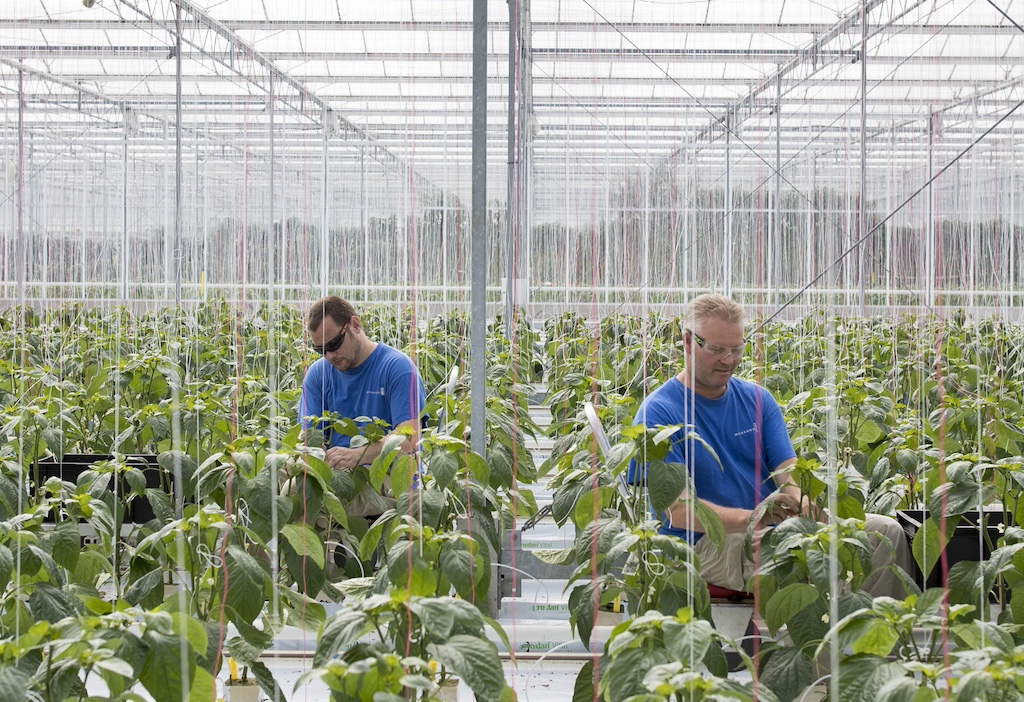
From seed to fertilizer, from data flows to logistics, the global food system has been consolidated into the hands of a small corporate core. (Jasper Juinen / Bloomberg via Getty Images)

Interview by
Dora Mengüç

Today roughly 25 percent of the global population works the land. Their grueling labor feeds the remaining 75 percent.

The true magnitude of farmers’ importance reveals itself in moments of crisis. They are a keystone in a fragile global food system. If their work is jeopardized, the consequences will not be abstract.

The world’s food system is not only buckling under the climate crisis, wars, and logistical breakdowns; it is also suffering the long-accumulated structural fractures of the neoliberal agricultural regime. From seed to fertilizer, from data flows to logistics, the entire chain has been consolidated into the hands of an unprecedentedly small corporate core.

Just four corporations — Bayer, Corteva, Syngenta, and BASF — now control roughly 60 percent of the world’s commercial seed and pesticide markets, an unprecedented level of consolidation across the food chain. The seed — humanity’s foundational agricultural innovation — now sits under the guardianship of multinational corporations.

The seed is as vital as oil and water. Whoever controls it, controls the terms of agricultural production.

One of the clearest thinkers diagnosing this landscape over the past several decades is Pat Mooney, who has spent half a century studying agribusiness monopolies, biotechnology, seed patents, and the global food system. Jacobin recently spoke to Mooney about the roots of today’s crisis and what is at stake in how we grow and distribute food.


Dora Mengüç

To begin with, this crisis didn’t emerge overnight. It is the product of deep historical accumulation. Without tracing the roots, we can’t fully understand where we are today. How did the rise of global seed monopolies within the capitalist agricultural system evolve into a structural pressure that reshapes national sovereignty?

Pat Mooney

This has been growing for a very long time, nearly half a century. But especially in the last few years, it has accelerated dramatically. Even places like the Davos World Economic Forum openly admit — including the industry itself — that our economy is broken. The food economy is even more visibly fractured.

Relying on multinational corporations based in the US, Germany, Switzerland, or China for our seed supply — instead of farmers growing and saving their own seeds — is extremely dangerous. For the first time, on a global scale, there is consensus that we need strong local food systems within this broken global one. But multinational food and seed corporations say the opposite: “Depend on us. Trust our supply chains and our cloud-based technologies.”

We know that’s impossible.

Dora Mengüç

Once you look at sovereignty through the lens of seed control, it becomes clear that this is no longer just economic competition — it resembles territorial encroachment. Does the argument still hold that whoever controls the seed controls food, and whoever controls food determines political and economic independence? Is calling this a “silent occupation” an exaggeration?

Pat Mooney

I wish it were an exaggeration. It isn’t. Seed is the first link in the food chain. If you control the seed, you control the entire food system.

And that control now rests in the hands of four or five global corporations. They’ve consolidated not just seeds but the agricultural chemicals tied to them — and they’re pushing into other sectors of the food chain. Once this control is lost, your soil is effectively under occupation. You become dependent on external supplies, and they decide what you grow, what you pay, and how you sell it.

Dora Mengüç

This occupation is no longer limited to land — it has shifted into the digital realm. Data, algorithms, and cloud dependencies are becoming the new fences around agriculture. How is the merger of Big Tech and Big Ag — through digitalization, data monopolies, and AI — reshaping global food security?

Pat Mooney

Honestly, no one knows where this is going. Digital technologies have transformed everything rapidly in recent years. Artificial intelligence goes even further. I call it DNA + AI: the merging of genetics and artificial intelligence is creating unprecedented control over the food supply.

Eleven companies in the world are valued at over $1 trillion — nearly all of them tech giants: Amazon, Apple, Microsoft, Google. Even Walmart is now a digitized global food retailer. These companies are moving to control the technological infrastructure of the food chain.

This creates two major risks: One, we don’t know who will ultimately dominate the supply chain. And two, if these companies shift priorities, farmers could be abandoned overnight.

This poses enormous risks for global food security.

Dora Mengüç

That digital captivity reshapes markets, too — whatever happens in the chain eventually shows up in people’s wallets. How should we interpret rising food prices in an era of wars, climate crisis, and corporate concentration? Is this multilayered crisis a structural outcome of the capitalist food chain?

Pat Mooney

We all know food prices are rising — anyone who shops feels it. But who is profiting?

Fertilizer companies blame wholesalers; seed corporations blame fertilizer companies. When no one is left to blame, geopolitical crises are invoked: hunger in Sudan, devastation in Gaza, the war in Ukraine.

Dora Mengüç

You point out that wars and humanitarian crises often become convenient explanations — a way for companies to deflect attention from the profits made along the food chain.

Behind the price crisis, there is an ecological collapse silently advancing — the erosion of diversity. How does the loss of local and traditional seed diversity accelerate biological and ecological breakdown?

Pat Mooney

It’s extremely dangerous. Our food system needs far more diversity — it’s essential for surviving climate change. Corporations focus on essentially five crops. Yet farmers have domesticated around 7,000 food plants throughout history.

If we depend on just a dozen crops, we’re in serious trouble. The same applies to livestock and fisheries. Corporations prioritize a few species, but the world relies on far broader diversity.

Dora Mengüç

And some countries hold such immense genetic wealth that their dependency becomes a global risk, not just a national one. In a period when multinational seed companies are expanding rapidly, does the dependency of countries like Turkey, which holds some of humanity’s richest agricultural genetic pools, represent a structural rupture for the global food regime?

Pat Mooney

Turkey is a good example. When a country like Turkey becomes dependent on others, it poses a risk for the entire world.

Turkey is one of the planet’s major centers of genetic diversity for many staple crops. If Turkey loses its traditional varieties, both Turkey and the world are endangered. The first wheat varieties we grew in Canada, for example, originated in Turkey — a mix of Turkey, Poland, and India, but the starting point was Turkey.

So, the erosion of Turkey’s genetic diversity threatens global food security itself.

Share this article

Contributors

Pat Mooney is a member of the International Panel of Experts on Sustainable Food Systems, a cofounder and former director of the Action Group on Erosion, Technology, and Concentration, an ambassador for the International Federation of Organic Agricultural Movements, and chair of the Institute for Agriculture and Trade Policy.

Dora Mengüç is a journalist who previously served as news manager at Sözcü TV and has worked across major newsrooms for more than two decades. He is currently a correspondent for Deutsche Welle and writes internationally for outlets including Le Parisien Matin.

Filed Under