In the West Bank, Farmers Are Under Israeli Attack

Israel routinely confiscates what it calls uncultivated Palestinian land. In the West Bank towns of Beit Furik or Beit Dajan, farmers who refuse to be driven from their territory are subject to constant attacks by armed settlers and the Israeli army.
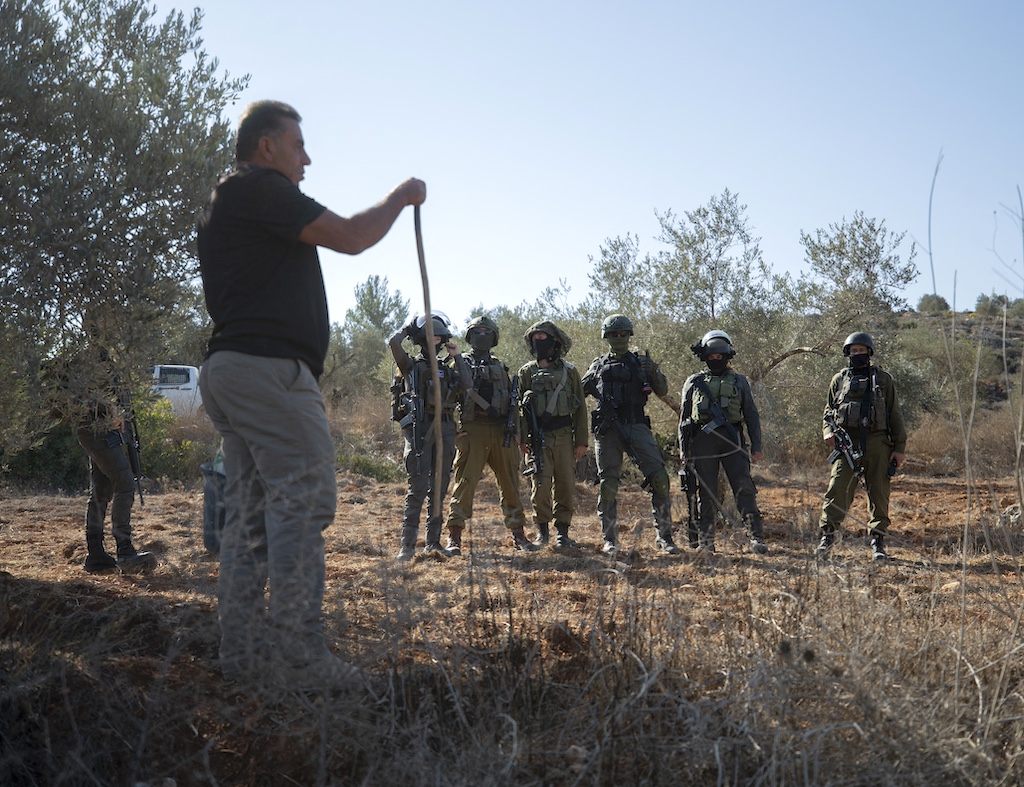
A Palestinian man stands near Israeli soldiers during the olive harvest in a village south of Nablus in the occupied West Bank. (Wahaj Bani Moufleh / Middle East Images / AFP via Getty Images)

Among the hills in the valley southeast of Nablus lives a community of around 28,000 Palestinians, residents of the small towns of Beit Furik and Beit Dajan. The area can be accessed through a single checkpoint, often manned not just by the Israeli army but also by settlers. Both towns are surrounded by settlements: the three largest rise on the surrounding hilltops, interspersed with military outposts. At least three other, smaller settlements made up of mobile homes have also sprung up without warning, sometimes just a few hundred meters from Palestinian houses.

The area is divided according to the Oslo Accords: the urban centers fall under Area A, part of the agricultural land under Area B, and most of the territory under Area C. The latter area, covering roughly 16,000 dunams (1,600 hectares), has been entirely seized by settlers and the military since October 7, 2023, depriving Palestinian communities of most of their farmable land.

“Israel has an internal law according to which if Palestinian land is not cultivated for more than ten years, it’s declared state land and confiscated. The problem is that settlers often prevent us from reaching it for long periods of time, so it remains uncultivated not by our choice,” explains Fares Nasasrah, mayor of Beit Furik. “Very often they don’t even respect the ten-year deadline, or they don’t consider animal grazing as a legitimate use of the land,” he adds.

This was the fate of Area C, which included the surrounding hills where shepherds used to graze their flocks and collect akoub, a wild plant used in traditional Palestinian cuisine. Beyond losing their main source of subsistence, over the past two years the towns have also lost jobs: thousands of residents who previously worked in Israel are no longer allowed to enter the Jewish state.

To endure, the municipal council created a circular economy system based on cultivating fields that were previously used only for seasonal harvests, such as wheat, and for grazing livestock. “To address these two problems” — the confiscation of much of the agricultural land that sustained the communities, and the economic and employment crisis — “we tried to kill two birds with one stone. In the span of two years, we reclaimed almost the entire valley in Area B and brought it into production. We try never to leave the land unattended, to prevent settlers from occupying it,” Nasasrah continues.

Fares Nasasrah, mayor of Beit Furik. (Courtesy of Annaflavia Merluzzi)

They built hundreds of greenhouses, established organic farms producing strawberries and seasonal vegetables, and above all created jobs for around eight hundred people who had been left unemployed. “After the war, I found myself jobless and with a family to sustain. Even though I had never worked the land, I had inherited knowledge about cultivating it — it is in our tradition, and this job transition felt very easy and natural to me,” explains H., a farmer working in a tomato greenhouse.

As for akoub, which grows only in the flora of the northern West Bank highlands, after October 7, 2023, Palestinians in the north realized they might no longer be able to access the plant. “So, seed nurseries were created in areas near Jenin and Tulkarem. We buy them from the Tulkarem refugee camp and plant them here; in a few months we’ll begin to see the results,” says M., a farmer who before the war worked as a laborer on Israeli construction sites. As a second job, he used to gather akoub in the hills; now, together with his son, he cultivates it in the fields of Beit Furik.

“We have a circular economy. We’ve managed to reabsorb the workforce into the community and direct the profits from the land back internally; whatever remains, we sell in nearby markets,” the mayor explains. The main challenge when they launched the project was irrigation. “We didn’t have enough water, nor an adequate system to distribute the amount needed for the dunams we wanted to cultivate.” Initially, the land was served by two underground wells built by residents about three years ago, “but last summer, settlers and soldiers filled them with cement.”

Together with PARC (the Palestine Agricultural Development Association), the independent union of Palestinian farmers, they raised funds and built a new pipeline system to irrigate the fields. “We now have two cisterns that together hold 500 cubic meters of water. They are the main target of settler attacks — because they know that destroying them would jeopardize the entire project.”

A second obstacle for the municipalities of Beit Furik and Beit Dajan was electricity. “We could only buy it from Tel Aviv, which barely supplied us with 1.25 megawatts per hour, when our actual need is 6 to 7,” Nasasrah explains. “And whenever there’s an overload on the Israeli grid, the first to have their power cut are Palestinian villages — it’s happened to us very often.” So, together with private investors, they built solar panel fields. “At the moment we have three sites and can supply the community with 4 megawatts per hour. We’re almost self-sufficient.”

However, this model of resisting through agriculture remains constantly under attack. Since October 7, 2023, more than seven hundred people have been injured in raids by the army and settlers. In dozens of cases, the injuries resulted in permanent disabilities. “In the past two years, there have been eight martyrs,” all killed with expanding bullets, banned by the Hague Convention back in 1899. These munitions, he says, “cause extreme suffering — we witnessed their deaths knowing how much pain they were in.”

“Settlers come down into the countryside daily and prevent farmers from working, often firing shots into the air and forcibly driving them away,” Nasasrah explains. Over the past two years, they have recorded sixty-seven attacks resulting in serious damage to people, agricultural equipment, and natural resources. The army, meanwhile, enters the village almost every day with platoons and tanks, even though its urban area lies in Area A, nominally under the civil and military administration of the Palestinian Authority.

On January 4, “without any reason, they began firing tear gas and chasing young people through the streets.” The previous evening, settlers and soldiers together attacked the community of Khirbet Tana, in Area C belonging to Beit Furik, forcibly evicting twelve families and detaining two youths, who were later released.

The local council in Beit Furik established organic farms producing strawberries and seasonal vegetables, creating jobs for around 800 people who had been left unemployed. (Courtesy of Annaflavia Merluzzi)

To avoid the land being confiscated, residents have not just maintained a constant physical presence but also attempted to register property with the Israeli Civil Administration. “But ownership certificates aren’t enough — you have to provide an enormous amount of documentation that’s very hard to obtain. They try to bury us in bureaucracy to discourage applications. Still, we don’t give up, and for some plots we’ve managed to get recognition.”

“The problem isn’t only the violence we endure but also the isolation they impose on us,” he continues. “During the war between Israel and Iran, they closed the checkpoints, preventing anyone from entering or leaving for three full days.” For this reason, too, they had to create a circular economy capable of ensuring food and water for the two communities — without relying on the outside world. “We lived with the constant fear of starving if the army decided to keep us sealed off for too long,” the mayor says.

The climate of terror in which they live “is deliberately created to make us abandon our project — they attack farmers through their means of survival.” In November, fifty farmers were arrested and four of them were held for “a couple of days, just to intimidate us.”

Fortunately, these small communities can count on the support of many local and international nongovernmental organizations. “Through the Italian organization ACS (Association for Cooperation and Solidarity), and other NGOs, we launched a home gardening project to ensure that nearly all families — even those living in town who don’t work the land — always have a source of food.” Hundreds of homes will have small, cultivable gardens, tended by women “who don’t go into the countryside out of fear of settler violence, and when they do, they can only work for a few hours and return home at first light.”

The women of Beit Furik are also going to be organized into a cooperative and provided with a stable and farm animals. “We’re trying to implement a form of women’s empowerment, working as well with feminist organizations like the Psychosocial Counseling Center for Women,” Nasasrah explains.

And he concludes: “A fundamental part of Palestinian identity is the bond with the land. We try to turn it into a principle of nonviolent resistance — one that allows us to continue living in our homes, in the valley where we grew up, enjoying the fruits that belong to us.”