Trump Tips the Scales in Honduras
Donald Trump’s meddling in Honduras’s national election aims to return the disgraced party of the narcotrafficking ex-president Juan Orlando Hernández to power.
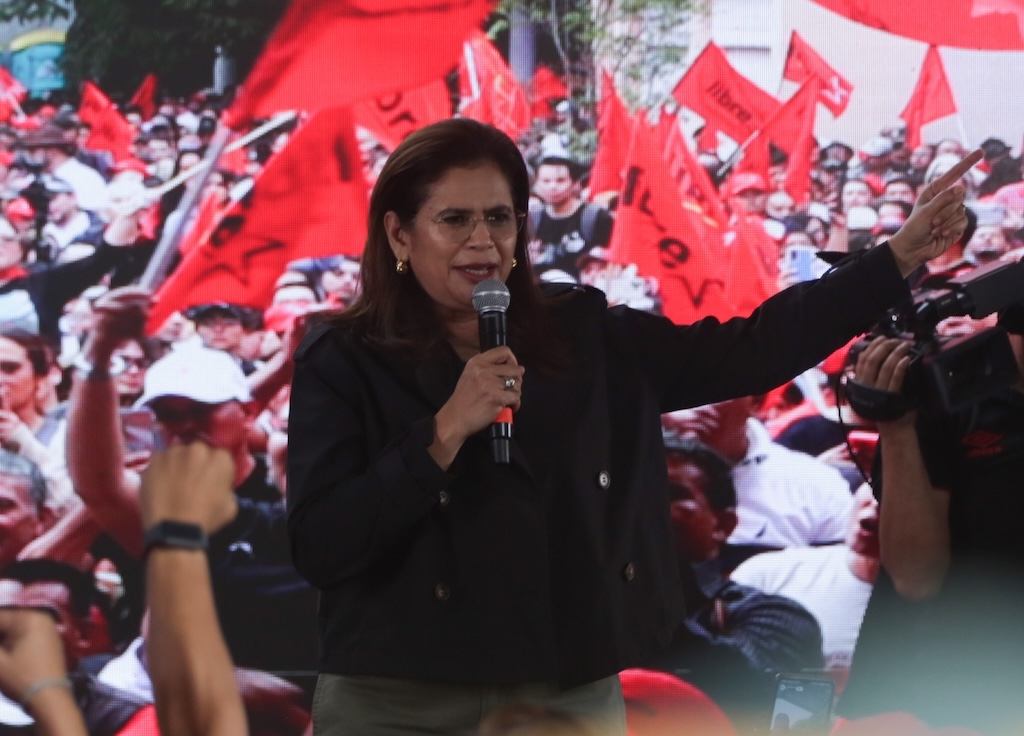
Honduran president Xiomara Castro speaks as dozens of members of the Liberty and Refoundation Party (Libre) enter the Presidential Palace following a call to action by Castro, who denounces what she describes as interference in the Honduran election by US president Donald Trump, in Tegucigalpa, Honduras on December 17, 2025. (Emilio Flores / Anadolu via Getty Images)
- Interview by
- Doug Henwood
Three weeks after Hondurans went to the polls in November, a winner has yet to be announced. In an election marked by irregularities, Donald Trump’s intervention before the polls opened in November was the most bizarre.
Trump’s last-minute enthusiastic backing of the far-right Nasry Asfura over the conservative Salvador Nasralla, propelling him from a dark horse into a credible candidate, came with threats to cut off US aid to the country. And just two days before polls opened, Trump pardoned former president Juan Orlando Hernández of Asfura’s disgraced National Party, who had been sentenced to forty-five years in prison for trafficking cocaine into the United States.
Doug Henwood had the Progressive International’s David Adler and Matt Kirkegaard on the Behind the News podcast to explain the preliminary results of the Honduran elections and how they fit into the US government’s renewed commitment to foreign intervention in the Western hemisphere. This interview has been edited for clarity. Subscribe to Jacobin Radio to hear future episodes.
The governing party is Libre, or Liberty and Refoundation, which refers to their founding ambition to bring new independence, a new constitutional order, after twelve years of dictatorship.
Many will remember the democratic elections in 2007, which brought to power President Manuel Zelaya, a former ranchero, a liberal figure who, in the course of his government, leaned more and more toward the sovereigntist, Latin Americanist pole that was at that time being led by Hugo Chávez and the ALBA bloc. That was very menacing to the Obama administration, for example, which saw that as a threat to their own doctrine of hemispheric dominance at that time. And that led to the United States’ passive support for a military coup in 2009 that forced Zelaya and his family to flee the country and that eventually put the National Party in charge.
I’m condensing a huge amount of history here. Many things happen in the course of those twelve years: selling off the country to crypto colonialists like Peter Thiel, the introduction of horrendous forms of deregulation, the plundering of the country, and, of course, the reprioritization of US military and economic interests.
Then, in 2021, Zelaya’s wife, Xiomara Castro, who at that time had become a leading figure in the force to recover the country’s democracy and to fight back against what was then very uncontroversially labeled a narco-dictatorship, won elections with a broad-front coalition to face off against the National Party, and they are the ones who’ve been governing for the past four years, not without problems of a divided legislature, not without problems of confronting foreign interests and such, but also with huge successes.
In the past year alone, Honduras has led the region in a 4 percent reduction of poverty, for example, alongside massive social programs and infrastructure development of housing, education, and the like. That was the record they were running on.
I’ll leave it to Matt to explain the profile of the other two candidates against whom Xiomara Castro’s party ran the former finance and defense Minister Rixi Moncada, a very credentialed, very serious candidate. She was facing off against two men in this election.
One is Salvador Nasralla from the Liberal Party and the other is Nasry “Tito” Asfura from the National Party. To start with Nasralla, the Liberal Party in particular is a sort of a catchall party. Traditionally, it’s been on the center or the center left of Honduran politics. And in fact, Salvador Nasralla was the candidate of the joint center and left wing in 2017. He was the vice president elected with Xiomara Castro in 2021 but then left the administration and became one of its greatest critics, and he’s viewed as a candidate that is up for sale, frankly.
His campaign was really oriented toward social media and toward the United States. At some of the rallies, his supporters would march with US flags. He attended the US congressional hearings on the elections last week and ultimately was rejected by Trump. Trump called him almost a communist.
Which is completely fanciful, right?
Completely fanciful. He belongs on the center right, if not just outright on the Right, as a candidate.
And of course, Trump then gave his endorsement to Tito Asfura from the National Party. And as David said, the National Party, which was in charge and in control after the coup in 2009 all the way through 2021, is a right-wing party, a machine party, a party with deep capacities to mobilize voters, even in rural areas, with narco-machine links. Those two candidates are now about neck and neck in the vote count, and we’ll see how it turns out.
Two questions here. One, if the record of the Liberal Party was pretty impressive, why did they do so badly?
A couple of things are important in explaining that that vote count. The first is that there’s a regional story that is important to tell alongside the national story in Honduras. Across the region, we have seen left-wing or progressive victories in countries as disparate as Chile and Brazil and Colombia and Mexico, a kind of second “pink tide,” as many would prefer to see it.
But the fact is that those victories have almost always come through a pact between left-wing forces who have taken the vanguard, oftentimes through a series of social mobilizations, oftentimes violent mobilizations, as we saw in the so-called estallido social that took over the streets of Santiago, Chile, took over the streets of Bogota, Colombia, took over the streets of Tegucigalpa, Honduras. You see the Left reclaim some protagonism but fundamentally rely, in an arithmetic sense, on a pact with liberal parties. What often happens is when that pact frays, as in the case of Honduras, liberals go their own way and face off against the Left. And the numbers are not there to compose the kinds of majorities that the Left would need to defeat the Right on its own, especially in the context of a country like Honduras, which, in contrast to others, doesn’t have a two-round runoff process — it’s just a straight shot. You get one go, and whoever wins in that first round, first-past-the-post style, is going to win it all. So there’s no room for a second-round recomposition of that left-liberal pact that has carried the country.
The second issue is more specific to Honduras. It’s just a very complex, very poor, very difficult country in which to mount a programmatic and developmentalist politics, and not just because it’s heavily astroturfed with US propaganda and mediatic problems, not just because of enduring structural dependencies.
For example, the headquarters of the US Southern Command is in the Honduran capital, and the outsize role, the hypertrophy, of US military and diplomatic influence on Honduran politics, and also the huge immigrant population of Hondurans in the United States, feed deep structural dependencies on the United States and lead Hondurans to feel menaced by the attack that Trump has led on Honduran migrants living there.
These things make it complicated to advance an anti-colonial, anti-imperial, or left-wing program and to be able to communicate it across a country that, like I said, is as complex and developmentally impeded as Honduras.
But there’s also, to be a bit self-critical here (Matt and I come from a position of institutional and personal sympathies with Libre and its project), we’re getting outgunned and outmaneuvered across the continent in terms of the TikTok-ification of politics, as the Right has become much more agile, much more competent in using social media platforms. As vacuous as the messaging may be, that’s where a lot of young people are signing on or watching these videos scroll past on their screens, and we are just less well-equipped with our flag-waving, street-filling, twentieth-century tactics to compete on an electoral terrain that has changed so much in such a short amount of time.
Now Asfura, who got the Trump endorsement, wasn’t doing so well until then. Why did Trump endorse him? What do you think?
Who knows!
That’s always the case with Trump, right?
That’s right. There are some theories. One possibility may be that if you have the possibility of endorsing someone fully in your camp or someone whose loyalty may be suspect, who formerly served in the government as vice president, why not go for the whole hog? That’s a possibility.
There’s also been some speculation that some of the lobbying firms connected to the National Party were campaign donors to Marco Rubio in the past, for example. It’s really hard to say. The United States has a deep relationship with the National Party in particular. It’s probably a mix of all these factors.
And what about the libertarian angle? The party has been running these libertarian experiments, charter cities, heavy crypto stuff. Did that have any effect? Peter Thiel and David Sacks are quite close to that tendency in Honduras.
In the course of that so-called narco-dictatorship that ran from 2009 to 2021, you saw the passage of legislation through a completely corrupt backdoor process that involved the then president basically evicting members of the Supreme Court to force through this legislation on the ZEDEs, the Zones for Employment and Economic Development, which essentially sold sovereign Honduran territory to these foreign corporations — in this case, California crypto corporations that wanted to make these free-floating libertarian paradise entities on the Mosquito Coast, on the island of Roatan in particular, where they began to build this thing called Próspera. When Libre came back to power in the free elections of 2021, when democracy was restored to Honduras, Congress voted unanimously to close the ZEDEs and to reclaim Honduran national territory.
That was deemed unconstitutional, and as a result Honduras was taken to the cleaners in secret arbitration courts in Washington, DC, to try to squeeze $11 billion, two-thirds of Honduras’s annual budget, out of Honduras as compensation for the so-called expropriation of the Próspera territory, which hadn’t even happened. Thus began a campaign of defamation against the government of Xiomara Castro as being somehow expropriationist and communist and all these kinds of things, but that also involved whispering in the ears of the MAGA clan. There was some uptake by the Democrats. You had the US trade representative at that time, Katherine Tai, speak out against the social investment climate in Honduras and its dangers. It wasn’t just a Republican thing, but it is true that Próspera made a pretty good bet through their former funder Peter Thiel to get in bed with the new Republican Party.
There’s much we don’t know, especially related to the most scandalous aspect of this whole moment in Honduran politics: Donald Trump’s exoneration of narco-dictator Juan Orlando Hernández, the former president of the National Party. Who exactly was whispering in Trump’s ear? Who exactly was convincing him that Tito was his guy? On what basis and in whose interests?
We know for sure that one of the lobbyists for Próspera — that crypto, colonial project on the island of Roatan — came before Congress a few weeks ago, before the election, to make the case that democracy was somehow under threat because of the government of Castro — very ironic, very Karl Rove turn-your-strength-into-your-weakness kind of moment — and we know that Joaquin Castro, for example, on the committee tried to push back on the credibility of these statements and the conflicts of interest there. But we just don’t know what happened yet.
These are the kinds of things that, in Trump world, oftentimes come out through people speaking too openly and frankly at Mar-a-Lago. So maybe later we will get a fuller account of the process that led to this series of drastic geopolitical moves that had such a profound influence on the trajectory of Honduran democracy. One would need to process-trace the precise influence that Thiel and Próspera and their lobbyists had in Honduras.
The reason why I’m hesitant to overstate this is because Honduras is like a colony — or, not to overstate this, I would say still a “tutelage democracy.” I mean, when you fly to Honduras, to Palmerola, you fly into a US military base. If you go to Tegucigalpa, it’s swarming with US military servicepeople. So it’s not like it’s only Próspera or only the Thiel crypto guys who are trying to use Honduras as a site of economic extraction or forward military deployment. There’s a wide range of interests that bring the attention of the White House and others to the electoral arena in Central America in general.
Now, why do you think Trump pardoned Hernández? And what effect did that have in Honduras?
Before the election I would have said that it was a major blunder, because it put JOH, as he’s known (JOH are Hernández’s initials), back in the spotlight and put the years of the narco-dictatorship, against which Xiomara Castro was swept into office in 2021, back into the spotlight.
At that point in 2021, during her electoral victory, she was playing a version of Frank Sinatra’s “New York, New York” as one of her campaign songs, alluding to the fact that Juan Orlando Hernández was going to be arrested and extradited to New York City on these drug-trafficking charges for which he was ultimately convicted. I think the Trump administration’s actions were ultimately a demonstration of power by the United States, and in an election where the United States had put its hand so firmly on the scales, as it has across the region, from Trump’s blackmail of Argentine voters to the possible impending war in Venezuela. This was just another way to demonstrate that the United States has control of the situation, and to show that even a completely disgraced, unpopular narcotrafficking president will be granted full clemency and that US interests reign supreme above all else. That signal was, I think, widely understood in the elections.
Several of the candidates, Nasralla in particular, alluded to the to the US armada off the coast of Venezuela and said, you know, look, if the United States thinks there’s fraud in Honduras, it’s possible that armada might just come over here and change things militarily. The shadow of the United States was completely omnipresent, as were the tweets and statements of Donald Trump. This was just the demonstration of US power and that they can do whatever they want.
Trump threatened tariffs and cutting off aid too, so he was really pulling out all the stops. And then, of course, his definition of electoral fraud is rather flexible, so his analysis of the honesty of this election will be very interesting to follow if his candidate doesn’t win.
We need to take a more regional perspective. It’s now become more démodé to speak about the Monroe Doctrine, its renovation and its reassertion, and I think that Honduras is a notch in the belt now. We’re watching unprecedented move after unprecedented move by the Trump administration, at least in the twenty-first century, like a $40 billion bailout for Argentina that saved Milei’s butt and guaranteed him a sweeping victory in the legislative elections.
Honduras is next. We’re seeing the United States tip the scales. Some of its strongest soldiers are still deployed out there to speak the language of free and fair elections while we’re the ones menacing them across the hemisphere. We have to see this as part of a broader plan that that is playing out across what they perceive to be a chessboard, across their “backyard.” I think that’s how they see it. One can only hope that the brazenness and the brutality of such an intervention and the hypocrisy of it — a guy, obviously, as Matt was saying, who’s leading a campaign against “narcoterror” in the case of Venezuela who’s just pardoned the most widely recognized narcoterrorist of the region and effectively brought his party back to power — could spark to life a movement to resist the Monroe Doctrine and reconstruct an anti-colonial bloc across the continent. But I wouldn’t want to get ahead of myself in predicting such a thing.
There were three major candidates. Who were they, and what parties and ideologies did they represent?