Trump’s Cynical Venezuela Saber-Rattling

Authoritarian leaders like to rally their populations against external threats, and Donald Trump has decided that Venezuela is a perfect candidate. So far, though, the public isn’t buying it.
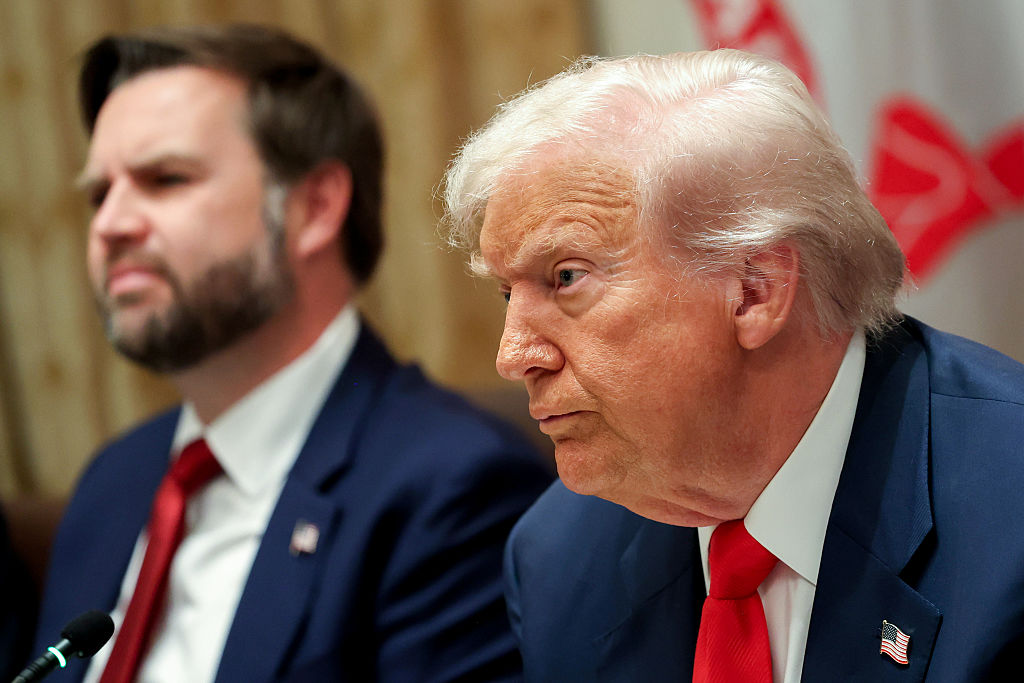
Donlad Trump’s brand of faux-populist authoritarianism requires an external enemy to complement his war against “the enemy within,” and he’s decided that Venezuela is a perfect candidate. (Alex Wroblewski / CNP / Bloomberg via Getty Images)

In a recent appearance on CNN, right-wing pundit Batya Ungar-Sargon defended the Trump administration’s policy of blowing up boats off the Venezuelan coast that it claims are carrying drugs. “Secretary of State Rubio has determined that these boats are carrying terrorists,” she said, “which makes the attacks on them legal.”

The idea that the executive branch can wave away all legal, moral, and constitutional obstacles to doing what it pleases by saying the magic word “terrorism” has been a depressingly standard one in recent American history. Ungar-Sargon’s framing on this point is basically indistinguishable from the kind of thing a bowtie-wearing conservative might have said in 2005 to justify the Bush administration’s policy of “enhanced interrogation” at Guantanamo Bay. But she followed it up with an attempt to give the Trump administration’s lawlessness a “populist” twist:

When working-class Americans in those forgotten Rust Belt communities where you have five kids who’ve overdosed and died, when they see him blowing up those boats, they feel like he sees their pain. They feel like somebody cares.

Reality check: All publicly available evidence shows that the drugs that cause overdoses in the United States don’t come from Venezuela at all. A small portion of the cocaine in America is Venezuelan but approximately none of the fentanyl. Nor is there even any evidence that a majority of Americans in the communities Ungar-Sargon is talking about believe that fentanyl is coming to the United States from Venezuela and thus “feel seen” when suspected Venezuelan drug runners (or random fishermen) are executed without trial. One recent poll shows that a whopping 70 percent of Americans are opposed to any “military action in Venezuela.”

The fact that Ungar-Sargon feels the need to combine her reheated “war on terror” talking points with rhetoric about “seeing” working-class people in the Rust Belt, though, says a lot about the strange domestic politics of Trump’s intervention in Venezuela.

Trump still wants to posture as a populist enemy of the Deep State. But he’s as desperate to topple Venezuela’s Nicolás Maduro as George W. Bush was to topple Saddam Hussein, and he’s willing to use all the tools neoconservatives fashioned in the 2000s. Trump’s brand of faux-populist authoritarianism requires an external enemy to complement his war against “the enemy within,” and he’s decided that Venezuela is a perfect candidate.

“Our Own Hemisphere”

In 2023, when then-senator J. D. Vance endorsed Donald Trump, Vance praised him for having supposedly broken from the “hawkish” policies of his predecessors and “kept the peace” during his first term.

Even then, that assessment required memory-holing quite a bit of what happened in the first Trump administration. Now that Vance is the vice president and his boss is pursuing an unabashedly hawkish policy in Venezuela, blowing up Venezuelan ships based on unfounded claims of “terrorism,” and openly contemplating a regime change war, Vance has to walk a very strange rhetorical tightrope. On Tuesday, he complained that “we’ve been told for decades the US military must go everywhere and do the impossible all over the world,” but “the red line for permanent Washington is using the military to destroy narco terrorists in our own hemisphere.”

In Vance’s mind, it seems, military aggression justified in the name of an open-ended right to wage war against terrorism and aimed at regime change in a country that’s never attacked the United States is a terrible thing when it happens in the Middle East — but it’s completely fine in “our own hemisphere.”

Unless the vice president is concerned about how much gasoline our bombers and warships will have to burn on their way to battle, it’s unclear why it should make a difference that what was previously done in Iraq and Afghanistan is now being done in the Western Hemisphere. And you’d have to know very little about the history of American foreign policy to think that asserting US dominance in Latin America represents some bold break from the preferences of “permanent Washington.”

The Domestic Politics of Trump’s Warmongering

All authoritarian leaders benefit from having an external enemy to rally their supporters against as they try to consolidate more power at home. But in principle, that enemy could have been China or Iran. They certainly didn’t select Venezuela because anyone in the White House seriously believes it’s where the fentanyl sold in the United States originates. Sometimes it almost feels like they threw a dart at a map of the world.

Even so, it might make a difference to Trump and his movement that the enemy they’ve selected is in Latin America.

Part of the reason is surely that Venezuela is an oil-rich nation. And the presence of powerful figures, like Marco Rubio, who come from South Florida and are ideologically fixated on countries like Cuba and Nicaragua, explains a lot about how an attack on Venezuela ever came to be seriously considered. But we also can’t disentangle the domestic politics of the choice from MAGA’s core priorities.

As Trump tramples constitutional rules and sends troops to blue cities, his rhetoric has become increasingly consumed with fulminations against “the enemy within.” This is a flexible concept, incorporating everyone from pro-Palestinian protesters to lone-wolf assassins to otherwise milquetoast Democrats who raise concerns about his mounting authoritarianism. The core of “the enemy within,” though, is the population of undocumented workers he’s targeted with theatrically cruel deportation sweeps and those progressives who infuriate him by protesting the deportations.

During last year’s election, he was already conflating the “invasion” by unauthorized immigrants with the fentanyl crisis, even though 86 percent of people arrested for smuggling fentanyl are American citizens and more than nine out of ten seizures “occur at legal crossing points or interior vehicle checkpoints, not on illegal migration routes.”

Trump needs to merge the immigration issue with the fentanyl issue, though, so he can sell his cruelty as a justifiable emergency measure to stop an existential threat. And it gets even easier to justify authoritarian encroachments when you merge the hysteria about immigrants and fentanyl with war against a “terrorist” external enemy — especially one that’s in the same general part of the world as the immigrants.

The good news is that, so far at least, it doesn’t seem to be working. Again, only 30 percent of the public is currently on board with intervention in Venezuela. Right now, the fentanyl cover story is a bit too absurd, and it’s a bit too obvious that, far from breaking with “permanent Washington,” Trump and Vance are selling precisely the same bill of goods as previous generations of warmongers, who have always told us that the next war will be different from the one before that, and the one before that, and the one before that.

None of this means that Trump might not get his regime change. It just means that this provocation could easily develop into a deeply unpopular war that will fail miserably in the goal of rallying the public behind domestic authoritarianism. The whole thing might fall flat, causing the administration to lose even more momentum. There’s some comfort in that. But if history has taught us anything, it’s that we shouldn’t underestimate the damage that can be done by unpopular leaders prosecuting unpopular wars.