Trump Needs War to Distract From His Domestic Failures

Donald Trump is making the United States’ affordability crisis worse and suffering historically low approval ratings. He is likely hoping wars abroad will divert the public’s attention from his domestic policy failures.
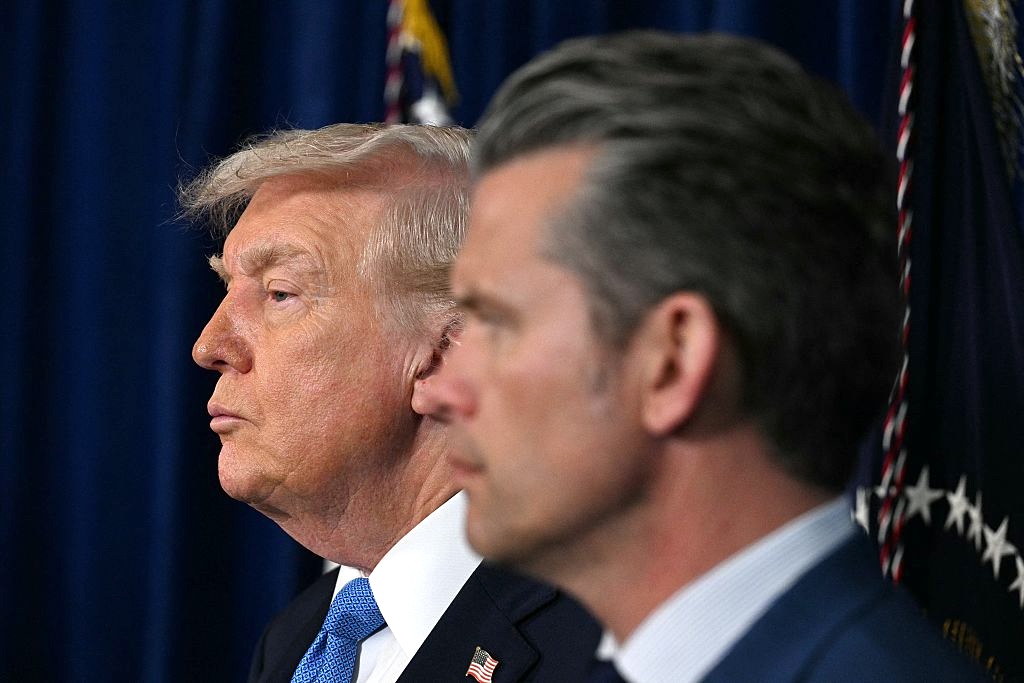
War appears to be a one-size-fits-all solution to all of Donald Trump’s problems. (Jim Watson / AFP via Getty Images)

This month, Donald Trump bombed Venezuela, kidnapped its president, and threatened Cuba, Colombia, Greenland, Mexico, Venezuela (really the whole Western Hemisphere), and Iran with military force. Last week, Trump said he’s going to propose a $1.5 trillion military budget next year, as Congress prepares spending bills that would give him $1 trillion this year.

The warning signs have always been there with Trump. We’re now seeing the beginning of what those signs were warning against. War is no longer just part of Trump’s political agenda; war is his political agenda. It’s a one-size-fits-all solution to all of Trump’s problems. Or so he hopes.

War Is Trump’s Answer to the Affordability Crisis

Foreign policy starts at home. For Trump, home is where his biggest political problem lies. The Jeffrey Epstein investigation looms large, but even that isn’t as massive a political liability as the affordability crisis, a major factor in his historically bad approval ratings. He’s desperate for a distraction.

I’m not about to argue that there’s one issue solely responsible for Trump going all in on neoconservative aggression. There are many relevant factors, evidenced by Trump transparently fighting a war for oil companies in Venezuela, the performative aspect of his broader foreign policy, and the long-standing status of the United States as an imperial power. Rather, my argument is that wars abroad can distract from problems at home, that this function is Trump’s intent, and that it’s a key part of the administration’s strategy. We’re witnessing a violent, cynical act of political self-preservation.

Trump is using war to divert the public’s attention away from his inability to govern. Here are three reasons why.

1) Trump Has Failed to Address Voters’ Top Concern

Affordability — the trendy term for economic security, referring to one’s ability to reliably make ends meet — is deteriorating in the United States, and it has been since roughly early 2022. It’s been voters’ top concern for about as long. In July 2022, YouGov added “inflation/prices” as an option in its near-weekly survey on what issue Americans say is the most important. This analog for affordability immediately became the most popular selection. Analyzing the polling data, I reported last month that US voters had ranked affordability as their top concern for forty-one months straight. It’s now been forty-two consecutive months.

If voters had no longer had a problem affording increasingly high costs, they wouldn’t still rank it as their top concern. But since they do, they do. The polling data’s message is that Trump has failed to fix the issue most responsible for his 2024 election victory, and one he campaigned heavily on. Pervasive insecurity at the human level — including economic insecurity and food insecurity, particularly among the working class — was once Joe Biden and Kamala Harris’s greatest political liability. Now Trump owns it.

2) Trump Has No Plan to Fix the Affordability Crisis

Trump has no credible solution to the affordability crisis, a fact the administration tacitly admits from time to time. For example, the latest annual report on food insecurity from the US Department of Agriculture (USDA) was quietly released last month, covering 2024. (It was supposed to be published in October, but it was delayed due to the government shutdown and presumably the 18,000 layoffs at the USDA.) The study found that forty-eight million Americans live in food insecure households, or 14.4 percent of the population — a 32.1 percent increase over 2019. Food insecurity is the highest it’s been in over a decade.

The Trump administration is so confident they’ll be able to fix the rising hunger problem that they not only canceled the next annual food security report but every one thereafter, claiming that they (the reports) “do nothing more than fear monger.” Unless Congress intervenes, the USDA will not provide a study later this year revealing the effects of further fraying the social safety net during an affordability crisis. Convenient, considering the Big Beautiful Bill’s sizable social welfare cuts, particularly to SNAP (formerly, Food Stamps).

3) Trump Is Making the Affordability Crisis Worse

On January 1, enhanced Affordable Care Act (ACA) Marketplace subsidies expired, thereby doubling monthly health insurance premiums for roughly twenty million people. Two days later, Trump launched his attack on Venezuela.

The type, timing, and sequence of these events so perfectly exemplify my argument (that Trump is using war to divert the public’s attention away from his inability to govern) that I feel like they almost undermine it. The lapse in welfare followed by a dramatic escalation in warfare is a parody-level illustration of my point. After all, I’m not implying direct causality, but in that particular case, the Trump administration seems to be.

However, that exaggeration is closer to the truth than naively arguing that the affordability crisis has no bearing whatsoever on Trump’s escalation in Venezuela and seemingly everywhere else. That would be like saying it’s purely a coincidence that the one pandemic-era policy Democrats managed to keep alive all this time (at least until recently) — after promising to make many of them permanent — is the one that sends tens of billions of dollars each year to health insurance companies.

The expiration of the enhanced ACA Marketplace subsidies marks the official end of the pandemic welfare state, illustrated below. Notice how relief policies overlap in 2021? Now look at 2021 in the food security graph above — welfare expansion in 2021 produced a record drop in hunger, despite the economic recession. (The United States also shrunk its military budget and ended a forever war in 2021.)