Behind Trump vs. Powell Is a Battle Over US Empire’s Future

After the 2008 crisis, the US set up a vast financial network offering liquidity to its allies. The ongoing clash between Jerome Powell and Donald Trump is partly about the future of this system and which vision of American empire it will promote.
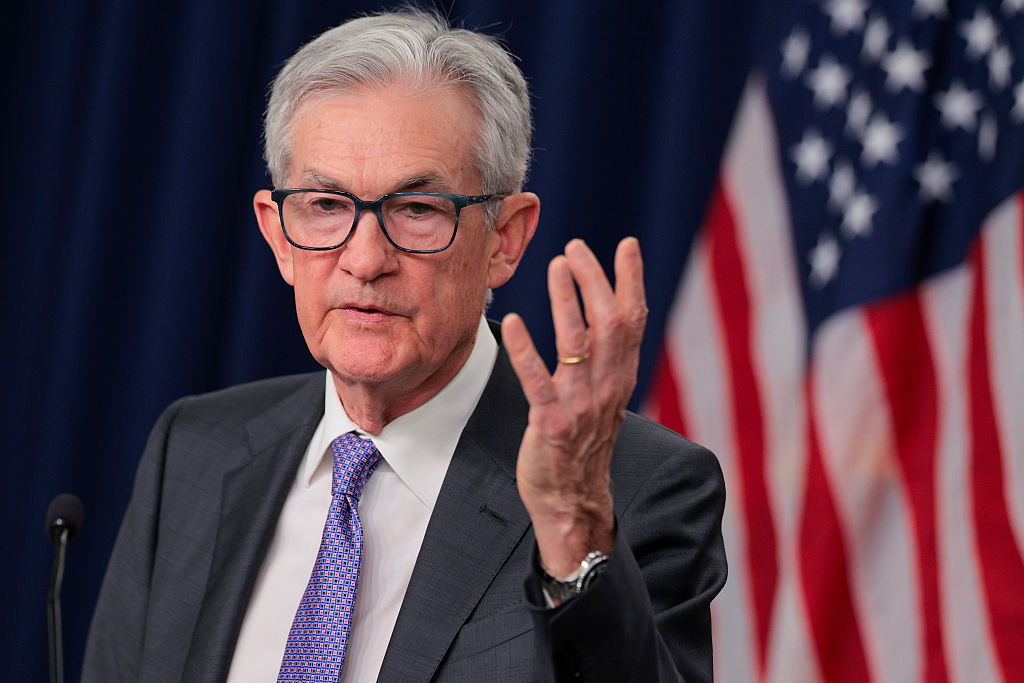
The clash between Donald Trump and Jerome Powell is a contest between a technocratic and an authoritarian vision of American empire. The Fed put itself at the center of a vast global financial system, and now Trump wants to weaponize it. (Chip Somodevilla / Getty Images)

On January 11, the Department of Justice announced that it was opening a criminal investigation into Federal Reserve chair Jerome Powell over charges that he had misled Congress about the cost of refurbishments to the Fed’s headquarters. There is little reason to view these investigations as anything other than a politically motivated attack. Documents shared with the Financial Times reveal that the Fed chair had written to Congress about cost overruns in July, and there is thus far no evidence that the Justice Department attempted to contact Powell to address these issues before launching a criminal investigation.

Seen in the context of Donald Trump’s first year in office, the charges against Powell are part of a broader campaign of lawfare against political enemies or liberals who hold positions that the president would like to see filled by allies. But this is the first time that criminal charges have been brought against a sitting chair of the Federal Reserve. In this respect, concern about the erosion of democratic norms is not unfounded — Trump’s actions are truly unprecedented.

At 7 p.m. on January 11, just hours after the Department of Justice’s Jeanine Pirro announced her investigation, Powell took to the Federal Reserve’s social media accounts and posted a two-minute video in which he set out to expose the president’s real, political motivations. Trump, Powell said, was frustrated that the Fed had not lowered interest rates fast enough, and he was willing to undermine the institution’s independence to get his way.

This confrontation, much like Trump’s attempt in August 2025 to fire Fed governor Lisa Cook, encouraged observers to interpret the current moment as emblematic of the wider struggle, between liberal defenders of the rule of law and a mafioso president, that has defined Trump’s first and second terms in office. This framing should be resisted. Not only does it obscure the stakes of the conflict, but it also sanitizes institutions like the Fed that are every bit as guilty of antidemocratic excess as Donald Trump.

A Clash Between Two Powers

Rather than being a clash between democracy and authoritarianism, the standoff between Trump and the Fed is one between an imperious US president and an independent bureaucratic agency that sits atop of the global financial system. As Powell alludes to in his recent statement, the US president wants to control US interest rate policy. Stephen Miran, whom Trump first appointed to chair the Council of Economic Advisers and more recently to fill a vacated seat on the Fed’s Board of Governors, has been tasked with implementing a new trade and currency policy framework that appears to center around other countries paying for continued access to “US public goods” such as its security and financing arrangements.

Recognizing the Fed’s key role in providing the world with dollars, the Trump administration has set out to transform the institution by exerting influence over its decision-making and, potentially, its domestic and international operations. Trump’s most recent attack on the Fed has concentrated the minds of central bankers who manage the global financial system. On January 13, Christine Lagarde, president of the European Central Bank, and other central bankers published an ECB statement expressing “full solidarity” with Powell and defending central bank independence along with democratic accountability.

The system that these central bankers are rallying together to protect is one that was assembled after the 2008 global financial crisis. Since then, the New York Fed has developed a close-knit infrastructure with fourteen foreign central banks. In this two-tiered swap line system, five foreign central banks are assured unlimited dollar loans when in need. Second-tier central banks — which include those of Brazil, Mexico, and Singapore — have more limited access (capped at either $30 or $60 billion) to dollar loans. (Borrowing dollars through a Fed swap is cheaper and stabilizes countries faster than borrowing from the International Monetary Fund — which is where most other countries go when faced with a currency crisis.)

Swap lines involve central banks exchanging equivalent amounts in their currency for dollars — this maintains a respectable veneer of reciprocity. The Powell Fed also institutionalized a new Foreign and International Monetary Authorities repo facility that provides foreign central banks with the ability to sell their holdings of US treasuries for cash.

Weaponizing the Dollar

When Russia launched its war on Ukraine, it was this intermingling of interests that compelled Europe to immobilize about €210 billion worth of Russian reserves in its jurisdiction. The bulk of Russian assets are held in Belgium, at the leading international securities depository known as Euroclear. Long considered a safe location to store dollar-denominated deposits outside of the United States’ jurisdictional reach, Belgium found itself in the crosshairs of an extraordinary tussle. The country potentially faces enormous costs from lawsuits — several have been filed in Moscow — accusing Euroclear of violating sovereign immunity protections extended to foreign reserves. Europe resisted pressures by Biden administration officials to confiscate the principal amount on the immobilized Russian securities and to transfer the proceeds to Ukraine. But it did pass new laws to enable the revenues generated by Russia’s frozen assets to be channeled toward funding Ukraine.

These very same foreign central banks first resisted but ultimately caved to US pressure that required them to flout the neutrality of financial infrastructures. The reason they have taken a stance against the US executive office this time around is because their own financial lifelines are at stake. The signers of the ECB document head institutions that have been the beneficiaries of the Fed’s vast and generous dollar liquidity program.

Figure 1. (Mona Ali / Jacobin)

Trump’s takeover of the Fed threatens to upturn the global wealth defense complex — its tiered swap line facilities (Figure 1). The Fed’s arrangements with fourteen foreign central banks, with standing and unlimited credit lines given to central banks from the Group of 10 (G10) nations, have assured these banks in times of financial emergencies.

Leveraging Financial Power

Central bank independence can be debated ad infinitum. What isn’t debatable is that the Fed is the custodian of more than $3 trillion worth of securities in foreign official and international accounts. These holdings of foreign and international assets (published weekly) have been trailing downward from $3.31 trillion on March 19, 2025, two weeks before Trump’s Liberation Day, to $3.06 trillion on January 7, 2026. The Fed also holds in its safekeeping between a half to one trillion dollars (depending on varying valuation estimates) in foreign-owned gold. Given Trump’s threats on the Fed, the managers of these monetary reserves are probably strategizing about where to move these stockpiles.

Russia’s assets have been frozen in Europe since 2022. On December 19, 2025, after intense campaigning and compromises, Ursula von der Leyen, president of the European Commission, announced that its members had unanimously decided against using Russia’s frozen assets as collateral for new funding for Ukraine. Instead, countries agreed to pursue new debt issuance to collectively support a €90 billion loan for Ukraine. The loan would be backstopped by the unused portion of Europe’s common budget. These are small steps that may contribute to Europe’s monetary evolution. But in fact, European willingness to expand its debt horizon is in large part thanks to Trump threatening that he would have the United States leave NATO unless Europe contributed more to its own security arrangements. (This led to NATO’s European members agreeing to commit to spending up to 5 percent of their GDP on defense expenditures.)

(A week before the momentous European Council decision in December, von der Leyen had announced that the European Union would seek to indefinitely extend sanctions on Russia, effectively immobilizing Russia’s assets until the war on Ukraine is over. This motion, which relied upon enacting economic emergency powers under Article 122 and required the vote of a qualified majority, also passed on December 19. Russia’s immobilized assets in Europe will only be returned if it pays war reparations to Ukraine.)

Europe’s actions on this front have not only been catalyzed by Trump’s withdrawal of financial support for NATO and Ukraine but also, more recently, by his peace plan, which critics have described as a concession to Vladimir Putin because it recognizes Crimea, Luhansk, and Donetsk as Russian. Threatening to bulldoze previous arrangements, Trump seeks US control over Russia’s frozen balances. According to his twenty-eight-point plan, Russia’s frozen assets are to be allocated into two fund pools: one of the pools will allocate $100 billion in immobilized cash balances to rebuild Ukraine, with half of the proceeding profits going to the United States. In addition, the proposal calls for Europe to donate the same amount to the Ukrainian fund. The remainder of the fund, as the US plan envisions it, will be a joint US–Russian investment fund for Russia.

Missed Opportunities

Seen in this wider context, Trump’s clash with Powell is not devoid of irony. The full-scale mobilization of global financial infrastructures to retaliate against Russia’s invasion of Ukraine was a project of the Biden administration in which the United States led the largest plurilateral sanctions campaign in history. But now the Trump administration has launched an assault on the US Fed, the nerve center of the global dollar system.

Policies that seem straight out of the Biden administration’s bucket list — from price controls to buffer stocks to curtailing stock buybacks — have already been announced by President Trump and Scott Bessent, his Treasury secretary. Trump’s comeback lays bare the abject failure of the Biden administrations to deliver economic democracy despite the political openings produced by the wave of protests in 2020 and the pandemic.

In contrast to the previous administration, the Trump administration appears to have grasped what was explicitly spelled out by John Maynard Keynes in his foreword to The General Theory’s German edition, published in 1936. Keynes wrote that expanding aggregate production and employment — what we now call Keynesian policies — would be easier to carry out in a “total state.” Keynes clarified that this is why he called it “a general theory.” At the time, the Nazis were in power. World War II, which indeed gave birth to Keynesianism in practice, was just three years away.

By attacking the Fed chair whose term is about to end in May, Trump has inadvertently made the process of stacking the open positions at the Fed’s governing body with his own choices more complicated. Bessent had tried to stop Trump from investigating Powell last year for this very reason.

It is a small irony that once again a US president will have sown doubt about that aspect of American power — its assurances of dollar liquidity to rich nations — that is the source of its hegemony overseas. If Miran and Trump’s plans to remake the global financial system succeed, it is possible that those most affected by the loss of the Fed backstop will be America’s closest, and most powerful, allies. Without the protection of unlimited liquidity provided by the United States, these foreign central banks may have to impose greater discipline on their own financial sectors. Viewed abstractly, this could lead to positive developments. But as a technocratic order collapses into totalitarianism, they may be easily missed amid the chaos.