The Fed Is Quietly Bailing Out Wall Street

The Federal Reserve has quietly delivered nearly half a trillion dollars to Wall Street with few strings attached over the past few months. These cash infusions could signal instability in the broader financial sector.
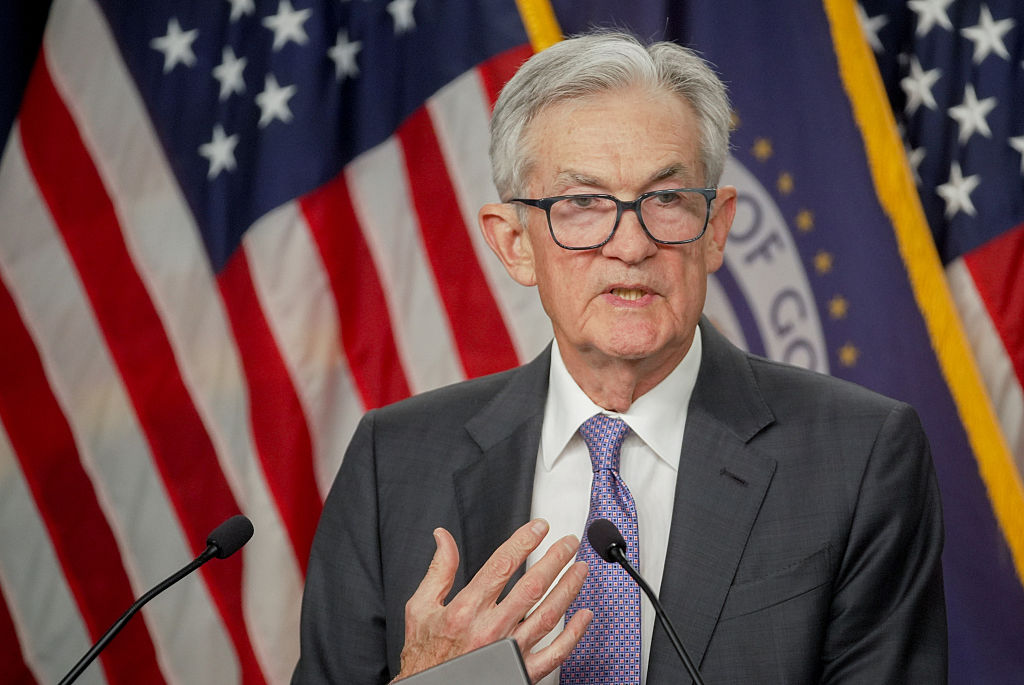
The New York Federal Reserve has recently delivered a series of major cash transfers to Wall Street. (Al Drago / Bloomberg via Getty Images)

The Federal Reserve has quietly delivered nearly half a trillion dollars to Wall Street with few strings attached over the past few months through an obscure government financial program intended for banks struggling to make cash payments.

These cash infusions could signal instability in the broader financial sector — and come as the central bank is besieged by potentially market-rattling turmoil following the Trump administration’s launch of a criminal investigation into Federal Reserve chair Jerome Powell.

The New York Federal Reserve, a regional branch of the larger central bank that works to maintain the country’s financial stability, kicked off the new year by dumping nearly $97 billion into the banking sector since December 31, 2025.

The move is the latest in a series of major cash transfers the New York Federal Reserve has recently delivered to Wall Street.

The infusions began with an $11 billion transfer on June 30. In October, the transfers became much more frequent, culminating in a massive $50 billion infusion on Halloween, as first reported by investigative news outlet DCReport. In total, after doling out little to no money since July 2020, the New York Federal Reserve has transferred more than $420 billion to Wall Street in the past seven months — a record amount from the program.

For comparison, that lump sum is nearly equivalent to the pot of money that Congress passed to bail out the banks during the 2008 financial crisis under the Troubled Asset Relief Program.

Amid the deluge, the central bank has encouraged Wall Street to make use of the program and lifted its $500 billion cap on such transactions, meaning there is no limit to how much banks can borrow to meet their cash liquidity needs.

All of these cash infusions — issued through an arcane and newly restructured division of the New York Federal Reserve branch — amount to some of the largest cash bailouts since the COVID-19 pandemic sent shock waves through financial markets in 2020.

Experts argue that this uptick in Federal Reserve lending could indicate that banks do not have the liquid cash on hand to make payments and dole out loans. But the circumstances driving those transactions — and whether they signify broader financial turmoil — remain unknown. It’s unclear, for example, which banks received the funds, since that information is kept secret for two years to help protect the institutions’ reputations.

“Without more information, it’s impossible to say whether this is a good big deal or a bad big deal [that] regulators are getting banks to use liquidity facilities or . . . if the financial system is under stress,” said Todd Phillips, a former senior attorney at the Financial Deposit Insurance Corporation, a federal agency that oversees the banking sector.

In an email sent to the Lever after publicationthe New York Federal Reserve said the large infusions were routine activities and disputed the idea that they might indicate looming market disruptions.

“[These] are temporary short-term loans to assist in funding operations . . . they are a market functioning tool, primarily used to support effective monetary policy implementation and interest rate control,” wrote a bank spokesperson.

“It’s a Moral Hazard”

The cash infusions are intended to provide additional liquidity to banks that are short on cash so they can continue extending lines of credit to the public and businesses.

These infusions, called repurchase agreements, are a form of short-term lending in which the Federal Reserve trades cash in exchange for assets, usually Treasury bills and mortgage-backed securities, as collateral from the banks. But according to critics, the money has instead frequently ended up in the hands of hedge funds and other financial firms, which often use it to make risky bets on various securities and derivatives that can be more profitable than ordinary loans.

“It’s a problematic signal that markets are using the liquidity for reasons that are not part of the intention of providing liquidity in the first place,” said Phillip Basil, a director at the consumer advocacy group Better Markets. “That’s the problematic thing about this, [banks] end up using [the funds] for just financial market transactions, instead of allowing it to flow to more productive places.”

If banks are tapping the Federal Reserve’s repurchase agreement operation to cover their losses from poor financial decisions, that could encourage further risky financial behaviors.

“Financial firms have learned and are just kind of expecting that anytime something bad happens, the Fed is going to bail them out . . . it’s a moral hazard,” said Phillips.

Banks usually first turn to the private markets when they need cash to make payments on loans and for lending purposes. But higher interest rates for private repurchase agreements have led to a recent slump in the industry, so the New York Federal Reserve stepped in and encouraged banks to instead use its in-house repurchase agreement provider, offering more favorable rates than those available in the private market.

While this practice was previously only used for emergency circumstances, the central bank in 2021 turned the operation into a “standing repo facility” to expand its lending even in noncrisis periods and “support smooth market functioning.”

Historically, banks have been reluctant to use the Federal Reserve for short-term lending unless they’re desperate because it can send a signal to the market that the institution is short on cash. Over the past year, the Federal Reserve has tried to break that stigma by urging banks to utilize the system. Federal Reserve economists believe the policy acts as a relief valve to keep interest rates within their target margins.

“With the steady decline in the level of reserves, we have observed upward pressure on [repurchase agreement] rates at times in recent months,” New York Federal Reserve president John C. Williams told the New Jersey Bankers Association on December 15. “When this occurs, the Fed’s standing [repurchase agreement] operations can act as a shock absorber by capping pressures on money market rates resulting from strong liquidity demand or market stress. I fully expect that standing [repurchase agreement] operations will continue to be actively used in this way.”

While the recipients of these infusions aren’t immediately disclosed, the considerable size of the recent repurchase agreements suggests that one or more of the largest banks in the country are likely involved.

Financial analysts writing for DCReport suggest the massive cash infusion could be an effort to shore up the billions of dollars that some major banks have lost from shorting precious metals. The commodity’s price has soared to historic levels thanks in part to technology- and defense-sector demand, leading to massive losses for those who had bet that prices would drop.

“Highly Negative Consequences”

President Donald Trump has long tried to exert more control over the Federal Reserve, an independent banking regulator whose top official is appointed by the president and confirmed by the Senate.

During his 2024 presidential campaign, Trump said the president should have a say in setting interest rates and other economic matters. Then, last March, after Trump took office, the president began publicly pressing the Federal Reserve to lower interest rates to help stimulate borrowing and economic activity.

In August, the Trump administration accused Federal Reserve governor Lisa Cook, who helps set interest rates, of mortgage fraud and referred the matter to the Justice Department. Later that month, Trump tried to remove Cook from her position, but the Supreme Court allowed her to remain in her position at least until it hears arguments on the matter on January 18.

Now the Trump administration has launched a criminal investigation into Powell, the Federal Reserve chairman who sets policy on interest rates and other economic matters, over whether he lied to Congress about the agency’s $2.5 billion renovation of its Washington, DC, office.

On Sunday, Powell released a statement claiming the probe is likely an attempt to pressure him and other high-ranking Federal Reserve officials to lower interest rates.

A number of former Federal Reserve officials, including Alan Greenspan, Ben Bernanke, and Janet Yellen, called the investigation an “unprecedented attempt” to undermine the Federal Reserve’s independence and warned that “This is how monetary policy is made in emerging markets with weak institutions, with highly negative consequences for inflation and the functioning of their economies more broadly.”

This article was first published by the Lever, an award-winning independent investigative newsroom.

Share this article

Contributors

Luke Goldstein is a reporter with the Lever. He is an investigative journalist based in Washington, DC, who was most recently a writing fellow at the American Prospect and was with the Open Markets Institute before that.

Freddy Brewster is a reporter with the Lever. He has been published in the Los Angeles Times, NBC News, CalMatters, the Lost Coast Outpost, and more.

Filed Under