The War on Inflation Is a Class War
Federal Reserve chair Jerome Powell recently warned that the United States was at risk of stagflation, a combination of high inflation and economic slowdown. When this happened in the 1970s, capitalists used the crisis to attack organized labor.
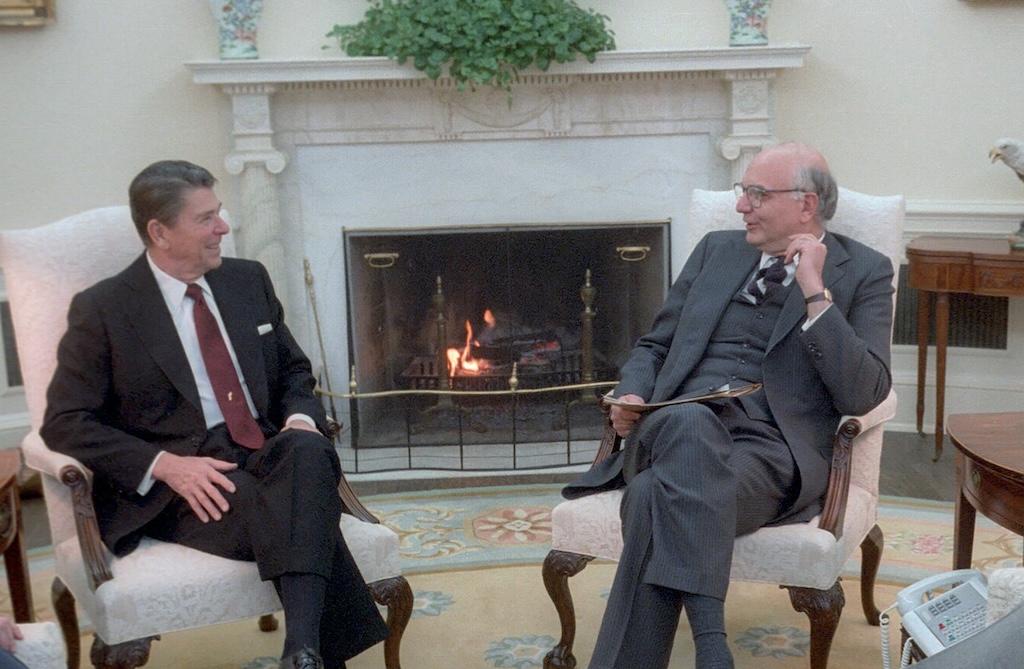
Fed Chair Paul Volcker meets with Ronald Reagan in the Oval Office to discuss monetary policy on December 14, 1981. (Reagan White House Photographs / Wikimedia Commons)
In his May 2025 quarterly announcement, Federal Reserve (Fed) chair Jerome Powell warned of the rising risk of stagflation, a dreaded combination of high inflation and unemployment. Mainstream thinkers characterize stagflation as a “calamitous anomaly” to be fixed through monetary tweaks, but there are other approaches.
The dominant economic model from 1958, dubbed the Phillips curve after Keynesian economist A.W. Phillips, maintains that inflation and unemployment have an inverse relationship. As the economy grows, employment increases, which in turn raises demand and then prices. But stagflation — a situation in which prices rise while growth stagnates — breaks with this logic.
In the 1970s, the stagflationary crisis that rocked the United States came as a surprise to many mainstream economists who had accepted the dominant view. But a post-Keynesian and Marxist tradition has long held that stagflation is a recurring feature of capitalism. Now that we might be at risk of facing a similar crisis today, their ideas are worth revisiting.