On “Liberation Day,” Trump Signed America Up for Stagflation
Yesterday Donald Trump announced sweeping tariffs on all of America’s trading partners, with the explicit aim of “liberating” the US from unfair trade. Not only are these efforts confused, they will lock America in a cycle of stagnation and inflation.
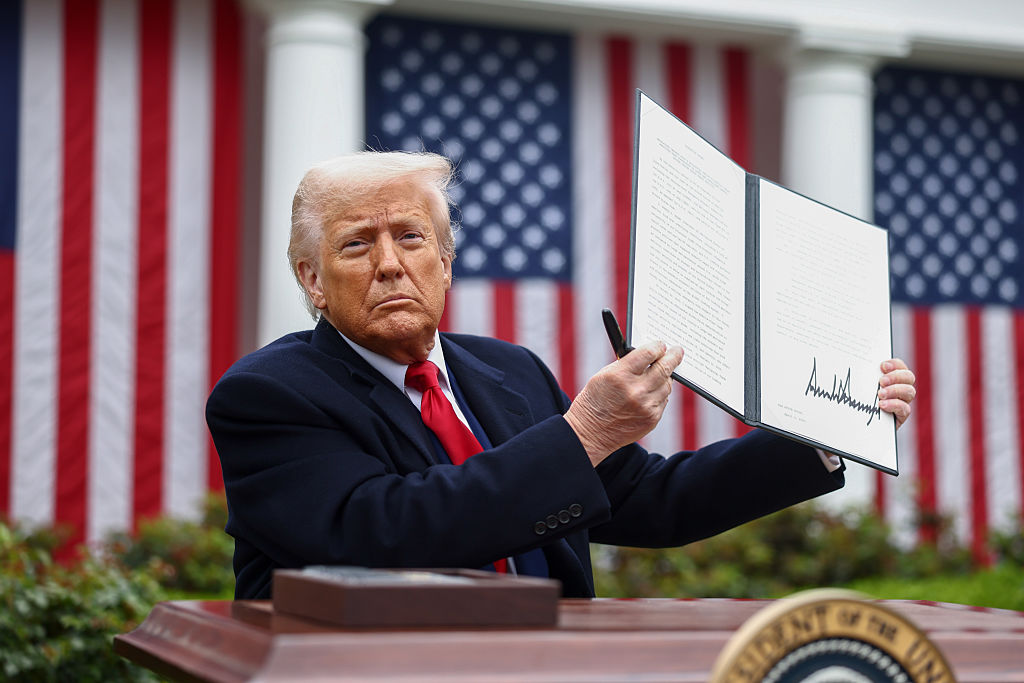
President Donald Trump displays a signed executive order during a tariff announcement in the Rose Garden of the White House in Washington, DC, on April 2, 2025. (Jim Lo Scalzo / EPA / Bloomberg via Getty Images)
Yesterday Donald Trump announced what amounts to a dramatic escalation of the trade war initiated during his first term. Addressing a crowd of auto union workers at a Rose Garden event at the White House, the president revealed the details of his plan to reset the United States’ relationship with its trading partners, framing his tariffs as a “declaration of economic independence.”
He began his speech with what amounted to a fever dream of American victimhood. Lamenting the “unilateral economic surrender” of his predecessors in the Oval Office, he decried being “looted, pillaged, and raped by friend and foe alike,” who “got rich at [America’s] expense” by way of “undervalued currencies,” “stealing our intellectual property,” and instituting “unfair rules and technical rules.” These trade barriers, whether tariff-based or not, were to be broken down. This effort would “supercharge the domestic industrial base,” while allowing the United States to pay down its national debt and reduce taxes.
The historical record, of course, begs to differ, though economic history does not seem to be Trump’s forte. At one point during his address, the president opined that the United States was “proportionally the richest” between 1789 and 1913, when trade barriers were in place, and that the Great Depression of the 1930s would have not occurred as it had if the ultraprotectionist 1930 Smoot Hawley Tariff Act had stayed in place longer.