Europe’s Liberation 80 Years On: Yugoslavia and Albania
The Western Balkans was the only place in Europe where resistance movements defeated the Nazis without having to rely on Allied troops. Any progressive future for the region will have to build on the proud legacy of this mass liberation struggle.
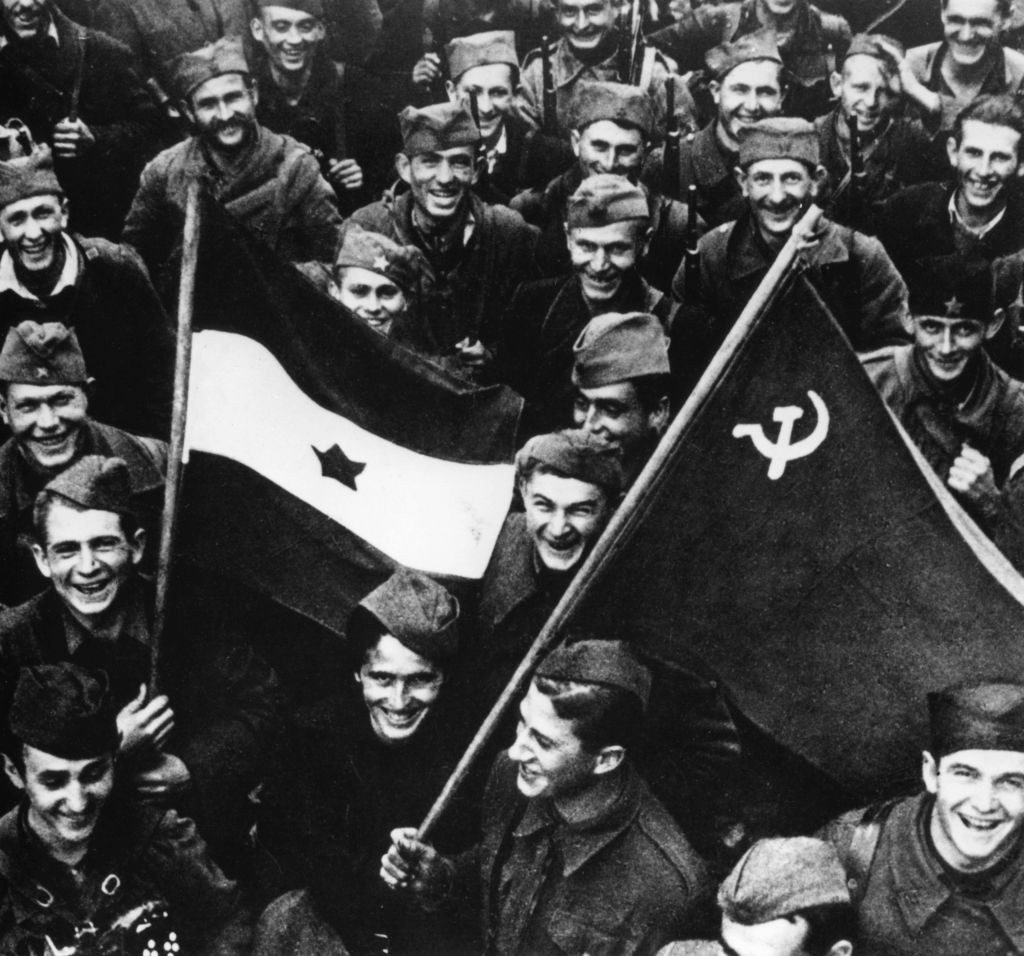
The liberation of Belgrade, Serbia, October 1944. Jubilant Russian troops and Yugoslav partisans mingle on the streets. (Art Media / Print Collector / Getty Images)
Over the past eighty years, Albania and the states that formerly comprised Yugoslavia have experienced a roller-coaster ride through history — victory over the Nazis, revolutionary change, construction of socialism, transition, and restoration of capitalism. That experience will inform remembrance of liberation from Nazi Germany, which is marked by several countries in the region on May 9.
Perception of the anti-fascist legacy in the Balkans is a complex topic. People are mostly preoccupied with existential concerns and lack the interest or privilege to engage in historiographical debates. Remnants of the anti-fascist legacy are everywhere, yet decades of revisionism have erased from collective consciousness the fact that the freedoms we still enjoy were built on the blood of the partisans.
Legacies of Resistance
Balkan forms of socialism had their own contradictions and ultimately collapsed due to both external and internal factors. These contradictions are also felt in today’s perception of the anti-fascist legacy. While socialism was the greatest modernization project ever seen in this region, it simultaneously gave rise to a privileged bureaucratic class, the so-called red bourgeoisie.