The Same Enemy Is Driving Protests Across the Balkans

In Serbia, the connivance between politicians and multinational capital has fed a sustained protest movement. Current protests in Albania, resisting a luxury development project backed by Jared Kushner, target a similar cronyish capitalism.
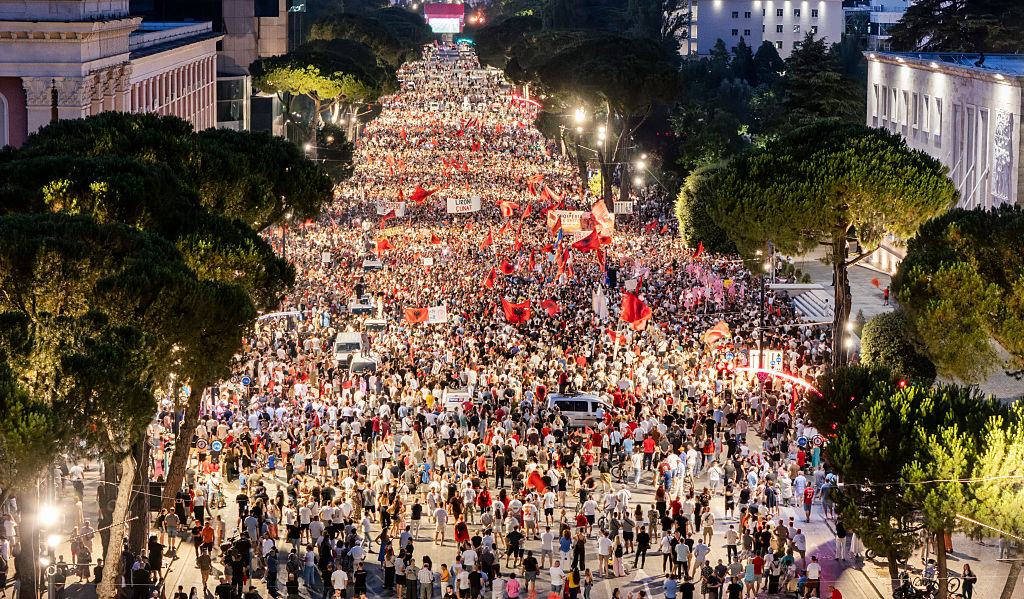
A drone view shows thousands of demonstrators gathered in central Tirana during the thirty-fifth consecutive day of protests against a proposed luxury tourism development project linked to international investors, including Jared Kushner, in Tirana, Albania, on July 4, 2026.

A drone view shows thousands of demonstrators gathered in central Tirana during the thirty-fifth consecutive day of protests against a proposed luxury tourism development project linked to international investors, including Jared Kushner, in Tirana, Albania, on July 4, 2026. (Vlasov Sulaj / NurPhoto via Getty Images)


I’ve been following the recent protests in Albania but from a particular angle: as a participant in a similar wave of mass protests in Serbia. In 2024, I got three months of death threats after I published a scholarly article exposing controversial economic data related to a German-backed lithium mining project that threatened to tear up the Serbian countryside. Since some of the threats were written in German and followed a visit by that country’s then Chancellor Olaf Scholz, the case drew international attention. It is still under United Nations investigation and was covered by the Guardian, which helped draw attention to the massive statewide protests and subsequent repression in Serbia at the time. Previously, I was involved in internationalizing Serbia’s lithium struggles, linking activists and local communities from Portugal, Chile, Spain, Germany, and elsewhere with those in Serbia under what became known as the “Jadar Declaration.” It was these international links that triggered the threats in my case.

So, there’s good reason to speak up about what’s happening in Albania after the last month of protests against a destructive luxury resort project backed by Jared Kushner. Surely, not everyone shares this view. Decades of nationalism and war have created deep divisions between Serbia and Albania. Yet there are important similarities. Both governments are currently facing backlash from their citizens over ties to foreign-led development projects. This marks a shift in both countries: citizens are no longer identifying with their own states. Instead, both societies are experiencing a growing divide between citizens and state structures, which repress their own populations in defense of projects led by US and other global elites.

Like Serbia, Albania has experienced brain drain. It lost more than a million citizens through migration during the post-1991 transition to capitalism. Official UN estimates suggest that over 43 percent of the population now lives abroad. Both countries face mounting environmental conflicts, while political opposition is either ineffective or, in Albania’s case, sometimes aligned with extractive industries, while trade unions remain weak. Both countries are also becoming increasing focuses for US capital. Already prior to the Zvërnec luxury resort scheme, Kushner was involved in a real estate project in Serbian capital Belgrade proposing redevelopment of the General Staff Building — a partially destroyed site, until now preserved as a memorial to the 1999 NATO bombing. Plans to transform the site into a luxury development, reportedly linked to the Trump network, provoked public outrage and led to the project’s withdrawal.

Kushner’s trajectory in the Balkans is emblematic of a broader transformation of US hegemony in the region, which some have now dubbed “Trump’s Balkan doctrine.” In Serbia, the United States was the third largest international investor in 2024 and signed a landmark Energy Cooperation Agreement with its government. In May, a previously announced €2.6 billion hydroelectric Đerdap 3 project was even publicized by the US Embassy in Serbia. Similar dynamics appear in Bosnia and Herzegovina, where American investments used to be €6.1 million in 2022. However, this is expected to surge, as the United States has brokered a €1.5 billion deal with Bosnia and Croatia to construct a liquefied natural gas (LNG) pipeline connecting the two countries — a key target for US LNG exports. The company set to do the construction is AAFS Infrastructure and Energy, a Donald Trump–linked US-based enterprise now officially endorsed by the Bosnian state.

The same approach is now changing Albania, where US investment previously rose from approximately $100 million in 2020 to over $300 million in 2023. This is also expected to surge, as the United States seeks to position Albania as an LNG hub through a $6 billion project in cooperation with Greece. Thus, US energy investments are changing the Balkans as a whole.

This is in line with the strategy encoded in the “Western Balkans Democracy and Prosperity Act” passed by the US Congress in October 2025. The same strategy features US attempts at removing Chinese and Russian influence and explains why, subsequently, Serbia’s Russian-owned oil sector has faced sanctions, contributing to supply instability and pressure on the national currency. This reflected a broader strategy of restricting energy flows among China’s partners, from Venezuela to Iran. In this context, the Balkans is now embedded in shifting patterns of US hegemony.

It is only within this context that Kushner’s $1.4 billion Albania project must be understood. And it is not without precedent: Peter Thiel has also expressed intentions to build a Mediterranean city populated by IT specialists and a racially exclusive elite, where capital is explicitly prioritized over democracy and human rights. The expansion of US capital in the region thus signals not only increased investment but also increased power over the Balkan states; a broader Pandora’s box of projects is emerging, some of which are deeply unsettling.

In fact, the Balkans are once again transforming into a site of geopolitical competition between major powers, potentially destabilizing Europe. This is another structural reason why intra-Balkans solidarity will become more widely important.

Citizens of Albania and Serbia are therefore justified in questioning whether their states function as agents of their citizens or as intermediaries for global capital, enforcing its conditions on their populations. The citizens of Bosnia are doing the same. Even though protests in Bosnia are still localized, in past instances they did spread across the country, as in 2014. In all three cases, the Balkan states increasingly appear as vehicles for foreign capital and its fantasy projects while repressing their own citizens.

Beyond the Fragments

Historically, the Balkans have been marked by fragmentation shaped by both national conflicts and competing external influences. These divisions have made the region vulnerable to extractivism. Overcoming them is thus essential if any pan-Balkan strategy — politically or economically speaking — is to emerge in response to what increasingly look like proxy resource conflicts.

Issues such as mining and ecological degradation transcend national borders and create material interests that can potentially be articulated across them without relying on the states that are backing devastating projects. In this sense, we are witnessing an opening in the region. Previously, isolated, nationally bounded movements were unlikely to succeed against transnational forms of power. For Serbia, Bosnia, and other Balkan countries to support Albanian protests is thus not only a moral claim but a strategic necessity.

If the Balkans is to avoid becoming another peripheral zone for elite megaprojects and a proxy for clashes between extractivist superpowers, we need to do more than think in terms of the nation-state. In fact, this also opens up space for rethinking the Balkans itself. Recently, the Regional Alliance to Defend the Nature of the Balkans, a network of over thirty organizations across the region that also includes the Alliance of Ecological Organizations of Serbia, expressed its full support for environmental activists, local communities, and citizens in Albania. There have also been limited instances of cross-border activism between Bosnia and Serbia’s local communities when it comes to the struggle against lithium mining. So, the perspective of integration, one might say, is opening up.

However, the obstacles to deeper society-wide cooperation remain substantial. Bosnia, Serbia, and Albania all have weak opposition forces that are unable to channel this energy or, in some cases, are even opposed to it. If a new political opposition emerges with an alternative vision, and if they can articulate it effectively — which the student movement in Serbia certainly had the potential to do in some regards — such cooperation could reshape the Balkans. At the very least, the current moment may be creating conditions for the Balkans to assume a new role.

Finally, we cannot ignore an old idea. The proposals for Balkan federation were conceived a hundred years ago out of the fear that the region as a whole might be subordinated — like the process that is currently under way. This confronts the Balkans with an alternative. The region may again become a resource colony, as many protesters fear. Or else it can avoid this fate by choosing the path of solidarity and mutual support. To do that, it has to recognize what’s at stake.