Balancing Union Support and Worker Control
To capture the surging pro-union spirit across the United States, unions must be prepared to support worker-led organizing without attempting to control it, writes former Starbucks rank-and-file organizer Jaz Brisack.
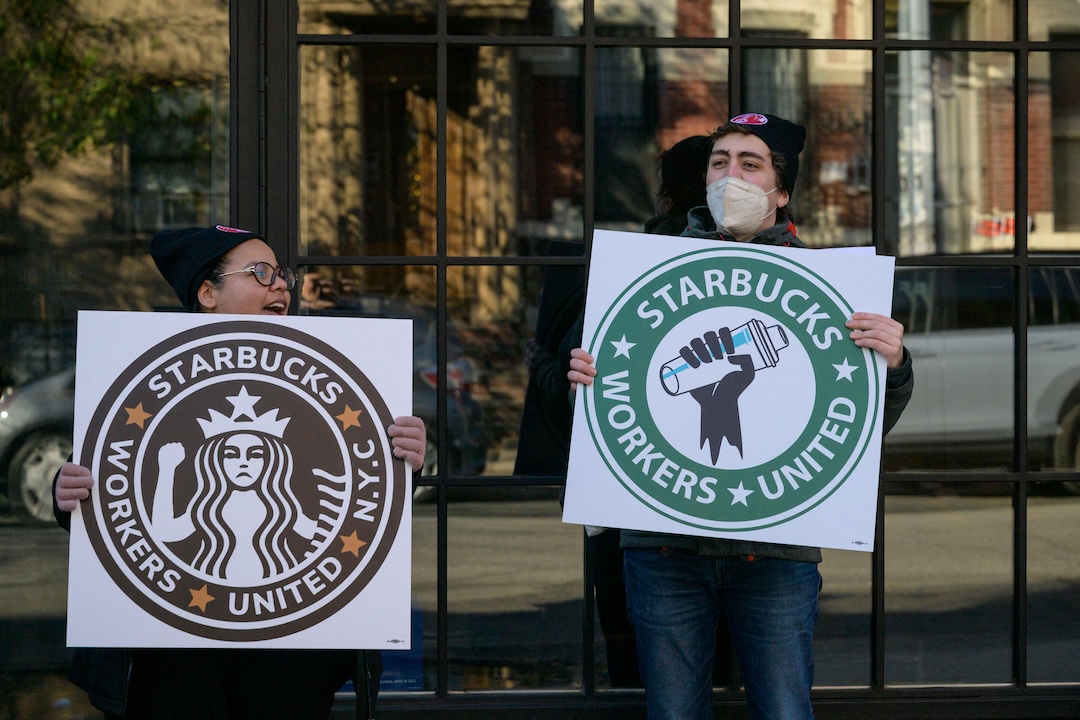
Starbucks workers strike outside a Starbucks coffee shop on November 17, 2022, in Brooklyn, New York. (Angela Weiss / AFP via Getty Images)
There is no doubt that the “worker-to-worker organizing” model outlined by Eric Blanc in his new book, We Are the Union, is key to union organizing success. Since 2018, my organizing mentor Richard Bensinger, the former AFL-CIO organizing director who has since helped workers organize at companies ranging from Starbucks to Canada Goose, has been kicking off Inside Organizer School trainings by declaring that there are two components to every successful campaign: a strong, representative organizing committee within the workplace; and a hammer — the leverage to force a company to recognize workers’ right to organize. Blanc’s book provides a deep dive into aspects of the former: how workers can take the lead on building vibrant and dynamic union campaigns at their workplaces.
Blanc writes, “Three things in particular define the new model: 1) Workers have a decisive say on strategy, and 2) Workers begin organizing before receiving guidance from a parent union, and/or 3) Workers train and guide other workers in organizing methods.” At times, this definition seems not only expansive but also paradoxical, encompassing everything from the Industrial Workers of the World (IWW)–affiliated Burgerville campaign in the Pacific Northwest to the new leadership of the United Auto Workers (UAW), who came to power through the efforts of a reform movement within the union. The terminology folds in just about every iteration of the recent labor upsurge, despite the significant differences between unions, campaigns, and approaches.
My own experiences as a union organizer — both as an external staff organizer on campaigns as varied as Tesla and Ben & Jerry’s, and as a salt at Starbucks, where I got a job as a barista to help start a union drive — have underscored the crucial importance of worker leadership, local autonomy, and harnessing the camaraderie of the workplace in order to withstand fierce union-busting campaigns. They have also highlighted the need for principled and strategic unions prepared to support worker-led organizing without attempting to control it, while helping win the right to organize through mobilizing the rest of the labor movement and the public around the fight.