How Useful Is “Worker-to-Worker Unionism”?
In his new book, labor scholar Eric Blanc offers illuminating case studies of recent union victories. But it’s not clear that “worker-to-worker unionism” amounts to a widely applicable “emergent model” of unionism that can save the labor movement.
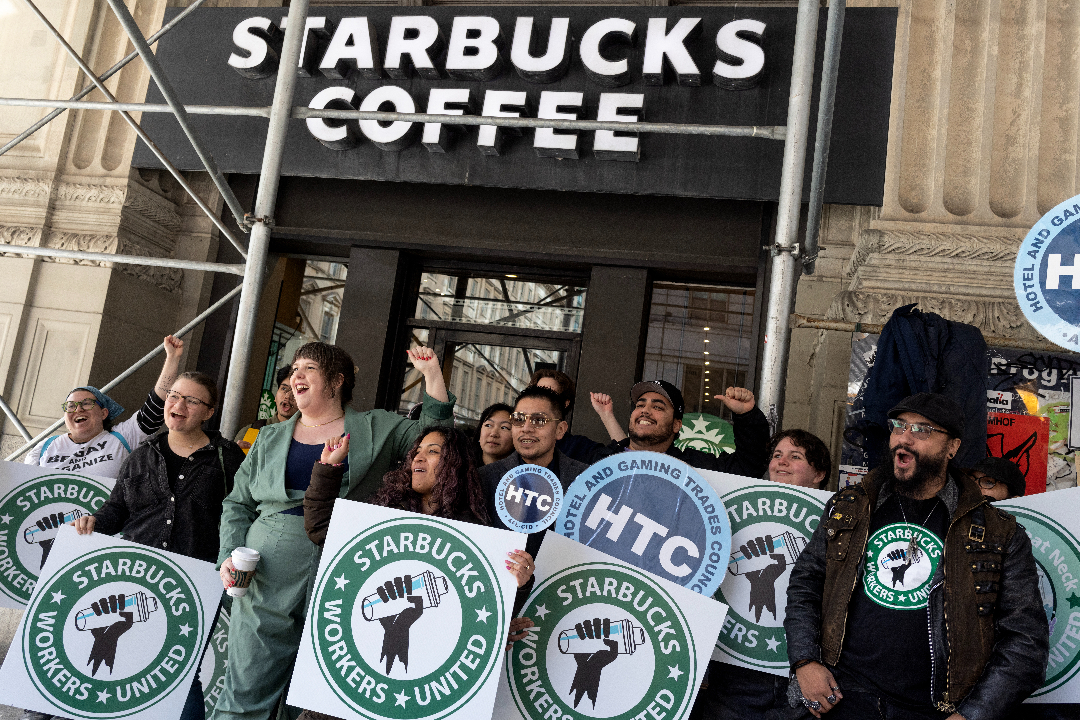
Starbucks union members and their supporters picket in front of a Starbucks store on February 28, 2025, in New York City. (Andrew Lichtenstein / Corbis via Getty Images)
In We Are the Union: How Worker-to-Worker Organizing is Revitalizing Labor and Winning Big, labor studies scholar Eric Blanc lays out the case for what he calls “worker-to-worker” unionism (W2W), a “staff-light” approach to organizing in which workers themselves lead campaigns through self-organization, being “workers’ best bet to win widely.” Through case studies illustrating the strengths of this “new model” of organizing, he demonstrates that W2W has already proven its mettle in winning not only unions but also first contracts. And by sifting through debates among labor strategists, he further argues that W2W offers the best “roadmap” for a labor resurgence in the United States, though he is careful to add that other fortuitous conditions are required for W2W to succeed — most of all, a serious investment of resources from organized labor.
The strength of We Are the Union is undoubtedly in its case study presentations. Blanc helpfully captures the stories and dynamics of successful campaigns that offer concrete examples of W2W, including those of the Burgerville Workers Union, Colectivo Collective, NewsGuild, and Starbucks Workers United. He’s able to do so thanks to extensive interviews with and surveys of organizing workers, snippets of which pepper his case presentations in illuminating ways. As with his previous Red State Revolt on the 2018 teachers’ strike wave, We Are the Union is a helpful resource for labor strategists and organizers seeking to understand the basics of the campaigns involved.
Useful as the case studies are, however, it’s questionable whether or not they add up to an “emergent model” of unionism that is widely applicable. Organized labor should indeed be seeding new organizing and cultivating worker self-activity in a way that gives workers agency and decision-making. But the “worker-to-worker” conceptualization does not point to much beyond this claim, which needs no new phrase to be expressed and is a far cry from anything that might resemble a “roadmap” for labor revitalization. More troubling, if we nonetheless follow Blanc in seeing the exemplary iterations of his proposed model as generalizable, more serious doubts about the viability of W2W emerge.