The Free Spirit of Germany’s Carnivals Is Under Attack
Carnivals in Germany have long satirized the powerful. Calls to keep politics out of the festivities are now being used to silence dissent.
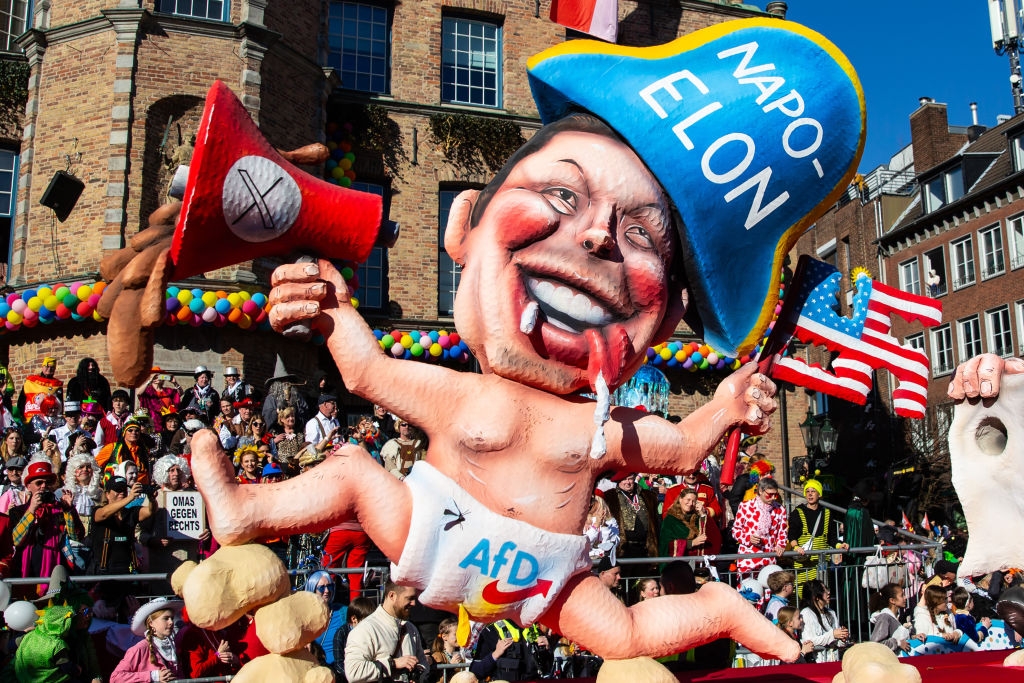
A Carnival float mocks Elon Musk, the German party AfD, and the United States during the annual Rose Monday parade on March 3, 2025, in Düsseldorf, Germany. (Hesham Elsherif / Getty Images)
Carnival celebrations in Germany’s Rhineland region are characterized by five things: Music, costumes, flowers, candy, and giant, handcrafted floats, many of which function as life-size political cartoons. On all fronts, this year’s festivities — concentrated in the cities of Cologne, Düsseldorf, and Mainz — did not disappoint.
One of the most eye-catching floats in February featured caricatures of Donald Trump and Vladimir Putin crushing Volodymyr Zelenskyy with the text “Hitler-Stalin Pakt 2.0” written on their arms: a reference to the Nazi-Soviet Pact of 1939, which paved the way for their partitioning of invaded Poland. Elsewhere, the US president was seen riding a carriage pulled by the Statue of Liberty, chained up and forced onto her knees.
Elon Musk — another prominent figure currently on German minds due to his support for the far-right Alternative für Deutschland (AfD) — was also featured. One float depicted him in a diaper bearing the party’s logo as well as a bicorne hat labeled “NAPO-ELON,” and another showed him and AfD leader, Alice Weidel, seated on a seesaw made of arms locked in perpetual Hitler salutes, Weidel raised high by Elon’s weight. Weidel also appeared in a float that turned her into the witch from “Hansel and Gretel,” handing swastika-shaped treats to unsuspecting children in shirts identifying them as “Erstwählers” or first-time voters.