Cyprus’s 50-Year Cease-Fire Hasn’t Brought Peace
In July 1974, the Greek junta carried out a military coup in Cyprus, followed five days later by a Turkish invasion. For 50 years since, the island has been divided, with no reunification in sight.
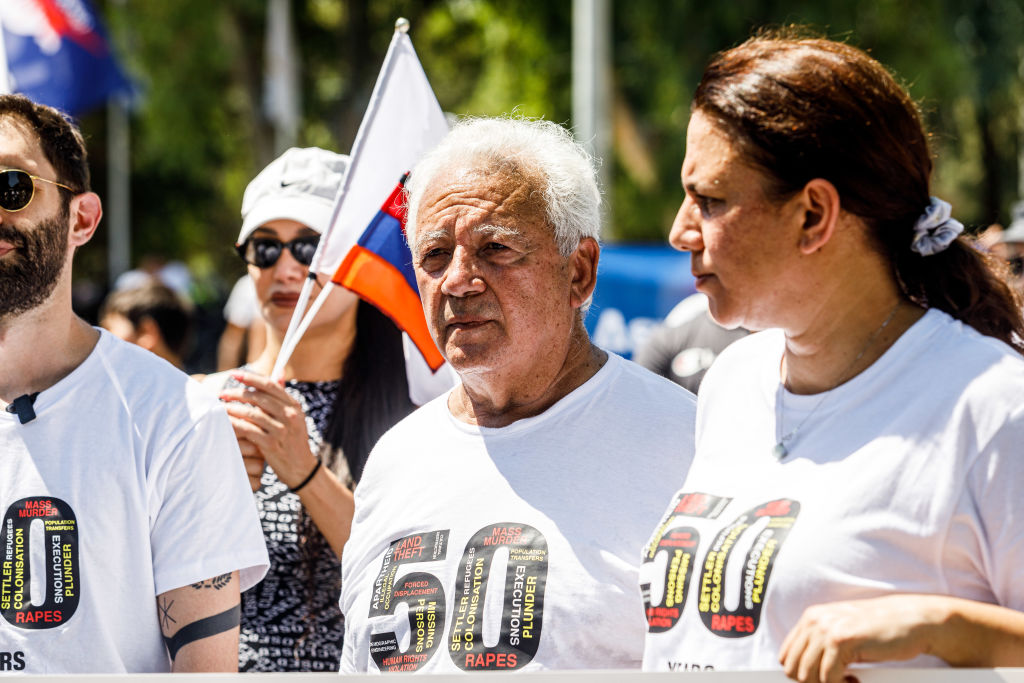
A group of Greek Cypriots and Turkish Cypriots gathering to protest the situation in Cyprus, demanding unification and peace between all communities, in Nicosia, Cyprus, on July 20, 2024. (Kostas Pikoulas / NurPhoto via Getty Images)
At the Taşucu port I see the Cyprus boat coming toward the mainland, the island less than eighty kilometers away, and the gas beneath this seabed only a footnote in that whole story. I stayed there once; ten days on both sides of an island needlessly divided. On my last evening, I met with members of Turkish and Greek cycling clubs, both of which would have happily referred to themselves as simply “Cypriot.” The ethnic distinctions belong only to lines that need not be there. Those who love the bicycle often seem able to maintain a love of the world and faith in how it could be.
The island of Cyprus, by square kilometer, is the most militarized rock on earth. It hosts most of the British military in the Mediterranean, and while British-Turkish relations may be historically among the best of all European and Western states, still the Turks have no enthusiasm for being militarily encircled. Cyprus itself was a British colony of largely harmonious Greek-Turkish relations until, determined to cling to power, the British waged a concerted divide and rule strategy of random killings and general brutality. British rule eventually came to an end in 1960, although the British military bases remained, and the Turkish Cypriot self-defense militias always feared that their fellow islanders — the majority Greek Cypriot population — might turn on them when the occupier was gone.
And so it went. But it was not only the Greek Cypriots who were to blame; the extremists of the island would have been far less potent without the military dictatorship back in Athens. Drunk on Hellenist fantasy, its leaders do not want an independent Cyprus; they want Cyprus inside Greece. The junta stages a coup so ferocious in its onslaught that the Cypriot president has to be evacuated to Malta by the British Royal Air Force still on the island. The Greek Cypriot militia, EOKA (National Organization of Cypriot Fighters), which has attacked Turks for decades, is now so emboldened that even Greek Cypriots fear what its fanaticism means for the island. Cyprus will be Greek. For five days this is the state of affairs, with Turkish Cypriots shut terrified inside their houses, until the Turkish government resolves to refuse this remaking of a new normal and the total violation of the 1960 Cypriot constitution. It sends troops.