Born and Misunderstood in the USA

It is received wisdom that Ronald Reagan played “Pink Houses” and “Born in the USA” at his rallies because he thought he could drain these songs of their meaning. A new book explains how heartland rock came to appeal to left- and right-wing fans alike.
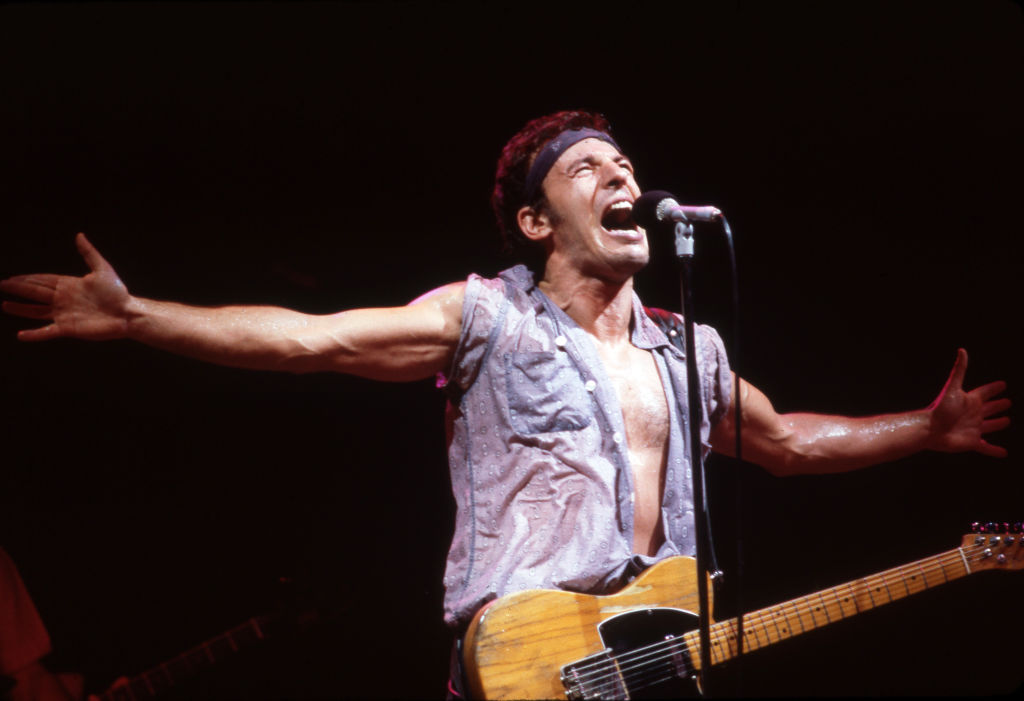
Bruce Springsteen during his "Born In The USA Tour" on July 30, 1984, at Joe Louis Arena in Detroit, Michigan.

What came to be known as heartland rock was a music of longing for the stability and security of postwar America. This nostalgia gave the genre its broad bipartisan appeal but also facilitated its cynical appropriation by the Right. (Ross Marino / Getty Images)


Ronald Reagan had a childhood out of a heartland rock song. His family moved from rental to rental in a series of small Illinois towns — Tampico, Galesburg, Monmouth — before settling in Dixon, a Twainish town on the Rock River, when he was ten. You can hear a cloudless movie version of this life in a small-town ditty by John Mellencamp; a haunted, rain-lashed rendition on Bruce Springsteen’s Nebraska.

As a child, Ronald was anxious and lonely and small. He squinted a lot and looked in photographs like he wanted to disappear, fade into the wall or cornfield or whatever backdrop might allow him to flee a family that one critic called “a surreal Norman Rockwell portrait.” His father was an alcoholic who leaped from one sad, shady business scheme to another. His mother spent her days in church, performing in the choir as if it were cabaret and taking home a stream of stray boarders, whose souls she dreamed of saving.

What saved her son was the power of positive thinking. As Rick Perlstein frames it in The Invisible Bridge, Reagan “worked out in the psychic gymnasium of boyhood fantasy with ten times the furious determination of an ordinary boy.” He checked out library books on self-made men, became entranced by the heroic simplicity of sports, and character-acted his way through high-school theater. He reimagined “the morass in front of him as a tableau of simple moral clarity” and superimposed it atop his family’s white, clapboard, American Gothic–looking balloon-frame house in the heart of America.

Redemptive fantasy, everyday heroism, small-town pain and small-town glory, nostalgia for a fictional childhood you never had, a general mood of “suck it up and tough it out and be the best you can”: this was the soil Reagan plowed for his American myths. It was also the soil that the 1980s genre of heartland rock, described in Erin Osmon’s new book as the fruit of the last truly popular season of left-populism in American culture, cultivated for its imagery.

The tension here — the bristling intimacy between Reagan’s right-wing reboot of the American imagination, and the left-populist rhetoric of rock stars who wrote music to oppose him — lends strangeness, difficulty, and allure to a heartland rock genre that might more simply be seen as the music that still feels good to hear when its smooth, mid-tempo anthems siren out of your dad’s garage.

Small-Town Nostalgia

Certain genre labels endure through vagueness. “Modernism as a notion is the emptiest of all cultural categories,” Perry Anderson once protested. “There is no other aesthetic marker so vacant and vitiated,” he went on, “a portmanteau concept whose only referent is the blank passage of time itself.” And yet few terms have been more perennially reemployed.

You could say something similar of heartland rock. It was a term invented by journalists in the 1980s whose only referent is the blank map of sentimental geography. For some, the American heartland conjures up the Midwest; for others, the heartland stretches into the Texas panhandle and the rural South, or even rust-belt New Jersey and the sexless parts of California and Florida.

Osmon’s Won’t Back Down is the first history of the genre. She opens the book as an agnostic: “A generous person may view the term as a badge of honor — a way to commemorate a group of artists who worked outside of corporate pop music’s trends and garnered acclaim. A more cynical person may say that the term was a product of college-educated metropolitan writers who couldn’t tell the difference between Michigan and Florida.” Yet she quickly takes a pragmatic approach, accepting that heartland rock exists because people talk about it as if it exists and deciding therefore that her book has the intriguing responsibility of fleshing out the most “vacant and vitiated” category in 1980s pop.

Her story is a happy mix of the old and the new. Readers who know little of heartland rock will learn the standard tale of the genre, though relayed with healthy skepticism. Rock’s post-Vietnam middle lane — not punk, not disco, not coffee-shop-troubadour-style singer-songwriter folk or anything glittering with synth — found fame with Bruce Springsteen’s 1975 Born to Run, as “a gifted songwriter from an unassuming area, who looked like a regular person and couldn’t sing all that well, released a rock album rooted in historical sounds and the Everyman, to widespread acclaim.” But Osmon knows that to frame it this way — as a genre that bolted one day out of the vague, rusting, Jersey Shore blue — is to rip the story from the fabric of left popular culture.

Before Bruce, before “Jack and Diane,” before “Mary Jane’s Last Dance” and “American Girl,” there was Bob Seger. Born in 1945 in Detroit and raised as a white working-class townie in nearby Ann Arbor, Seger was a son of Henry Ford and the Popular Front — he was born in Detroit’s Henry Ford Hospital amid the backdrop of the antifascist politics of the late 1930s and 1940s. These forces marked postwar American culture with a left-populist streak. Seger’s dad was a medic at Ford’s River Rouge plant whose gaze drifted so far outside Ford’s factory gates that one day he ditched his wife and young son and went west, trying and failing to make it big with his band in California.

Back in Michigan, his son grew up with a single mother and a radio. The radio was always on, and always tuned to the blues, R&B, and soul, the black music that the culture of the Popular Front worked to desegregate. By the time Seger grew old enough to harbor his own music-making dreams, there was a new, post–Popular Front left cultural scene to affiliate with. He grew his hair down to his ass, wrote songs against the Vietnam War, and played rallies alongside the Black Panthers. Then, in 1976, as the New Left receded, he released Night Moves, the smoothest of all heartland rock albums, and blasted into the ether. He became one of the first heartland rock stars and the bridge between the Old Left, the New Left, and the strange ensuing fun house of Reagan’s postmodern mystery tour.

Osmon’s book adds two things to familiar notions of heartland rock: an expanded canvas and a richer sense of history. For her, heartland rock is more about a sensibility than a sound or geography. It was mainstream rock that equated solidarity with a broad, imagined popular class of farmers and workers; reverence for small towns and stranded places, common sense and common dreams; distrust of the supposedly progressive sweep of history, of new fashion, media, and bright-lit megalopolises.

Beyond these, Osmon’s version of the genre is impressive for its protean shape. In this paradoxically inaugural and revisionist history, a supposedly white, masculine music stretches wide enough to include Bonnie Raitt and Tracy Chapman; a famously breezy, mid-tempo sound becomes likewise defined by the lashing 4/4 drums of John Mellencamp’s “Rain on the Scarecrow”; and the stripped-down, disco-skeptical authenticity of heartland rock turns out, by the middle of the 1980s, to want nothing so much as to emulate the freaky, futuristic synths of a very different sort of Midwestern pop star, Prince. Typically, heartland rock’s Mount Rushmore leaves space only for the splayed power stances of four guitar-playing white men: Seger, Springsteen, Mellencamp, and Tom Petty. The cover of Osmon’s book nods to this while adapting it, subbing out Seger for Lucinda Williams and pasting them all atop stars and stripes.

This lightly defamiliarizing story emerges out of Won’t Back Down’s structure. The book is organized not by idea or theme or artist but by year. The first chapter drops us into 1980, the last leaves us in 1989, and in between Osmon goes year by year, tracing heartland rock’s development throughout a halfway-house, purgatorial decade suspended between the Cold War world of welfare states and legible left and right movements and the screen glow of Reagan’s neoliberal future.

A lot depends on how you read this history. For Osmon, heartland rock is a belated form. It belongs to the past and is best heard as the last campfire-pop of an old, universalist, left-populist cultural strategy of framing a broad, inclusive image of the people, unafraid of the symbol of the Common Man. This left-populist legacy was famously misunderstood. Both its supporters and critics wrongly imagined the genre, because of its red-white-and-blue imagery and soaring, ironized hooks — “Ain’t that America, home of the free?” — to be the musical counterpart to Reagan’s Make America Great Again politics. For Osmon, this was due to right-wing cynicism. Reagan kept playing “Pink Houses” and “Born in the USA” at his campaign rallies because he thought he could drain these songs of their real meaning. Meanwhile, Mellencamp and Springsteen kept sending their lawyers after him while writing songs opposing Reagan’s cultural influence.

This view of heartland rock’s misinterpretation has become the consensus. All you have to say is “the misinterpretation of ‘Born in the USA’” and everyone knows what you mean, as if the right interpretation were somehow straightforward and the song were merely a four-minute adaptation of Noam Chomsky’s view on American imperialism.

In truth, the consensus obscures something, and the misinterpretation has been misinterpreted. The fact that heartland rock was a belated left-populist form meant, in practice, that it was not much of a left-populist form at all. Its songs stretched out over the radio into a world without context, shorn of the political movements that grounded earlier moments of left culture. Mellencamp and others made heroic efforts to rebuild this context, coming together with Midwestern farmers during the 1980s farm crisis and organizing a benefit festival, Farm Aid, that still carries on to this day.

But they were outflanked by a wider social logic. The old popular class ways of life, farming and industrial work, were vanishing from the heartland, and with them disappeared the movement legacies, from the Populists to the Congress of Industrial Organizations (CIO), that once cohered a shared working-class politics. In its place came a new culture of incoherence. The real power of heartland rock comes from how it caught this shapeless, changing culture in its simple yet vexing imagery, its ambivalence, its scrambled and wistful affect.

There was nothing belated about this music. In a way few other popular genres managed to do, heartland rock gave form to our future. Listen again to Mellencamp’s “Pink Houses” or “Small Town.” The symbols of America, the small family house, the hometown. They all represent things you love and take immense, even buoyant pride in that hurt and disappoint and bind you and therefore congeal in a thick, stalemated ambivalence that frustrates any conclusive interpretation. This ambivalence is why heartland rock still speaks to us. It was an apparently authentic, back-to-basics music that was opaque and a backward-looking, nostalgic sound that was actually futuristic.

The best of heartland rock previewed a political culture where the symbols of old — worker, farmer, nation, youth, home — slipped and came unmoored. The one post-Reagan thing we all shared was a faintly conservative, commonsense longing for security in an age when “dreams came and went,” when the place “good enough for me” was perhaps better described as the place where they’d probably bury you.