How Capitalism Undermines Democracy
Milton Friedman argued that capitalism was democracy’s natural home. He couldn’t have been more wrong.
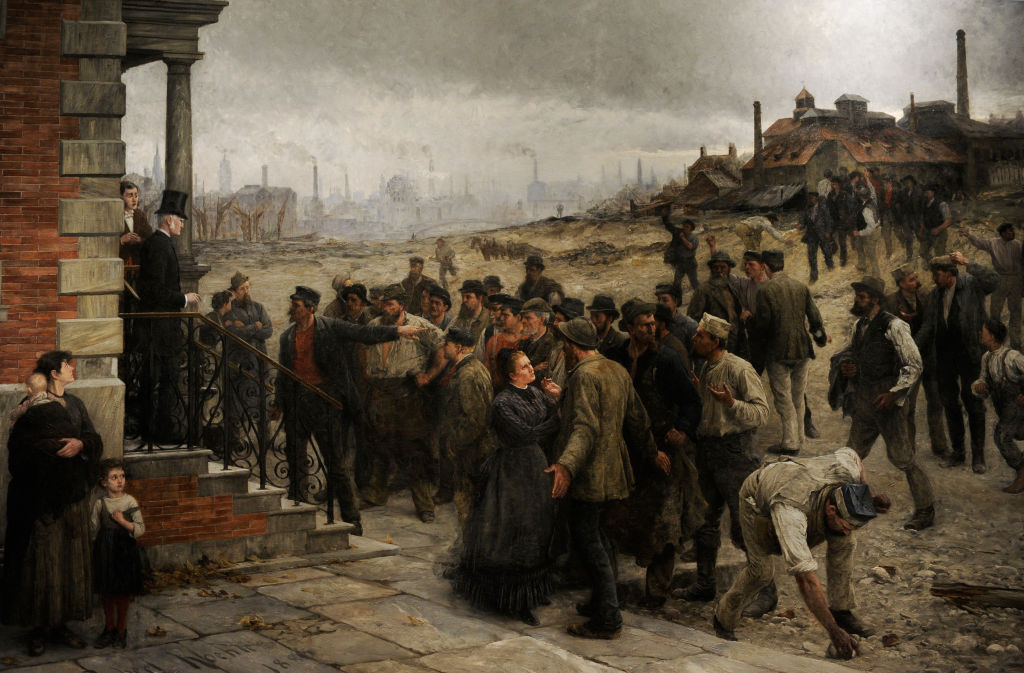
Milton Friedman said capitalism was the ideal soil for democracy. In fact, every democratic right we have was won against the objections of the capitalist class. (Universal History Archive / Universal Images Group via Getty Images)
- Interview by
- Melissa Naschek
Libertarian thinkers like Milton Friedman like to say that capitalism not only gave birth to democracy but also is the ideal economic system to complement democracy. But while capitalism may have created the conditions for democracy, it’s actually the main obstacle to securing full democratic rights.
On this latest episode of the Jacobin Radio podcast Confronting Capitalism, Vivek Chibber and Melissa Naschek examine the worker struggles central to the rise of democracy and why, in a system built around profit, the ruling class opposes it. Confronting Capitalism with Vivek Chibber is produced by Catalyst: A Journal of Theory and Strategy and published by Jacobin. You can listen to the full episode here.
Melissa Naschek
There’s been a lot of discussion on the state of democracy, in particular in the United States but also around the world. People are very concerned about how stable democracy is in the modern capitalist world. So today, I’d like us to look at the big-picture relationship between capitalism and democracy.
Vivek Chibber
The true nature of the relationship between capitalism and democracy is an absolutely central issue. The Left has historically taken it up as one of its central questions, but so has the Right.
If you look at Milton Friedman’s book Capitalism and Freedom, which is one of the classics of modern neoliberal thought, Friedman made a very strong argument for the connection between capitalism and democracy. In many ways, he was mirroring certain kinds of Marxist arguments when he said that capitalism is not only consistent with democracy but that it’s also the best possible system for democracy. And he was contrasting it with the Soviet Union.
When you compare liberal democracies with the Soviet Union, it’s an easy case for Friedman to make. When you have a state-controlled economy where the government plans authoritatively — telling producers what to make and how much to make and directly or indirectly telling labor where to work and when to work — you can’t have democracy in such a system, because basic choices are being directly controlled by the government.
He makes the argument that in a free market, free choice in the market is easily translated into free choice in politics. So his work becomes a defense of capitalism not just as an efficient system but as the system that maximally promotes freedom.
Melissa Naschek
Do you agree with Friedman that capitalism is the ideal economic system to promote democracy?
Vivek Chibber
No, it is not. If it were, we wouldn’t have to be anti-capitalist. As people who are trying to promote greater freedom and greater democracy, we also end up as anti-capitalists. That means we are pointing to flaws in capitalism that systematically undermine democratic aspirations and democratic values.
That being said, it is correct to say that capitalism laid the foundations for democracy. So we have to examine both of these things. We should start with how capitalism laid the foundations for democracy and then go on to why, nevertheless, there are significant tensions between the capitalist economy and democratic politics.
So how did capitalism lay the foundation for democracy?
To understand that, it’s useful to look at what preceded capitalism, when there wasn’t any democracy, and at why the economic systems that preceded capitalism made democracy a nonstarter. That system, in Europe and much of the non-European world, was called feudalism.
The essence of feudalism was that the ruling elites had direct personal authority over the individual persons of the peasantry and their families. And they needed to have individual authority and power over them, because that’s the only way they could get a surplus out of them.
These peasants owned their own land. They had control over their own land, which meant that they could provide food and shelter and basic resources for themselves without ever having to depend on the feudal nobility and the feudal landed classes. If the feudal landed classes disappeared, the peasantry would be fine — which means they didn’t need them at all.
So how did feudal lords get a surplus out of the peasants if the peasants didn’t need them? They did it through physical threats, direct coercion, the exertion of monopoly rights, and constraints on the mobility of the peasantry. This was accentuated in serfdom, but even without serfdom, you had all sorts of institutionalized forms of control and authority over the peasants, which made coercion and physical threats absolutely essential to the system.
Now, when you have a system like that, the essence of a democratic system becomes impossible. And what is the essence of any democratic system? Formal equality. The possibility of each person having equal say in the political system.
Capitalism at the Birth of Democracy
Melissa Naschek
In other words, you’re saying that in a feudal system, a state authority or something analogous is essential for extracting surplus.
Vivek Chibber
Whether you look at India, China, or Europe, something all feudal systems had in common was that the local landed classes also had a monopoly of political power and political authority over their peasants. Lords could directly govern as they liked in the localities they had power in, which meant that peasants simply could never have the same political rights as the lords did. It was a nonstarter. If they had equal political rights, lords would lose the ability to extract a surplus out of them.
Melissa Naschek
If we compare this with today, imagine if your boss at your job had total say over where you lived and what you did in your free time and had the ability to physically punish you. It’s a very distinct system.
Vivek Chibber
Imagine in that system giving the workers equal rights. It would be impossible. The system would collapse. In order for the system to sustain itself, the lordly class as a whole had to deny even the possibility of equal rights to peasants.
What happens when you switch to a capitalist economy? The essence of a capitalist economy is that capitalists own the means of production, whereas in feudalism, peasants had control over the means of production.
Once capitalists have control over the means of production — they own the factories, they own the land — peasants have no rights over the land anymore. Now the only way laboring people, whether they’re farmers or peasants or proletarian workers, can survive is by going out and finding a job, because they can’t sustain themselves on their own land anymore. They don’t own the land.
Going out and finding a job means you have to seek out employers who’ll give you the job. That means employers don’t have to coerce you or put limits on your mobility the way they did in feudalism. Employers can sit back and wait for workers — whether they’re agricultural workers in the countryside or urban workers in the cities — to come to them.
It’s really important that, because they don’t have to physically go out and push these people around in order to get them to come to work, then at least in principle, if those workers had formal political rights, it wouldn’t harm or undermine the process of class reproduction. It wouldn’t harm or undermine the economic power of the employer class. They can give the workers political power without it threatening their economic power. Whereas in feudalism, if you gave peasants political power, it would wipe out the economic power that the lords had.
One way to think about this is that in capitalism, at least potentially, there’s a separation of economic power and political power. Whereas in all the systems that preceded it — slavery, feudalism, tributary systems — the one characteristic that bound them together, even though there were many differences between them, was the fusion of political power and economic power.
So Friedman is right in one sense, which is that capitalism does lay the foundation for democracy, because the ruling class in capitalism — the capitalist class — can relinquish direct political power over the persons of the exploited without also giving up and losing their economic power.
The question is, while it does make it possible to have democracy, is capitalism the ideal system or the best possible system for democracy? And to that, the answer is no.
Melissa Naschek
Why not?
Vivek Chibber
Let’s just examine the facts here. Capitalism came about in Northwestern Europe in the late 1400s and early 1500, and spread out over the rest of Europe and then over the rest of the world over the centuries.
In short, we can say that capitalism is fairly stable in Northwestern Europe by 1550. Democracy doesn’t come about until the early 1900s. So why did it take 350 years?
It’s because even though capitalists can function without direct political power, they are very much happier to wield it if they can. And this has to be explored. What is the place of political domination in capitalism if it doesn’t require it as a precondition for its existence?
Melissa Naschek
I think it would also be important to say what kinds of political domination we’re talking about.
Vivek Chibber
Let’s start with the place of political power is in capitalism. In feudalism, you needed to physically force the peasants to do the work for you, because they had their own land. Why would they come to your land to do any kind of work for you if they didn’t have to?
In capitalism, you don’t have to force workers to come to the work. They will seek you out, because they have no other way of surviving.
That makes it sound like capitalists don’t need political power over the workers anymore, but that’s not true. In other episodes, I’ve talked about what exploitation entails. For workers, when they come to the job, it solves one huge problem, which is that now they have some way of getting money in order to survive. But once they’re at work, a whole series of new conflicts opens up. The boss tries to get them to work as fast as they possibly can, as hard as they possibly can, oftentimes at speeds that are directly injurious to them. He gives them wages that are lower than what they would like. He makes them work for longer hours than they would want. All of these are aspects of work that they find injurious and objectionable, and they resent it.
Their natural reaction when they come to their job is to work only as fast and as hard as they absolutely have to, which means they try to shirk and hold back, so that the intensity of their labor and the quality of their labor is at a pace and a tempo that is less injurious to them, less harmful to them, than the pace and tempo the boss would like.
Melissa Naschek
Another component of this that we’ve talked about previously is that in capitalism, workers no longer own the means of production. This means you no longer have the right to decide how the work is completed. You’re at the mercy of the people who do own these things, and so you no longer have control over the process of how things are made.
Vivek Chibber
Because there’s this conflict of interests, employers cannot trust the workers to deliver the quantity and the quality of work that they would like. How do they get the quantity and the quality of work that they want? They only get it by, oddly enough, exerting control over those workers. What kind of control? This is what management does.
While you don’t force the workers to come to work for you, while they’re at work, you do have to boss them around. You do have to issue threats. The typical threat is, “Do what I want or I’ll fire you.” But the other threat is, “Do what I want or I’ll lower your wages.” “Do what I want or I’ll put you in a worse position inside the firm.” There are all kinds of ways in which employers still have to threaten their workers.
The difference with feudalism is this. In feudalism, you have to go out and catch the workers, bring them to the land, and force them to work. While they’re on the land, they pretty much work at their own pace.
In capitalism, capitalists don’t have to force workers to come to work for them, but once they get to work, capitalists have to exert authority over them in order to get them to work at the level that they want. Workers, for their part, try to use whatever power they have to bring the pace of work closer to their own interests, to the tempo that they would like, and they try to use whatever power and leverage they have to bargain for better wages.
This means that at the workplace, there is a battle over who’s got more power, who’s got more bargaining leverage, and who can set the terms of the work. And what this means is that capitalists try very hard to make sure that workers do not have any leverage in their bargaining at the workplace.
Now, why should that matter for democracy?
One of the things that gives workers leverage within labor conflicts is political rights. If they have political rights to, for example, have representatives of their own in the government, those representatives can pass laws that protect workers at the workplace. One such law can be the law allowing workers to organize unions.
For the first three hundred to four hundred years of capitalist history, unions were in fact illegal. Why were they illegal? Basically because employers did not want their workers to have the right to come together and bargain collectively, because that gives them more leverage against the employers.
There were all sorts of other political ability that workers had, including the right to vote. Workers were denied the right to vote for the entire history of capitalism until relatively recently. Why? Because if they had the right to vote, they would put into place parties and laws that better positioned them to bargain against their employers.
Ironically, even though capitalism laid the foundations for democracy by separating economic and political power, as long as capitalists could wield political power in a unilateral way, they were happy to do so, because in so doing they were able to press down harder on their workers at the workplace and get more of a surplus out of them.
This means there was a tension right from the start between the possibility of formal democracy and the capitalist economy. How was that tension in fact manifested? It was manifested in the fact that capitalists, from the moment capitalism was born, fought against political equality and formal rights for their workers, because that would affect the bargaining between the two classes in the economy.
Melissa Naschek
So how did we even get democracy in the first place, if there is this conflict within capitalism?
Vivek Chibber
In other words, where does democracy come from if the most powerful elements in society, which is capitalists, don’t really want to see it?
Let me reiterate this. In every country, every single time we’ve seen democracy arise, the one constant factor has been that economic elites and businesspeople have fought against it. That’s been true in the Global South, in Asia, in the Middle East, in Latin America, in Europe, and in the United States. So the question is, then, how did you get democracy?
And the answer is that ordinary people fought for it long and hard. We see the struggles for what we today would call actual formal democracy, which is universal suffrage and political rights. We see that starting in the seventeenth century in Europe, in the English Revolution of 1640. Then we see it in the French Revolution and the American Revolution. But those were just the biggest explosions of those demands.
What you in fact see is a steady, unceasing demand and fight for democratic rights from the laboring classes right from the start of capitalism. And it wasn’t until the early 1900s that you see what we today would recognize as democracy, which is basic protections around individual rights and universal suffrage.
Where did democracy come from? It started with movements from below. But it’s no coincidence that the speed with which democratic rights are acquired really takes off in the 1880s and 1890s. That’s when the modern trade union movement was born.
It’s workers who have an interest in having democratic rights, because the working class needed democracy in order to defend itself against elites at the workplace and outside the workplace. But until they could organize themselves as a class through the trade union movement, they had very little means of actually achieving it.
Between 1880 and 1920, after close to three hundred years of democratic demands, you get a rapid acceleration of the movement toward actual modern democratic rights. That’s because it was the modern trade union movement that was actually able to effectuate it.
So ironically, Friedman does have a point, which is that there’s something in capitalism that made democracy possible. But what he doesn’t say, which he should have said, is that in order for that possibility to become real, you had to overcome the power of the class central to capitalism, which is capitalists.
Marx on Democracy
Melissa Naschek
If it’s the case that it’s really workers who are responsible for modern democracy, why were even previous Marxists, including Karl Marx himself, saying that it was capitalists and the bourgeoisie that were responsible for creating democracy?
Vivek Chibber
It’s an interesting question. Marx did abide by this notion that the key moments in the march toward democracy occurred in what was called the bourgeois revolutions — the revolutions of 1640 and 1688 in England, 1776 in the United States, and 1789 in France. He did think that the bourgeoisie played a big role in putting democracy on the agenda.
He also saw, in part through his own personal experience, that while the bourgeoisie might have put democracy on the agenda by wiping out feudal power and by putting equal rights on the political menu and even by fighting for political rights, they restricted how far those political rights would go. And it was the working class that took those rights and made them universal. He did see that.
I should say, he didn’t write a lot on the bourgeois revolutions. If you take all of Marx’s writings on the bourgeois revolutions, they really come to maybe eighty or ninety pages in a modern book today. And that’s a stretch.
But after he gets done writing this, in the Second and Third Internationals, this idea about the revolutionary bourgeoisie — which Marx always advanced with some degree of caution — hardened into an orthodoxy. And what you got, instead of saying that the bourgeoisie fought for some kind of restricted conception of rights, was this idea that the bourgeoisie actually gave you democracy. It was the bourgeoisie that fought for democracy, and it brought liberalism about. And that liberalism was then bestowed upon the working class.
So if you look back at the history of Marxist thinking, I think Marx can be faulted to some degree, but really it’s from the generation of Karl Kautsky and Vladimir Lenin on down — and especially when you get to the 1930s — that it hardened into a story where the working class is basically absent and it’s the rising bourgeoisie that’s giving you democracy at all.
While that excuses Marx to some extent, I should point out that he was guilty to some degree of exaggerating the role of the bourgeoisie, even in the limited sense that he was willing to give it some kind of acknowledgment. It is true that the French Revolution put democratic rights on the agenda. It’s true that a restricted notion of democracy was in fact promulgated. But the people demanding it and the people fighting for it were never the bourgeoisie.
The bourgeoisie as we conceive of the class — the capitalist class that employs labor and tries to maximize profits — really didn’t exist in France at the time. What they called the bourgeoisie is what we today call the professional classes.
Now, if you look at the professional classes today, it’s no surprise that the professional classes back then did want some degree of democracy, because what they wanted was a system in which there was advancement by merit, in which you couldn’t buy political office, in which elites had some degree of say in the system and it wasn’t just restricted to the nobility and the aristocracy. That’s no surprise, because the middle class today also wants that.
But just like the middle class today, the middle class back then was pretty contemptuous of ordinary people. The French professional classes did not fight for democracy for those who were below them.
What Marx did was recognize those limits, but he wrongly characterized and categorized that class of professionals as bourgeois. So in a strict sense, he was not only mistaken in giving the bourgeoisie the role of fighting for limited democracy; he was mistaken in his view that there was a bourgeoisie at all in France in 1789.
This is another instance where you can use the historical record to correct Marx and Marxists — but that correction ends up being closer to the basic underlying claims of Marxist theory than the ones Marx and his followers were making.
Capitalism Against Democracy
Melissa Naschek
You’ve said that when it came to how we got democracy, capitalists not only didn’t fight for it but actually, because of their direct conflict with workers, fought against democracy. But then there’s a separate question. Once you have democracy, is it compatible with capitalism, such that capitalism sustains it?
Vivek Chibber
It’s definitely still compatible with it, but the underlying tension never goes away, which means that democracy is always under threat in capitalism. It’s always in peril.
The reason for that goes back to that same underlying tension I talked about. Capitalists are driven by one thing and one thing only, which is profit maximization. They find that a fully enfranchised working class with its own party and political institutions is actually a hindrance to what capitalists would ideally like to see, which is having total power over what goes on in the workplace, how wages are settled, how workers live their lives, and what kinds of demands workers can make.
Melissa Naschek
Even after democracy is in place, capitalists never give up whittling away the institutions that give workers power in the political system.
Vivek Chibber
So even after democracy is in place, capitalists never give up whittling away the institutions which give workers entrée into the political system and power in the political system. They continue to fight against unions and whittle away the power of the unions. They try to weaken the parties of the working class. And of course, they try to, in whatever way they can, restrict the franchise as an effective tool.
How might they restrict it? By increasing the obstacles in the way of workers voting, by restricting entry into the political system, by making it difficult for people to register to vote. All of these things are part of the bourgeois toolkit.
And in instances where ordinary people aren’t able to effectively wield a counterweight to capitalist influence, we see the institutions that enable the working class to have entrée into the system being whittled down — and through that the participation of workers being whittled down as well.
Once that happens, that results in greater unchallenged power of capital within the state, within the political parties, within the political system. And that means democracies become less healthy. Democracies veer toward becoming oligarchies.
It’s a very well-established datum within political science now that the healthiest democracies are the ones where you have the most robust institutions of working people. What do we mean by healthy democracies? You can measure things like: What’s the level of voter participation? How much do laws actually reflect ordinary people’s preferences? How much do ordinary people get to participate in the political system? You can quantify all this. And we see across the board that, in every country where ordinary people have robust institutions of their own — trade unions, their own political parties, neighborhood associations, things like that — you get better and more democratic political outcomes.
In countries where the institutions of working people are the weakest, where political parties of the Left are the weakest, where labor parties are the weakest or absent, where trade unions are the weakest or absent, you get something like total domination of the political system and the state by capital, which means it’s more like an oligarchy. So that imbalance between workers and capitalists in the political system is crafted and maintained by capitalists as much as they can manage — which means that the tension between a fully functioning and healthy democratic system on the one hand, and capitalism as an economic system and the incentives that it generates on the other, never actually goes away.
Melissa Naschek
Is there a way to say how democratic our current society is? And is democracy a question of quantity versus quality?
Vivek Chibber
Democracy is always a question of quality, but there’s a way of quantitatively assessing what that quality is. The conventional way of measuring these things is who participates in the institutions of democracy, how much they participate, and how much laws reflect the preferences and desires that people have.
So if we look at the United States, for example, who participates in democracy?
There are a couple of ways of measuring that. One is electoral turnout. And what we see is that electoral turnout in the US is very low, which means that the democracy is not doing well. A lot of people are not participating. But more to the point, it’s skewed by income. It’s not that 70 percent of the people don’t participate and it’s a random assortment — it’s that the poorest 70 percent don’t participate. So it’s not only low participation; it is participation of the wealthy and nonparticipation by the poor.
Melissa Naschek
You can take that one step further and look at political associational behavior. Professionals and the upper class are far more politically organized. A far greater percentage of them are in political organizations that can advocate for them compared to working and poor people.
Vivek Chibber
And there are other measures of political engagement, like how often do you call your political representative? How much are you in touch with them? Again, there’s a huge income skew in this as well. Another measure is resources. Who gives to candidates? How much do they give? Here again, it’s the wealthy who give the most to candidates. It’s the wealthy who have the most influence over candidates.
And you can measure by where the money is coming from, which families it’s coming from, and what the income level is of the people it’s coming from. Again, that’s hugely skewed by income. The third and most devastating measure is when you look at the laws that are passed, you can weigh them, map them against opinion polls, and see if the laws are expressing the preferences that people have.
I’ll give you a very good example. For fifty years, we’ve seen in nearly every opinion poll that a large majority, even a supermajority, of Americans want a national health care system that is free and accessible. In that entire era, there has not even been the slightest movement toward that. All health care policy has been geared toward obviating this one alternative.
That’s just one example, but there are many such examples. There’s a very robust literature showing that if you compare policy outcomes to Americans’ preferences, the policy outcomes very neatly map onto the preferences of the top 10 percent of the population and have literally no connection to the bottom 50 percent of the population.
These are all ways of quantitatively measuring the quality of democracy. And on every single one of them, the United States is an outlier. It is by far the least democratic country in the advanced capitalist world.
Capitalism and Authoritarianism
Melissa Naschek
You’re talking about how a capitalist system lends itself to an oligarchic system of government. We can also look one step further toward an authoritarian form of government. Is that something we can blame on capitalism too, or is that a separate question from the kinds of tensions that you’re talking about?
Vivek Chibber
No, I think in every capitalist political economy there is a very strong impulse toward authoritarianism, unless it’s checked by the political institutions of ordinary working people.
This era of democratic backsliding has one common feature around the world, which is that it came after the decline of the Left. What do we mean by that?
The Left was always sustained by two kinds of things: robust political parties that fought for the rights of working people, and economic institutions like trade unions and farmers’ and peasants’ organizations. All of those things were dismantled in the neoliberal era. And as they were dismantled, what it meant was that the ability of ordinary people to come together to fight for their interests in the economic system and in politics was greatly reduced.
This shouldn’t surprise us: that was the whole point. The whole point of neoliberalism was to scale back the power of working people so that economic elites could claw back all the privileges in the workplace and outside the workplace that they had in the halcyon days before the trade union movement.
Melissa Naschek
It’s ironic that Milton Friedman, basically the philosophical father of neoliberalism, is the one who’s talking about how capitalism undergirds democracy. Meanwhile, he’s advocating a system that is systematically attacking it.
Vivek Chibber
This was the ideological complement to the economic agenda that they had. You destroy ordinary people’s ability to actually have an effect on and any kind of entrée into the political system, while all the time telling them that they’re in the best possible system.
Melissa Naschek
Right. As long as you just call it “free” and keep shouting that over and over, I guess people aren’t supposed to realize that their rights are being taken away and their lives are getting worse.
Vivek Chibber
Tell them that they’re free to be bossed around, free to be precarious, free to make whatever choices, buy whatever they want with the money they don’t have.
So once all these institutions are dismantled, it should be no surprise at all that the degree of corruption in the political system, elite capture, the skewing of all the laws toward elite interests, the complete evisceration of the social safety net — all of that comes next.
After that, it shouldn’t be a surprise that what we get from the voting masses is a wave of cynicism, anger, and dejection, because what they see is that while they have all the formal rights of democracy, their capacity to actually participate has been taken away from them. That capacity always depended on having some kind of collective institutions that brought them together and enabled them to give voice to whatever preferences and needs they had. The era of democratic backsliding today is a direct consequence of the bourgeois assault on the political and economic institutions of working people.
The Democrats and Democracy
Melissa Naschek
It’s interesting you bring up corruption, because when we’re talking about present-day democratic backsliding and the present-day fights to save democracy, there’s a big divide in American politics. There’s an idea that liberals are the ones who are fighting against corruption — i.e., Donald Trump — and that conservatives and Republicans are the ones who are at least permissive of, and at most actively facilitating, corruption. So does that mean that Democrats are in some ways more antagonistic to the capitalist class, because they’re fighting against this stuff?
Vivek Chibber
No, I don’t think it means that. What it means is that the Democrats are more worried about the brazen, naked assault on bourgeois institutions, whereas the Republicans are more willing to go along with it. Both parties have been participating in stripping down and dismantling basic political institutions, which makes elite capture and ordinary forms of corruption inevitable.
One open and naked form of corruption is campaign finance. The way campaign finance works today is legal and in that sense is technically not corrupt, but it is the most corrupting influence on politics there is. When it comes to campaign finance, both parties are wedded to it with complete fidelity.
The Democrats have no intention of fighting against the pillars of political corruption in this country. The difference is one of nuance. The Democrats don’t want to make it ugly. They don’t want to make it naked and out in the open, whereas the Trump faction of the Republican Party has no problem with that.
I want to be clear about this: it’s not that Trump does things Democrats don’t do. It’s just that he does more of it. Even things like benefiting from insider trading and making money off the stock market — Nancy Pelosi was doing the same thing. It’s just that she didn’t shove it in your face. She didn’t do it out in the open. Trump does it out in the open.
Melissa Naschek
A good example of this was just on display with the World Cup, where Trump very clearly participated in some match interference with Gianni Infantino, the head of FIFA. I tried to explain to friends who aren’t avid soccer fans and who know nothing about FIFA that the thing that happened here is just that Trump is proud of it and is talking about it out loud. But the reality is that FIFA is basically a criminal organization, and they’re all participating in the corruption. Usually they try to hide it. The difference with Trump is just that he’s proud of it.
Vivek Chibber
Yeah, and this is not a trivial difference, but it is a small difference.
Melissa Naschek
Because it undermines their narrative. Like you’re saying, there’s supposed to be this sheen on bourgeois institutions within democracy, because democracy is supposed to be there to say, “Hey, you’re not getting so dominated; you have a say in this.” So that image is important in society.
Vivek Chibber
One way to put this is that Democrats worry about legitimacy and Trump is simply about power. He doesn’t care about legitimate power. He just thinks, “As long as I have power, I don’t care if it’s legitimate.” Democrats do basically the same things that Trump does, but they’d like to do it on the down-low. They don’t want to make a big show of it.
But what that means for someone like us is that putting your faith in the Democrats as a party that will restore popular democracy — the participation of ordinary citizens in the institutions of a democratic government — is a fatal mistake, because the decline of American democracy has been a two-party affair. Both parties have taken part in it. They just differ in how brazenly they go about making those attacks.
Legitimacy and Capitalism
Melissa Naschek
More broadly, what is the relationship between legitimacy, capitalism, and democracy? How important is it that the masses of society believe that they live in a democratic society?
Vivek Chibber
My view — and I don’t think this is the most widely held view on the Left — is that it is not that important. There is a venerable tradition within the Left of saying that a capitalist state requires the active consent of the masses, and that this itself is premised on their seeing the state as being a legitimate state. But if that’s true, it supposes that once the bourgeois state loses legitimacy, it will become unstable.
Now, my own view is that for the masses of working people in our lifetimes, the bourgeois state has not had a great deal of legitimacy, because this state has been a neoliberal state that’s been slashing everything, taking everything away from working people, destroying their families, destroying their institutions. And the infamous Margaret Thatcher line, I think, encapsulates the bourgeois view: “There is no alternative.”
The left view that the bourgeois state requires legitimacy rides on a hidden premise, which is that if it loses legitimacy, it will either collapse or be overthrown. But in fact, it hasn’t had legitimacy in quite some time, and it’s very stable. The reason for that is that even if ordinary people don’t see the system as great and don’t give it their consent, they can’t get rid of it unless they overcome basic problems of collective action and social mobilization. And those problems are overwhelming.
When the state loses legitimacy, instead of people coming together and overthrowing it, if they don’t have the institutions to come together and do politics, they end up resisting in whatever way is feasible for them — which is going to be a very individual form of resistance, not a collective one. And if you’re resisting individually, you will always lose.
The second response, once they see that all we ever do is lose, is that they become cynical and they drop out. What is the defining characteristic of American politics today? It’s nonparticipation. And that nonparticipation is concentrated among the poorest of society.
That’s what Trump has basically come to realize. What he says is, “There isn’t anything they can do to stop me. I can do whatever I want.” And he’s not wrong.
Melissa Naschek
This makes me think of how prominent conspiracy theories and conspiratorial thinking have become in our present-day political culture.
Vivek Chibber
Conspiracies are a weapon of the weak. When structural forces are so overwhelming that you can’t possibly oppose them, you fall back on thinking it’s individuals, it’s cabals, it’s cliques who are driving everything, instead of seeing that really it’s the system itself that’s driving everything.
Rebuilding Democracy
Melissa Naschek
So if we live in a society that’s characterized by this unresolvable tension between capitalism on the one hand and democracy and empowerment for the many on the other, how can democracy be sustained and perhaps even strengthened within capitalism?
Vivek Chibber
Everything we’ve said so far points toward the obvious answer. A democracy is healthy when it reflects the aspirations, the desires, and the interests of all of its citizens, not just a tiny minority. And for that to be the case, there have to be institutions that increase the ability of people to participate.
The reason I say that you need institutions for that is this: all democratic participation requires effort and requires resources. To go out to vote, you need to take a day off from work. In order to come together around your interests, you need to be able to have conversations with people. You need to be able to have some kind of deliberations with them. In order to vote effectively, you need to have access to information. Who are the candidates? What do they stand for? Who’s going to fight for my interests?
In all of these deliberations, the rich have an intrinsic advantage over the poor. If you’re wealthy, you can hire somebody to go out and get information for you. If you’re wealthy, you can force political parties to come to you, because you give them the money to run. If you’re a capitalist, you actually have the power to sit back and wait for parties to come to you, because all those parties rely on your own investment and your investment behavior. If you are wealthy, you can be the person who’s giving money to the candidates. You can be making phone calls to them. If you don’t want to do it, you can hire somebody to do it.
In all these ways, the wealthy are individually positioned to exert influence and to participate. If you’re poor, because you lack the resources to go out and gather the information, to come together and deliberate, you need institutions to help you do it. That’s what political parties and trade unions did in the past.
Trade unions gave working people an institution in which they could go to the union hall and have discussions around who’s running for office. Trade unions disseminated information to people: trust this candidate. They oftentimes ran their own candidates and said, “We will fight for your interests.” They enabled working people to overcome the resource constraints that hobbled their participation.
Once you take away these institutions, poor people are left to fend for themselves in the political system. They have absolutely no way of matching the power of the wealthy.
That means if you want working people to have anything approximating the same influence that the wealthy have, you’ve got to build their traditional institutions of parties, trade unions, civic associations, working people’s clubs, things like that. That requires political mobilization. That’s what we’re going to need now.
Within capitalism, the natural tendency of the system is political capture by the wealthy. That means it’s going to be an undemocratic system. Even if you have full rights, even if you have formal equality, it’ll be totally dominated by the wealthy.
If you want to counterbalance that influence of the wealthy, it requires institutions of the poor — specifically of the poor, targeted toward the poor, representing and articulating the needs of the poor. Those are the same institutions that the social democratic and socialist Left built up for eighty years and that have now been dismantled.
Ironically, it’s not just that we need to build the institutions of labor to fight for, say, socialism or even for social democracy. We need those institutions just to have a better capitalism and a better democracy within capitalism. And that’s why liberals and socialists should be fighting on the same side. Because if you are an actual liberal who is interested in a robust capitalist democracy, you should be pro-union. You should be fighting for a labor party instead of these oligarchic institutions that we have now.