Lula and the Ranchers
In Brazil, Lula has wagered that concessions to agribusiness elites are necessary to advance his redistributive project. Yet these very elites may undermine his whole program.
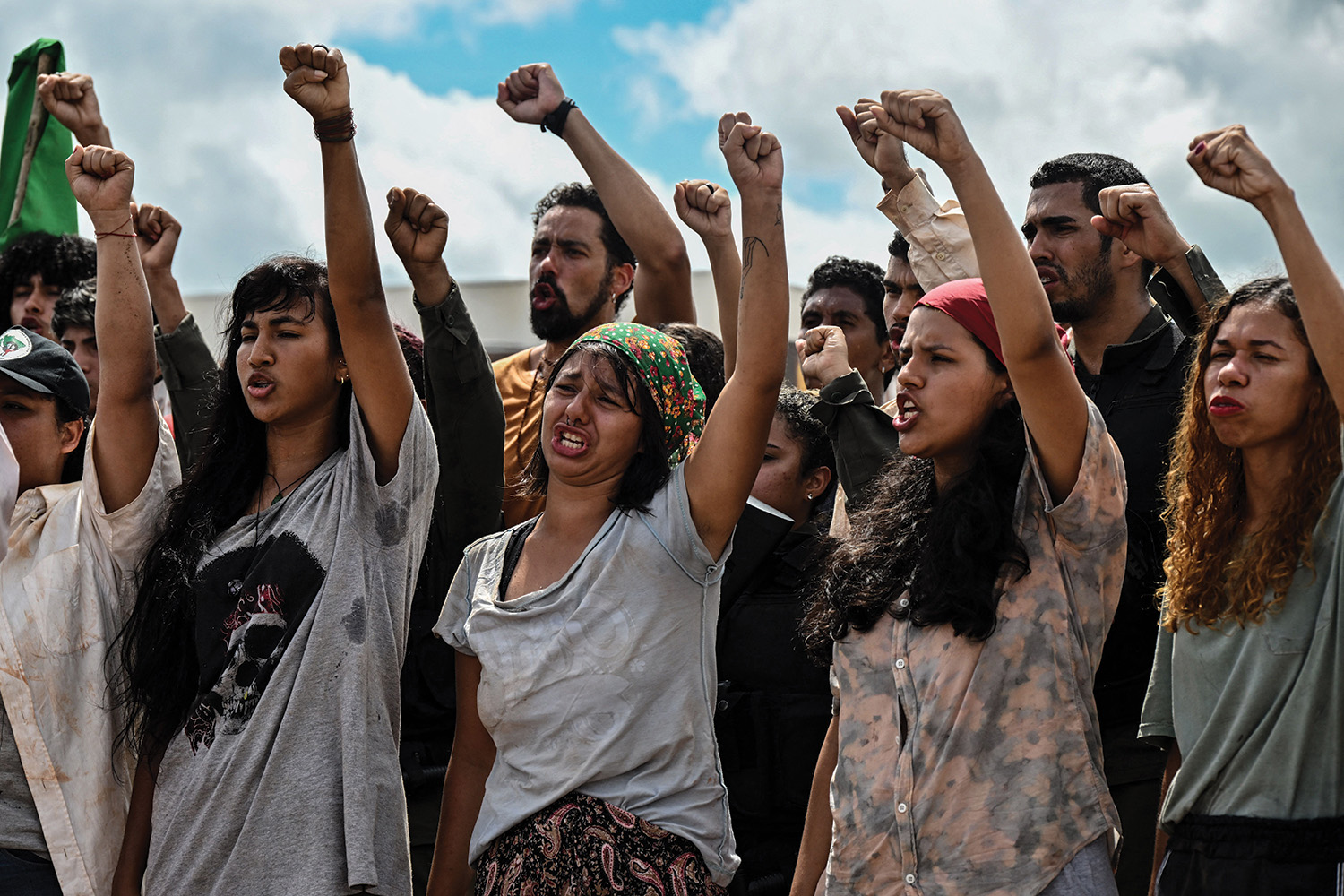
(Nelson Almeida / AFP / Getty Images)
Last September, Brazil — the world’s largest net exporter of agricultural commodities — announced the biggest grain harvest in its history. Farmers brought in a staggering 322 million tons of corn, soy, and wheat, said the government’s head of agricultural statistics — 50.1 million more than last year. During Luiz Inácio Lula da Silva’s first year back as president, Brazil’s massive agribusiness sector had never been more productive.
But record harvests have not warmed agribusiness to Lula or his center-left Workers’ Party (PT). The sector remains fiercely opposed to Lula’s environmental and social mandates, from preserving the Amazon to land redistribution. With Congress dominated by right-wing parties staunchly allied with agribusiness, appeasing large-scale farmers in the pursuit of broader social goals remains one of Lula’s core challenges. His redistributive agenda hangs in the balance.
The Bancada Ruralista
Brazil’s status as one of the world’s most unequal nations is starkly obvious in its agricultural sector. Three percent of Brazil’s population owns two-thirds of its arable land, while the smallest 50 percent of farms are clustered onto just 2 percent of that territory. Even as food and energy giants like Cargill and Raízen enjoy record harvests, half of rural Brazilians are poor. Some 4.8 million rural families are entirely landless. It’s little wonder that agribusiness remains staunchly conservative, resistant to even moderate reforms of its labor and environmental practices.
Agribusiness enjoyed its golden age under Jair Bolsonaro. After Brazil’s far right ousted the Workers’ Party in 2016, the sector dominated Congress, earned massive subsidies, directly dictated agricultural policy, and violently suppressed any movements for reform. On returning the PT to government in 2022, Lula inherited a state that had supercharged the power of agro-capitalists to new heights.
That power remains in place today. While Lula holds the presidency, the agribusiness lobby dominates Congress. The Bancada Ruralista — or “Ruralist Caucus” — contains an astonishing 374 of Congress’s 594 deputies and senators, and it is firmly opposed to Lula. This massive agribusiness front is eager to reinstate a right-wing government willing to cater to its preferred policies, as outlined by André Singer in New Left Review: “more guns, lower taxes on agribusiness and a sustained rollback of workers’ rights, environmental protection and the demarcation of indigenous territories.”
Agriculture is one of the key fault lines structuring Lula’s presidency. To his right, the powerful agribusiness caucus aims to resist any labor or environmental protections that undercut its bottom line. To Lula’s left, social movements like the Movimento dos Trabalhadores Rurais Sem Terra (the MST, or Landless Workers’ Movement) aim to pressure the government to take a firm hand with large landowners and ultimately pass agrarian reform. Wedged precariously in the middle, Lula has deftly attempted to manage these camps.
Both sides remain key to Lula’s socioeconomic vision: agribusiness as an essential pillar of Brazil’s economy, the MST as Latin America’s largest social movement and a longtime PT ally. Lula’s government has fully satisfied neither landlords nor the landless, while offering both enough concessions to avoid them breaking with the PT entirely. This uneasy balance of forces has chilled the three-way struggle between the government, agribusiness, and rural labor to a mutually unsatisfying stalemate.
Lula and Agribusiness
From the moment he hit the campaign trail in 2022, Lula recognized the importance of assuaging agribusiness’s fears of leftist rule. Anyone who thought he would treat agribusiness “in an ideological way,” Lula assured the sector, was mistaken.
He made key political appointments with agribusiness in mind, choosing a vice president, Geraldo Alckmin, with deep ties to the sector. The Ministry of Agriculture went to former soy magnate Carlos Fávaro, continuing a long tradition of setting industry insiders at the head of agrarian policy. Lula was also slow to replace bureaucrats appointed by Bolsonaro to INCRA, the state land reform agency — a fact that would trigger discord with the MST mere months into his second administration.
Even bigger concessions have come via huge state subsidies. June 2023 saw the launch of the largest agricultural financing plan in Brazil’s history: a massive 364 million reals that outstripped Bolsonaro’s budgets by nearly a third. These funds were coupled with highly favorable interest rates and incentives for farmers to employ eco-friendly farming methods. For agribusiness, the bottom line has always trumped ideological differences. “They know that from an economic point of view they have no problem with us,” Lula told the press.
At the center of these policies lies the PT’s vision of “modern agriculture”: a tidier version of the industrial, export-oriented farming system that has dominated rural Brazil for decades. Without changing fundamental structures of land ownership and monocrop production, the PT aims to reform the sector’s most ecologically and socially regressive practices to advance Brazil as a sleek, sustainable agricultural superpower. Practices recently tolerated by Bolsonaro’s government — from forced labor and deforestation to land grabbing — are now liabilities to a stable agricultural sector.
Perhaps the best instance of “modern agriculture” is Lula’s push to make Brazil a leading exporter of biofuels. The government aims to double its green energy production, mainly through sugarcane ethanol, in order to raise $10 billion in green bonds on Wall Street. This newfound emphasis on sustainable agriculture follows classic tenets of Lulismo: pursue growth within limits, and we all win. Fail to reform, and Brazil becomes unattractive to overseas capital. “Agro knows that if this agenda is not passed,” concluded finance minister Fernando Haddad, “they will lose the international market.”
In pushing for environmental and social protections as the necessary conditions for continued growth and trade, the Lula government is attempting to play to the better angels of the agriculture sector’s nature. Brazilian agribusiness is indeed not a monolith. The PT sees a growing rift between the more traditional, Bolsonarista farmers clustered in central Brazil’s agricultural heartlands, and the proponents of a “conscious agriculture” more inclined to reform — and it is attempting to win over the latter. Whether appeals to a burgeoning global premium on sustainability can woo enough of the agribusiness base has yet to be seen.
Lula’s efforts to restore ecological and pro-indigenous protections to the post-Bolsonaro Amazon suggest that major victories with agribusiness will be hard won. Agribusiness — especially livestock — is a leading cause of deforestation in the Amazon basin, and the Bancada Ruralista has backed laws opening up the region to ranching, mining, and land grabbing. Even victories for Lula’s sustainability agenda demonstrate the difficulty of pressuring the agricultural lobby. While “time frame” laws restricting indigenous land rights eventually met a Supreme Court veto, Lula could not prevent them passing both houses of Congress.
Ultimately, however, agribusiness is unlikely to risk outright war with the government. Agribusiness needs the state — subsidies, tax breaks, infrastructure, and trade diplomacy are crucial for the sector to function. With profits on the table, agribusiness has little difficulty ignoring ideological difference in the name of political pragmatism.
For staunchly conservative farmers, the dominant mood is, at best, one of damage control. Still, while global commodity prices remain buoyant, Lula has a good chance of shepherding gradual reform of agribusiness’s more destructive practices without alienating the sector entirely. Such regulation may never be popular among the political class, but farming elites could tolerate it given overall economic uplift.
Lula’s rural truce, however, is not just threatened by the beneficiaries of the existing agricultural paradigm but by those it has dispossessed.
The MST and Lula
Lula’s dilemma is often framed as managing a progressive government constrained by entrenched elite interests, from banks to agricultural corporations. Yet he has proven adept at sculpting a political project that uplifts workers without jeopardizing the commanding heights of capital. By encouraging growth and placing few restraints on capital accumulation, Lulismo cushions key sectors like agribusiness, allowing political space for measures like public housing construction and cash transfers that benefit millions of Brazilians.
Thus public hostility between Lula and agribusiness belies deeper affinity. Lula has never seriously challenged the profound hierarchies of Brazil’s agricultural sector. Rather, he has promoted the existing corporate paradigm while seeking to use its profits to gradually improve the lives of the working classes. Landowners have consistently benefited from Lulismo’s win-win approach. Agricultural GDP rose a whopping 75 percent during Lula’s first terms in office, and recent concessions demonstrate his ongoing commitment to promote the sector’s growth.
Lula has impressively managed a staunchly right-wing agricultural sector. Threatening to play spoiler, however, is neither the government nor the Bancada Ruralista but a third force entirely. The MST’s activity in recent months suggests that any “solution” to the Lula-agribusiness rift that ignores landless workers may ultimately be built on sand. While appeasing the powerful agro-bloc is clearly crucial to Lula maintaining power, protecting the status quo presents its own risks.
The Landless Workers’ Movement’s long-standing relationship with the PT offers it unique points of leverage. The MST lacks the power to openly confront agribusiness, but it can upset the rural stability that remains Lula’s biggest source of legitimacy in the eyes of the industry. Lula is thus in a double bind. Confronting agribusiness is politically suicidal, while neglecting the MST risks land occupations, blockades, and popular backlash the government can ill afford.
For the MST, Lula’s election raised expectations that the administration can scarcely fulfill. Four months into Lula’s tenure, land reform movements were still lamenting “the lack of priority given to the agrarian question.” By March 2023, the government had installed few replacements for Bolsonaro’s rural bureaucrats, with appointees to key agencies like INCRA clogged in endless negotiations. With more than two-thirds of INCRA offices headed by Bolsonaro allies, some one hundred thousand landless families languished in temporary encampments months into Lula’s presidency with little chance of settlement.
Upset with the sluggish pace of land redistribution, the MST launched a national campaign of protests, roadblocks, and occupations to pressure the government that April. While occupations rattled landowners across Brazil, it was the MST’s decision to occupy lands owned by Embrapa, a state-owned research facility, that threw Lula’s administration into crisis. A government unable to prevent invasions of its own territory, the Bancada Ruralista warned, was an unacceptable liability to agribusiness.
Eager to restore his administration’s credibility, Lula clamped down on the occupation, refusing to negotiate until the MST withdrew from Embrapa property. Following a series of emergency cabinet meetings and tense negotiations, the MST ended the action just days into it, unwilling to further undermine its closest political allies.
While destabilizing to all camps, the events of April 2023 gave none a clear edge. The MST is no closer to achieving basic land reforms, but it has obliged Lula to pay greater attention to settling landless families and financially supporting its existing settlements. Lula launched a charm offensive aimed at agribusiness, but even record-breaking farm subsidies have not fully reassured the sector.
As for the Bancada Ruralista, the Embrapa debacle gave it the pretext it needed to launch a Parliamentary Inquiry Commission (CPI) aiming to criminalize the MST and tarnish Lula by proxy. An overwhelmingly partisan investigation — all but four of its twenty-seven members belonged to the agro-lobby — the CPI has provided ample ammunition for anti-Lula media outlets. Yet, by October 2023, the inquiry had petered out with little tangible effect. Lula allied with centrist parties to sandbag the investigation, and MST leaders celebrated the national publicity the CPI provided. “The loser from this was agribusiness,” admitted the CPI’s lead rapporteur.