Kissinger in Western Sahara
Western Sahara, the largest non-self-governing territory in the world, is today bisected by a 1,700-mile-long sand wall and millions of land mines. Henry Kissinger and the Ford administration were undoubtedly proud of their hard work in the region.
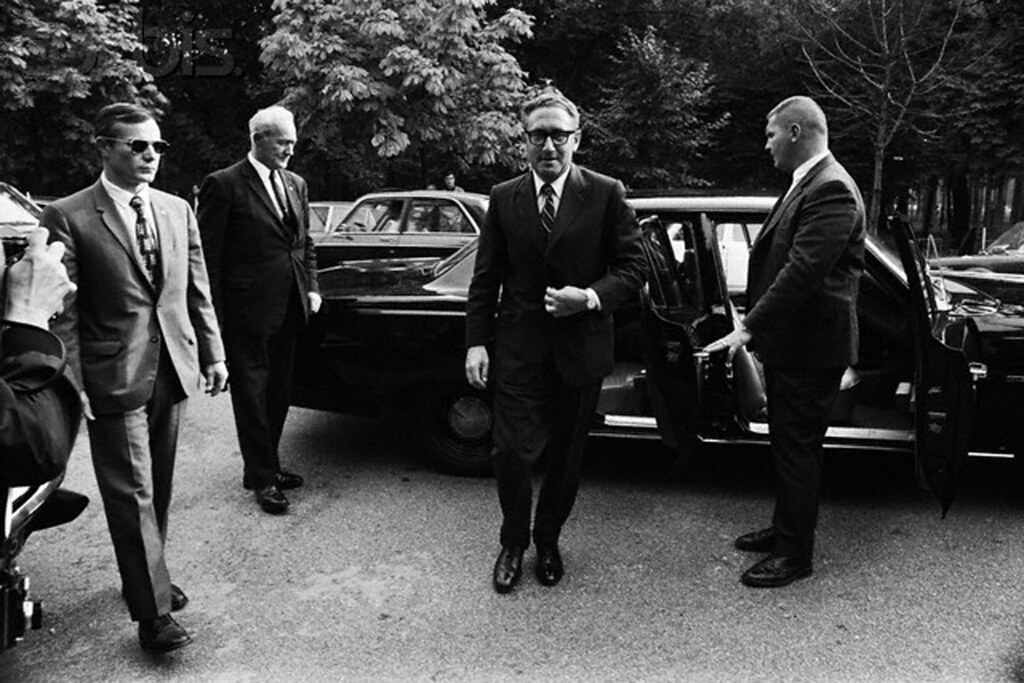
Henry Kissinger in Paris, France, in 1970. (Christian Deville / Apis / Sygma / Corbis via Flickr)
Western Sahara, situated in northwest Africa and occupied by Morocco since 1975, is by far the largest of the seventeen non-self-governing territories listed by the UN in which the decolonization process has yet to be completed. Yet, of all the foreign policy issues covered in this series, the role of the United States in Morocco’s annexation of Western Sahara is likely one of the lesser known. Indeed, the occupation there has long suffered from a general lack of international attention.
Previously known as Spanish Sahara, Western Sahara borders Morocco, Algeria, Mauritania and the Atlantic Ocean. Since the late twentieth century, the overwhelming majority of the territory has been under Moroccan occupation. The Polisario Front, the independence movement of the indigenous Saharawi people, controls the remainder in the form of the Saharawi Arab Democratic Republic (SADR). The two areas are separated by a 2,700 kilometer-long sand wall surrounded by an estimated 9 million landmines. For decades, American engagement in the conflict has been consistent, helping first to shape this situation and then to maintain it.
Under pressure from Morocco, the UN and a growing independence movement, Spain ceded control of the territory it had held since 1884. The United States attempted to portray itself as neutral in the October–November 1975 crisis in which Morocco (backed by France), Mauritania, and the Polisario (backed by Algeria) competed for control of Western Sahara in the face of the impending Spanish withdrawal.