Neoliberal Economists Like Milton Friedman Cheered on Augusto Pinochet’s Dictatorship
Friedrich von Hayek and Milton Friedman are the founding fathers of neoliberal economics. When Augusto Pinochet overthrew Chile’s elected government, they helped devise his economic agenda and endorsed the brutal repression that was needed to force it through.
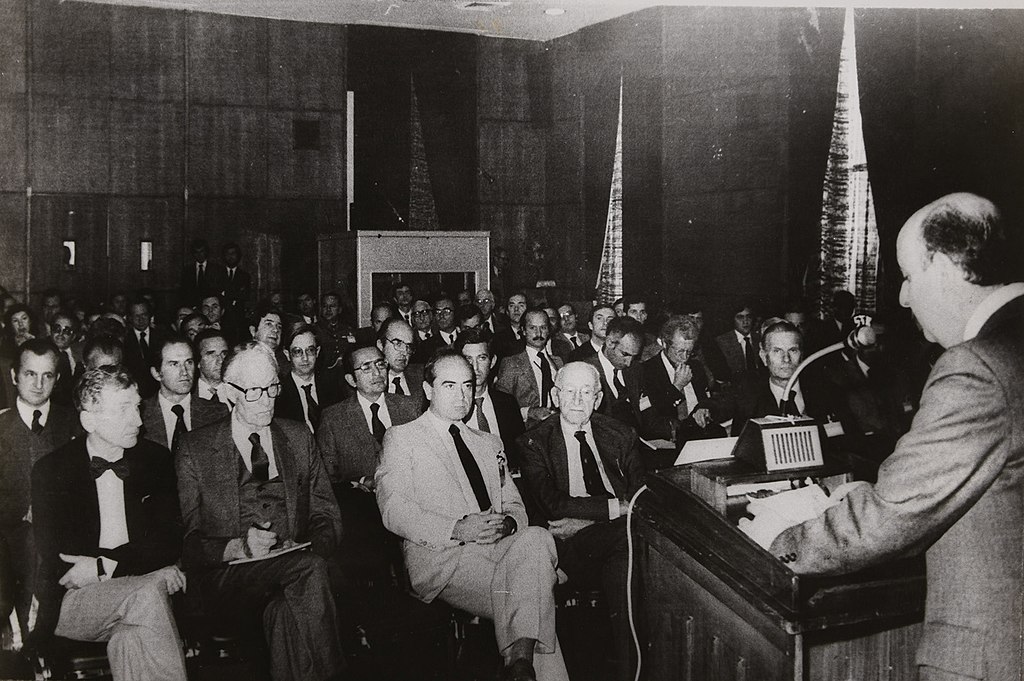
The president of the Centro de Estudios Públicos in Chile, Jorge Cauas, welcomes the conference “Foundations for a Free Social System” in April 1981. Friedrich Hayek can be seen fourth from left in the front row. (Centro de Estudios Públicos via Wikimedia Commons)
In late 1977, as the Chilean military junta extended the state of siege in place since its 1973 coup and formally dissolved all political parties, Friedrich Hayek wrote a letter to a German newspaper, the Frankfurter Allgemeine Zeitung, to protest what he depicted as unfair international criticism of the government of General Augusto Pinochet. When his article was rejected, he wrote to the editor expressing disappointment that the newspaper lacked the “civil courage” to resist popular anti-Pinochet sentiment.
Hayek singled out the human rights organization Amnesty International for turning “slander [into] a weapon of international politics.” After accepting an invitation to lecture in Chile, he complained, he was inundated with phone calls, letters, and anti-Pinochet material by “well-intentioned people I did not know but also from organizations like ‘Amnesty International,’” who asked him to cancel his visit. Hayek’s fellow Mont Pèlerin Society member, the Chicago School economist Milton Friedman, later echoed this assessment, describing Chile as an economic and political “miracle.”
Neither Hayek nor Friedman were detached observers of this “miracle.” Both men gave advice to Pinochet, and both had disciples in his authoritarian government — Friedman among the Chicago-trained técnicos (or “Chicago Boys”), who formulated its economic “shock” program, and Hayek among the conservative Catholic gremialistas, who produced an institutional order to protect the economy from political challenge. These two civilian elite factions were to define the economic and political orientation of Pinochet’s government.