When Neoliberalism Hijacked Human Rights
When the architects of neoliberalism cobbled together their new economic order at Mont Pelerin, they included a moral vision with it. Co-opting the once revolutionary concepts of universal human rights, neoliberals refashioned the idea of freedom by tying it fundamentally to the free market, and turning it into a weapon to be used against anticolonial projects all over the world.
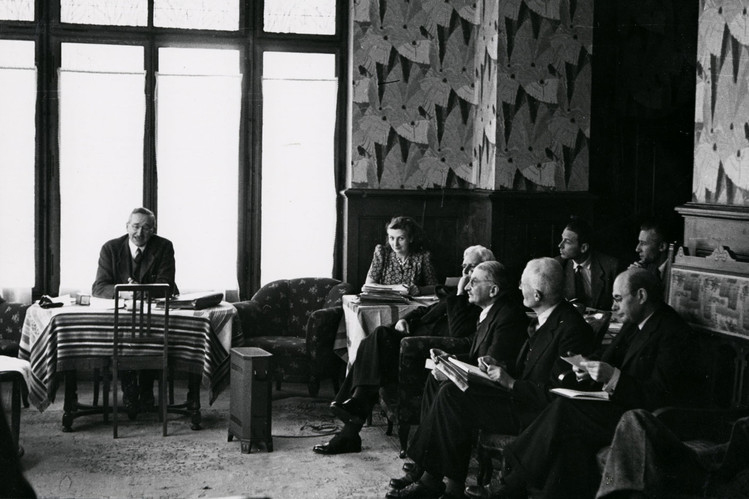
The first meeting of the Mont Pelerin Society, in 1947, with founders, Friedrich Hayek and Ludwig von Mises. (Mont Pelerin Society)
Jessica Whyte begins The Morals of the Market with an anecdote about the 2017 Grenfell Tower fire that is simultaneously horrifying in its crassness and blandly familiar. In the wake of that devastating fire which killed seventy-one people and left hundreds homeless, Jeremy Corbyn quite reasonably suggested that empty investment properties in this upper-class, West London neighborhood might be requisitioned to house survivors currently sleeping on floors in churches, mosques, and local halls.
The temerity of this proposal sparked outrage among the propertied and the invested. It prompted Conservative Party peer Daniel Finkelstein to compare Corbyn to Hugo Chávez in an op-ed for the Times, which argued that the solution to Grenfell lay in the Human Rights Act. Human rights protections exist, he continued, precisely for such an occasion: so that people “can secure their individual liberty — in this case, their property — when the popular will is against them.”
It would be easy, Whyte notes in her introduction, to dismiss Finkelstein’s use of human rights language as baldly cynical and self-serving, a response all too common among academics when confronted with the hypocrisy of public figures like Finkelstein, Niall Ferguson, or Thomas Friedman. Such dismissal, however, fails to grasp the way Finkelstein’s take on human rights “has a long lineage among neoliberal politicians and thinkers.” Indeed, as Whyte demonstrates, this neoliberal understanding of human rights evolved historically alongside and in relation to those “true” human rights that would seem to adhere most logically to a tragedy like the Grenfell fire: the right to adequate housing or the right to water and sanitation.