No, Pride Isn’t for Cops, Too
Stonewall was a riot — but in some cities, Pride officials have banned “political” groups and welcomed cops. Now activists are organizing radical Pride marches to show that Pride is a protest, not just a party.
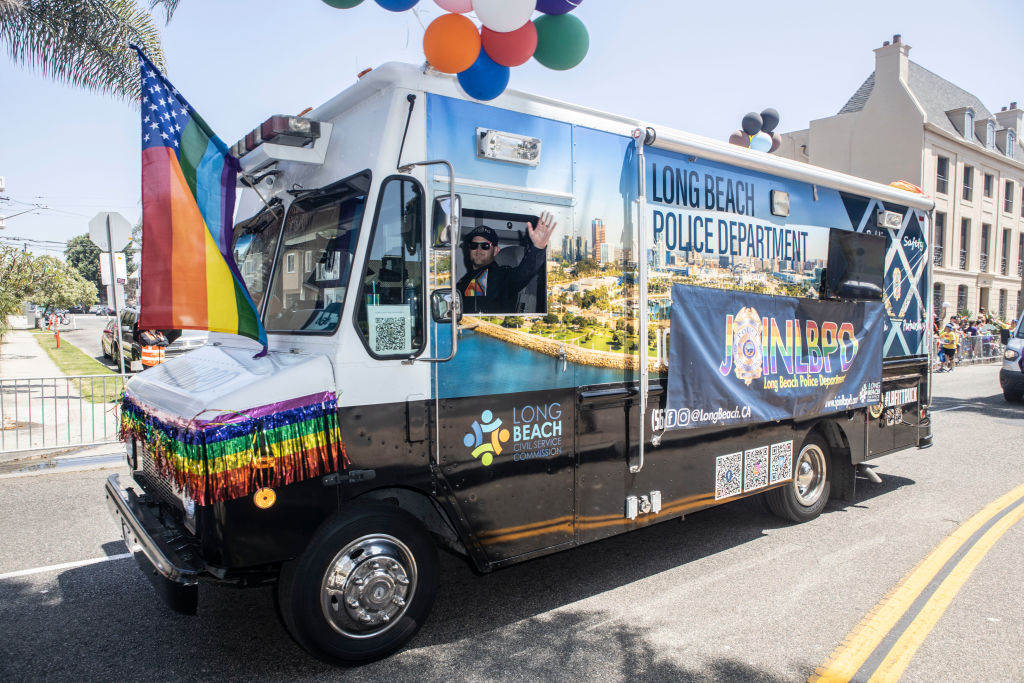
The Long Beach Police Department participates in the Long Beach 40th Annual Parade event on August 6, 2023 in Long Beach, California. (Harmony Gerber / Getty Images)
In 2016, Toronto was preparing for its annual Pride march. For the first time, Canada’s prime minister, Justin Trudeau, would attend alongside the thousands in the parade, with Black Lives Matter (BLM) as guests of honor. But BLM was angry, after years of seeing Blockorama — the only Pride month event for black queers — moved further from the march, even as police were welcomed at the parade. Objecting to their presence, BLM blocked the march for thirty minutes.
This cop involvement especially mattered because Toronto Pride had first begun in 1981 as a protest against a police raid on four bathhouses in the city. That February, officers armed with crowbars and sledgehammers had arrested over two hundred fifty gay men in “Operation Soap.” Black activists who participated in that first Pride were back in 2016 and were joined by both younger protesters and indigenous drummers in bringing the march to a halt. Faced with the protests, Toronto Pride’s executive director, Mathieu Chantelois, signed off on BLM’s demand not to allow the police to return in future — but then backtracked, claiming he had only done so to get the march moving again. After widespread criticism, Chantelois resigned; next time around, the police float was noticeably absent.
Toronto is hardly the only city where police have joined Pride. In a similar action in Britain last year, activists from Lesbians and Gays Support the Migrants (LGSM) broke through the barriers at London’s Pride march to stage a die-in. Holding funeral bouquets and draped in pink veils, they held up the march for twenty-three minutes — one minute for each person that had died in police custody since 2020 — to protest metropolitan police officers joining the parade.