Keep Your Guns and Batons Away From My Pride Parade
The queer left should loudly and proudly reject the participation of armed and uniformed cops marching at Pride. The world we envision won’t be achieved with more LGBTQ police officers.
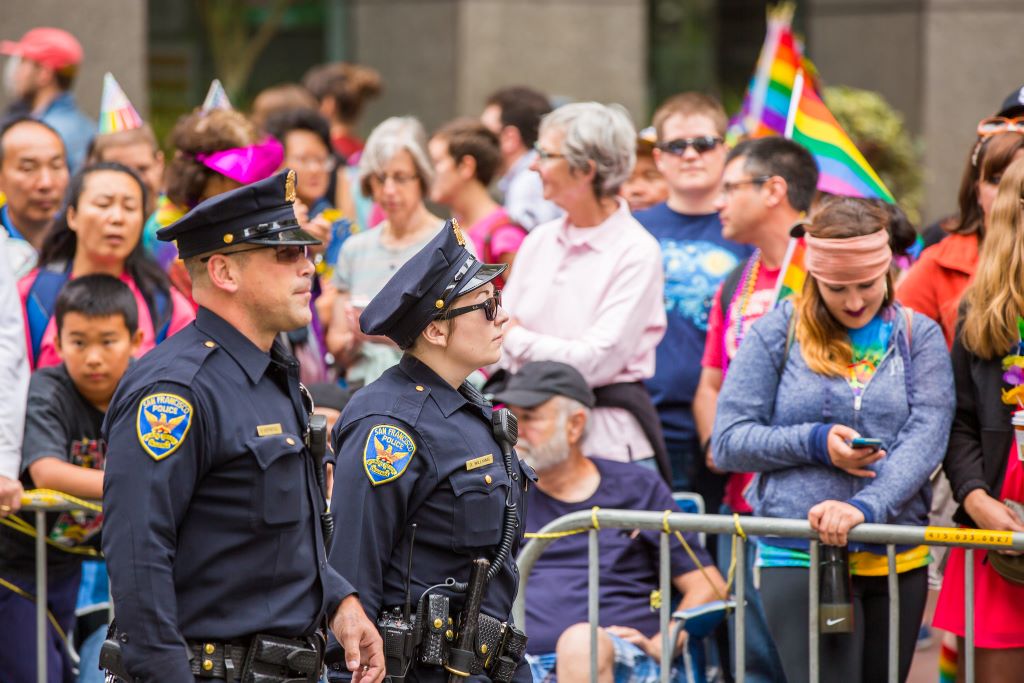
Police officers at the 2015 Pride parade in San Francisco, CA. (Thomas Hawk / Flickr)
The participation of cops at Pride events has always been controversial. Now, in the wake of the murder of George Floyd and the uprising that followed, more local Pride march planning boards are reexamining how they involve police. This year parade planners have chosen to ban police officers from marching in uniform in cities across the United States, including Philadelphia, New York City, and San Francisco — decisions that have led to heated debates within LGBTQ communities as well as pushback from politicians.
In San Francisco, police officers were initially told they could march in the city’s Pride parades dressed in civilian clothing representing their department, just like any other work-based group, but that they had to ditch their official uniforms (and guns). Unsatisfied with the prospect of marching out of uniform, the police department announced that it would boycott the parade, and Mayor London Breed joined them. Breed’s statement argued that Pride parade organizers were hypocrites: “We can’t say, ‘We want more Black officers,’ or ‘We want more LGBTQ officers,’ and then treat those officers with disrespect when they actually step up and serve.” Within a couple weeks, San Francisco Pride buckled to the pressure and reversed their decision.
Pride events are often corporate-sponsored and watered down to begin with, which leads many on the queer left to write them off as lost causes. But the co-optation of Pride isn’t inevitable and doesn’t have to be accepted. The queer left should loudly and proudly reject the participation of armed and uniformed cops marching at Pride. The world we envision won’t be achieved with more LGBTQ officers. We want to rethink the role of police in our society — and our own history and experiences teach us why.