MLK Was an Exemplar of a Black Socialist Tradition
Martin Luther King Jr had a rich relationship with socialist politics: he sympathized with but ultimately rejected Marxism, and he settled on a Christian socialism that viewed the struggle against racism and class oppression as fundamentally intertwined.
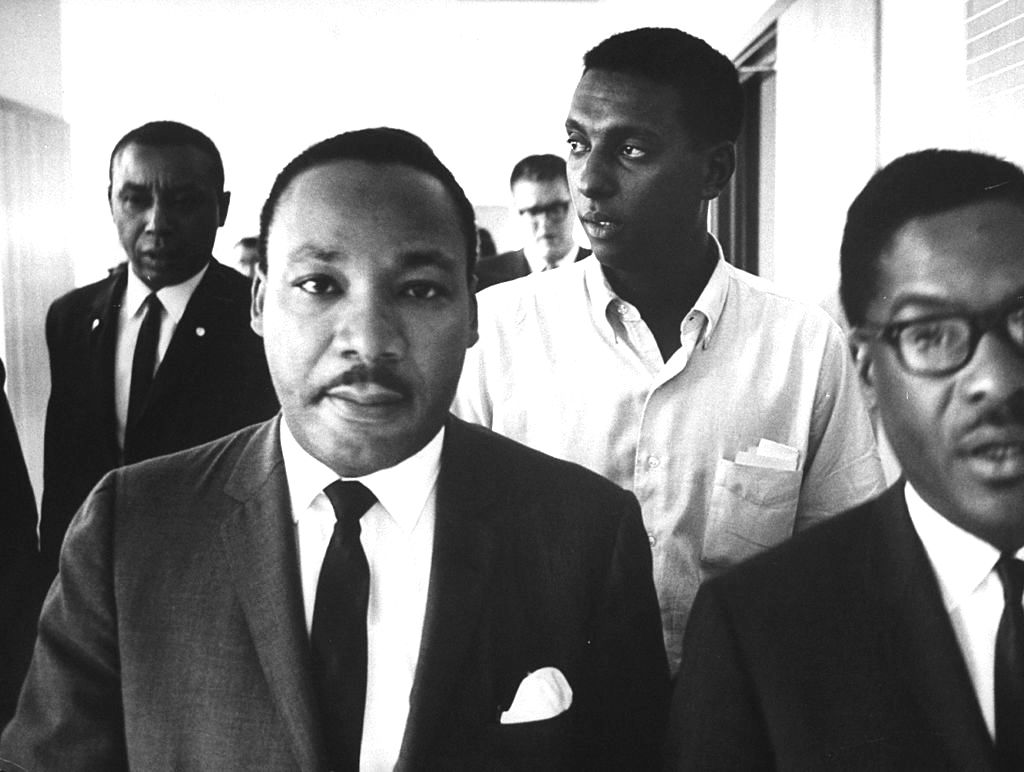
Martin Luther King Jr with civil rights leaders Floyd McKissick and Stokely Carmichael during a march through Mississippi to encourage voter registration. (Vernon Merritt III / Getty Images)
That Martin Luther King Jr “refused to repudiate Marxism wholesale” is now well established, with historians pointing out his deep-rooted concern for economic structural inequality. King did not shy away from speaking his mind within his closest circle. While quarreling with civil rights leader Andrew Young’s centrism, he alleged: “You’re a capitalist and I am not.” According to King biographer David Garrow, while talking to his friends in the 1960s, the preacher admitted that “economically speaking he considered himself what he termed a Marxist, largely because he believed with increasing strength that American society needed a radical redistribution of wealth and economic power to achieve even a rough form of social justice.”
He had entertained such ideas for a long time, formulating very early on the substance of his critique against capitalism and wealth inequalities. Rev. J. Pius Barbour, mentor and friend to the Kings, reminisced that when Martin was a young seminarian, he hinted at his socialistic leanings, saying that “Marx had analyzed the economic side of capitalism right” as “the capitalistic system was predicated on exploitation and prejudice, poverty.” In a letter he wrote to his future wife, Coretta, in 1952, King confided that he gravitated more toward socialism than toward capitalism.
That King eschewed using the word “socialist” publicly until his final days was arguably less an expression of his genuine reluctance than a prophylactic measure to avoid the stigma and the governmental harassment suffered by dozens of black radical activists. In a telling fashion, black radical writers and activists summoned to testify before “loyalty boards” were asked, “Do you think an outspoken philosophy of race favoring equality is an index of communism?”