Civil Rights Unionism
In 1940s North Carolina, a Communist-led union of tobacco workers fought to bring democracy to the Jim Crow South.
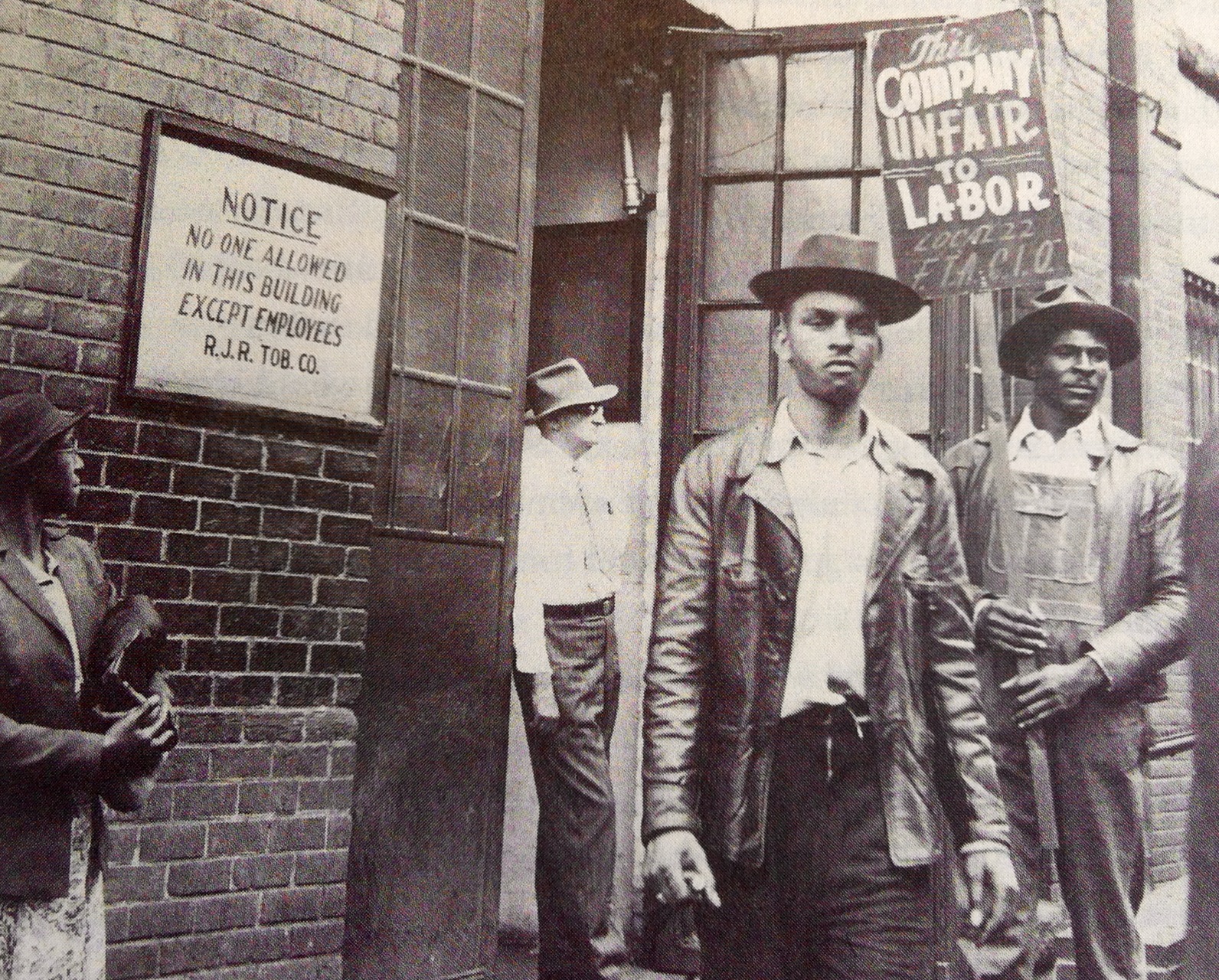
An R. J. Reynolds supervisor watches workers during a 1947 strike by Local 22.
When CIO organizers first arrived in Winston-Salem in 1941, Robert Black was a lanky young baseball player who could barely imagine that a trade union might some day bring “that big giant,” R. J. Reynolds, “down to earth.” By the end of the war, Black not only stood at the helm of the South’s largest black-led local, he also found himself at the epicenter of a political struggle that turned on the enfranchisement and mobilization of the South’s black and white poor.
Local 22 had never limited itself to workplace demands. Even before it gained recognition, it had taken up broader civic issues, supporting the federal government’s wartime price controls; helping to defend William Wellman, a black North Carolina man, against a death sentence on a false rape charge; backing a black candidate for the Board of Alderman; and joining forces with the city’s dynamic young ministers to help blacks register to vote. Once established, the union put voting rights and education for active citizenship at the top of its agenda.
This linkage between union building and social transformation propelled Local 22 beyond the bounds of conventional trade unionism. As Black recalled, “After we built our union, we told the people that just to build a union is not going to solve all of our problems. . . . If you are going to defeat these people, not only do you do it across the negotiating table in the R. J. Reynolds Building, but you go to the city hall, you elect people down there that’s going to be favorable and sympathetic and represent the best interest of the working class.”