The Constitution Can Be a Weapon in the Battle Against Oligarchy
From the US’s beginnings, progressive forces have tried to use the Constitution to expand democracy and resist rule by the rich. But overcoming oligarchical threats to freedom and democracy requires understanding the structural basis of capitalist domination.
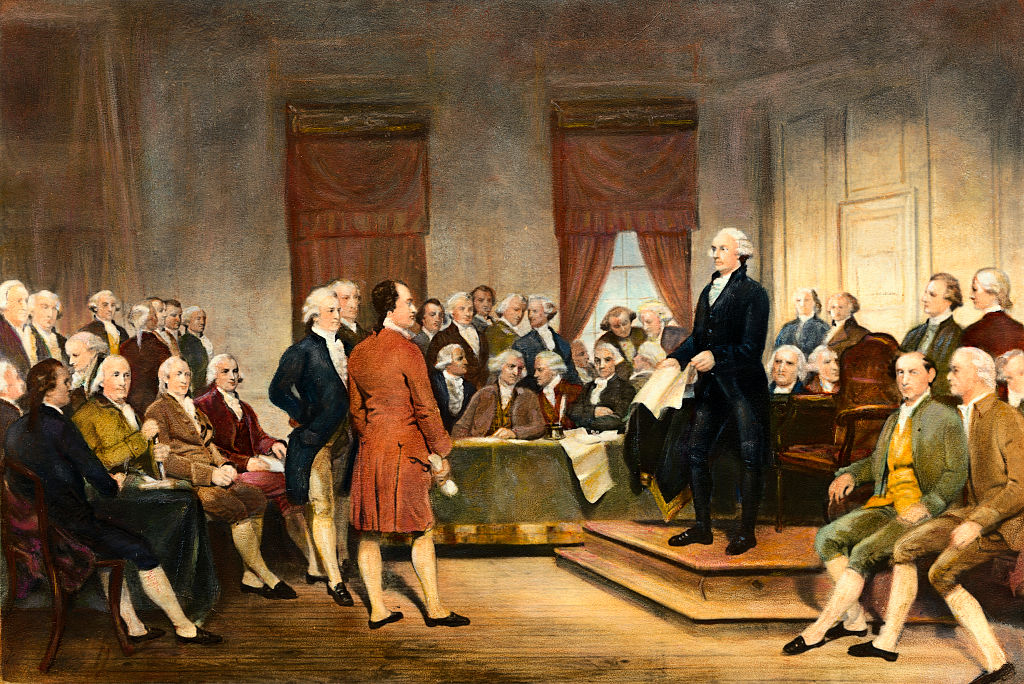
The signing of the US Constitution in 1787, painted by Junius Brutus Stearns. (Bettmann / Getty Images)
Joseph Fishkin and William E. Forbath begin their sweeping history of our nation’s “constitutional political economy” with the recognition that “[o]ur constitutional system is headed for a historic confrontation.” Income and wealth inequality have reached historic proportions. But legal and legislative responses to this crisis confront decades of neoliberal orthodoxy and conservative judicial reaction. Fishkin and Forbath hope to counter this neoliberal offensive by construing inequality as a problem of domination. What this review hopes to show is that understanding precisely the nature of this domination is essential for overcoming the oligarchical dangers that Fishkin and Forbath bemoan.
The Anti-Oligarchy Constitution’s key argument is that we currently lack the constitutional language required to address inequality and its many social ills. Our prevailing horizon of thinking about the Constitution is determined by what the oracular Supreme Court proclaims it will limit or permit. This is an individualizing conception of the Constitution that is centered on a narrow interpretation of negative liberty and “assume[s] that the only real constitutional claims are the ones enforceable in court.”
The Constitution’s Democratic Substance
Through a historical retelling, Fishkin and Forbath advance an alternative vision of the Constitution. This is a structural, political, and “positive” vision, one focused on what the Constitution demands from the people and their representatives in Congress as much as what the Supreme Court says it forbids. In this view, the Constitution is not — or is not just — an “outside constraint” on democratic politics. Rather, the Constitution forms the substance of a “democratic constitutional politics.”