The Floods Devastating Pakistan Are More Than a Natural Disaster
Monsoon rains and melting glaciers have driven tens of millions of Pakistanis from their homes. The disaster shows that the poor Global South populations who do least to cause climate change are the people who pay most for its consequences.
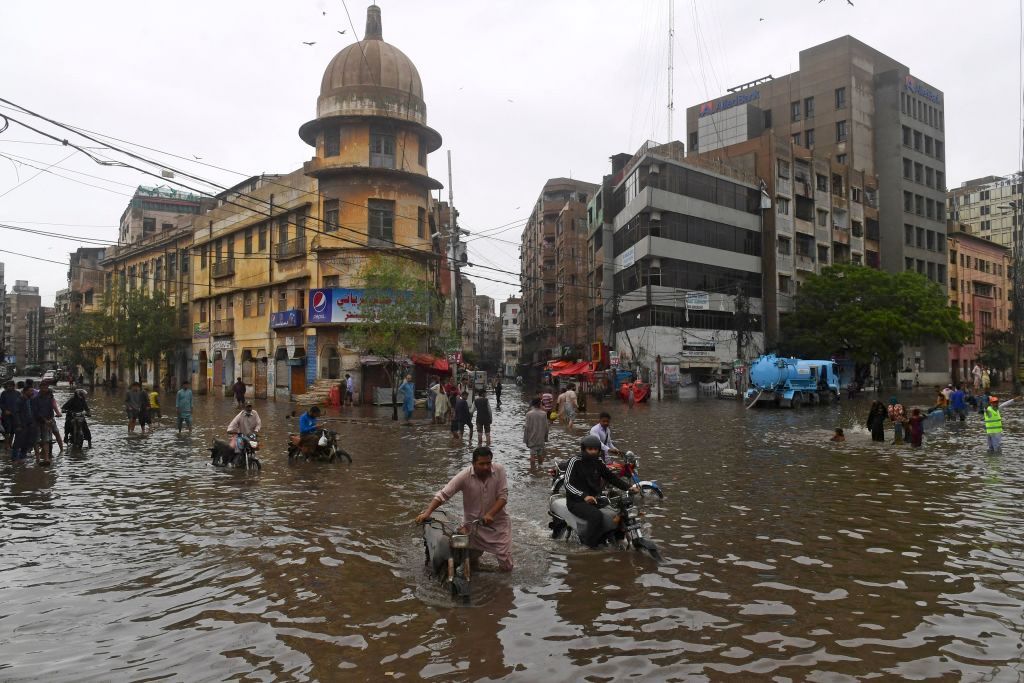
People wade across a flooded street after heavy monsoon rainfall in Karachi, Pakistan on July 25, 2022. (Asif Hassan / AFP via Getty Images)
A decade since the last mega-floods that hit Pakistan in 2010, the country is once again reeling from devastation on an unimaginable scale. Monsoon rains and melting glaciers have combined to displace at least 35 million people from their homes while over a thousand people are already reported dead. It is estimated that Pakistan is losing at least $10 billion due to the widespread destruction caused by the floods. Moreover, agriculture and livestock has been destroyed on a massive scale, triggering fears of severe food shortages in the coming months.
Both locally and internationally, remarkably little media coverage was given to the floods that began hitting Balochistan province in July. Instead, public discussion was dominated by the power struggle between ousted leader Imran Khan‘s party and the Pakistan Democratic Movement (PDM) coalition government — including the crucial by-elections in the Punjab province. In August, both sides began filing politically motivated cases against their opponents; the arrest of Shahbaz Gill, chief of staff in Khan’s Pakistan Tehreek-e-Insaf (PTI) party, further polarized the political landscape, with expectations of more showdowns in the coming weeks.
Yet while political commentators in Islamabad and abroad were busy reporting every detail of the political gossip generated in the center, faint cries of help began circulating on social media from people affected on the peripheries of Pakistan. Soon, floods began overwhelming areas in Sindh and south Punjab. The first time floods became the main headline on a Pakistani channel was August 23. By this time, more than twenty million people had already been affected, making it the worst natural disaster in the country’s recent history.
The media’s delayed response to the climate catastrophe is partly explained by the fact that the narrative around “natural disasters” does not easily offer a neat categorization of heroes and villains. This turns them into a tragedy that can invoke global pity but is unable to generate political contestation. Yet, politics really is at the heart of the tragedy today unfolding in Pakistan. It is thus imperative to nominate the villains responsible for the needless suffering of millions of people.
Erasure of Politics
The unprecedented monsoon rains (which followed an unprecedented heat wave across the country) that caused flooding in Pakistan are the predictable horrors of climate change, the result of a fossil-fueled political economy of capitalism. It is widely understood that colonialism and imperialism thwarted the development of poor countries, allowing the Global North to benefit from exploiting the former. According to economic historian Utsa Patnaik, the damage done to the Indian economy alone by the British equaled $45 trillion, thus creating islands of prosperity in the metropole while subjecting millions in the colonies to poverty, unemployment, and starvation.
This exploitative relation is exacerbated when we examine how greenhouse emissions in the Global North are leading to a climate breakdown, affecting countries that are not only vulnerable to climate change but also do not have the financial capacity for rehabilitation or building climate resilient infrastructure. For example, the Global North had already exceeded its share of safe emissions in 1939, almost eight decades before the current flooding we are witnessing.
Pakistan has not even used its fair share of safe emissions (since 1959, the country has contributed 0.4 percent to total greenhouse gasses) whereas countries in the Global North have exceeded their quotas by 90 percent. We also know that a hundred companies are responsible for 71 percent of emissions, while the top twenty polluters have caused one-third of greenhouse gasses in the atmosphere. The ghosts of the past are coming back to haunt those who played no role in nurturing them.
The time and spatial lag between the causes and effects of climate change is one of the primary reasons why it is easy for liberals to present such disasters as “humanitarian” issues, erasing the political roots of the tragedy. As Fredric Jameson reminds us, this amnesia is built into the logic of capitalism, as the accumulated exploitation of the past is deployed to control the present. But since this past is rendered invisible in the commodities exchanged on the market, it appears as if this exchange is equal. In other words, capitalism appears natural, but presupposes a history of violence and exploitation — a history that capital negates and suppresses in its own development.
The erasure, from public discourse, of polluters who are primarily responsible for the suffering of millions of people and for threatening planetary catastrophe, is itself part of this process of exploiting the time and spatial lag between greenhouse emissions and their deadly consequences. The result is an attempt to depoliticize this suffering and obstructing accountability of countries and companies in the Global North — giving the false impression that we are “all in this together” as one threatened human family.
The Debt Juggernaut
Pakistan was already dealing with a dire economic crisis when the floods hit the country. There was an acute balance of payment crisis when PDM ousted Khan’s government in April while the external debt was estimated at $28 billion. As the new government sought International Monetary Fund (IMF) assistance, one of the key demands of the financial institution was to end subsidies on oil and to increase tariffs on electricity consumption. As the PDM government capitulated to these demands, inflation reached up to 27 percent. While the poorest and the middle class were hit the hardest, elite privileges, which were estimated to be $17.4 billion in a United Nations Development Programme (UNDP) report, remained untouched. In other words, we witnessed a grotesque example of austerity for the poor but socialism for the rich.
In early August, the government announced another exorbitant increase in electricity tariffs, leading to spontaneous protests across the country. The government was then forced to reverse some terms of the hike due to public pressure, but the overall dismal living conditions continue to haunt ordinary citizens; 40 percent of deaths are due to waterborne diseases, around 40 percent of children are malnourished, and twenty million are deprived of schools. While the future looks bleak for the public, the IMF expects Pakistan to continue “restructuring” its economy in tune with market forces.
It is pertinent to remember that Pakistan’s debt has been used to fuel an elite-driven economy controlled by feudal elites, real estate tycoons, and military businesses. In fact, most of Pakistan’s loans were doled out to military dictators who played a key role as the strategic allies of the United States in the Cold War and the “war on terror.” Yet, it is the public that is forced to pay the price of US imperialism’s alliance with Pakistan’s ruling elites.
History’s Debt
Even before the floods, it was clear that Pakistan’s economy could no longer sustain the exorbitant taxes demanded by the IMF, particularly without touching the privileges of the elites. With floods that have caused over $10 billion in damages, it is clear that Pakistan will require unprecedented support from the world. It is perhaps also an ideal time to open debate on correcting historical wrongs, including cancellation of debt, as part of global efforts toward climate justice.
Fortunately, this demand is now gaining momentum in mainstream discussions. Many organizations, including the Committee for the Abolition of Illegitimate Debt, have long argued that loans acquired due to colonial plunder and military dictatorships must be declared “odious” and be canceled. Now, there are growing calls by activists, frontline communities, and academics to cancel debt as part of climate reparations for countries in the Global South. The Intergovernmental Panel on Climate Change has also accepted the role of colonialism in deepening global warming, further strengthening the case for reparations.
Activists in Pakistan are also demanding that creditors in the Global North cancel Pakistan’s debt, provide investment and technological transfer for building climate resilient infrastructure, and hold their fossil fuel companies responsible for polluting the planet. This is on top of the $100 billion dollars committed to poor countries in the Paris Accords, a commitment that has not been honored as yet. These demands should not be confused with a nationalist claim in which South and North become reified categories. Rather, as suggested earlier, the role of the ruling elites in Pakistan (and arguably across the Global South) in handling economic and climate issues has been dismal.
Instead, these demands are meant to be a point of departure for a politics that takes questions of historical injustice, imperialism, and capitalism seriously in order to create an alternative order. It can provide the glue that connects socialists in the Global North fighting militarism, jingoism, and fossil companies with socialists in the Global South who are fighting back the exploitative nexus between local elites, foreign countries, and international financial institutions. In other words, it is a call to begin a shared international project that presents a bold vision for the future rather than limiting the realm of possibilities to philanthropic endeavors.
Corporate greed and financial speculation have proven incompatible with the sustainability of life. The twin crisis of indebtedness and climate catastrophe in Pakistan gives us a blueprint for a dystopian future, but also provides an opportunity to change the course of history. No poor country can rebuild itself after facing the scale of destruction we have seen in Pakistan. Either this will lead to the intensification of walls, violence, and censorship as frontline communities become sacrifice zones for corporate greed and recklessness, or we will witness global solidarity where we assert our common humanity by redistributing resources and mitigating historical wrongs. Internationalism or apartheid are the options which the climate crisis presents to humanity. It is time we all choose a side.