Japan’s Peaceful Foreign Policy Is Under Siege From Right-Wing Militarism
Seventy-five years ago today, Japan adopted a constitution that ruled out ever using war as a tool of state policy. The country’s conservative leaders now want to ditch that commitment as they embrace the dangerous role of a militarized US client state.
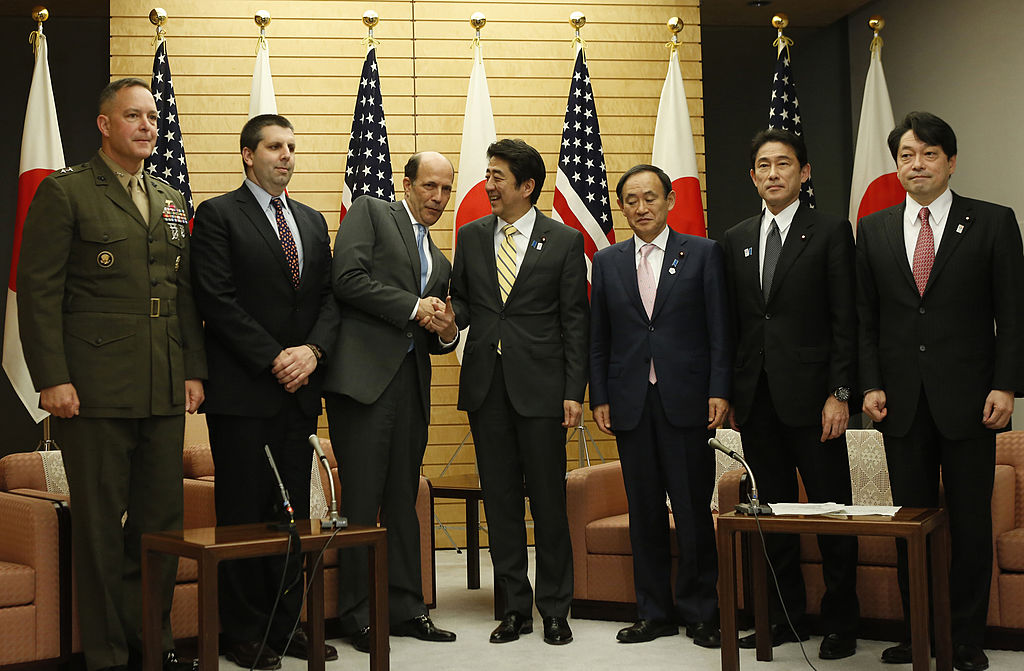
Former prime minister Shinzo Abe (4th L) and former US ambassador to Japan John Roos (3rd L) exchange smiles with then chief cabinet secretary Yoshihiko Suga (3rd R) and then foreign minister Fumio Kishida (2nd R) at the joint announcement on a US-Japan agreement to install some US bases in Okinawa, in Tokyo April 5, 2013. (Issei Kato / AFP via Getty Images)
Uniquely among the world’s constitutions, Japan’s was drawn up in 1946 at the behest of a foreign, occupying force. Having come into force in May 1947, it now celebrates its 75th year, unrevised.
US general Douglas MacArthur, who then ran the country, resisted global demands that Japan’s wartime commander in chief, the emperor Hirohito, be indicted for war crimes and instead insisted he remain “at the head of the state.” Since this provoked great suspicion in the countries to which Japan’s forces had laid waste throughout the Asia-Pacific region between 1931 and 1945, the constitution’s first eight clauses, devoted to defining Hirohito’s position and powers, were followed by the famous Article 9.
Its wording spelled out the principle of state pacifism: