No, Japan Should Not Remilitarize
Washington’s push to rebuild Japan’s military, disbanded after World War II, is incredibly dangerous. Not only would remilitarization stoke conflict in the region, it would also embolden the growing Japanese far right.
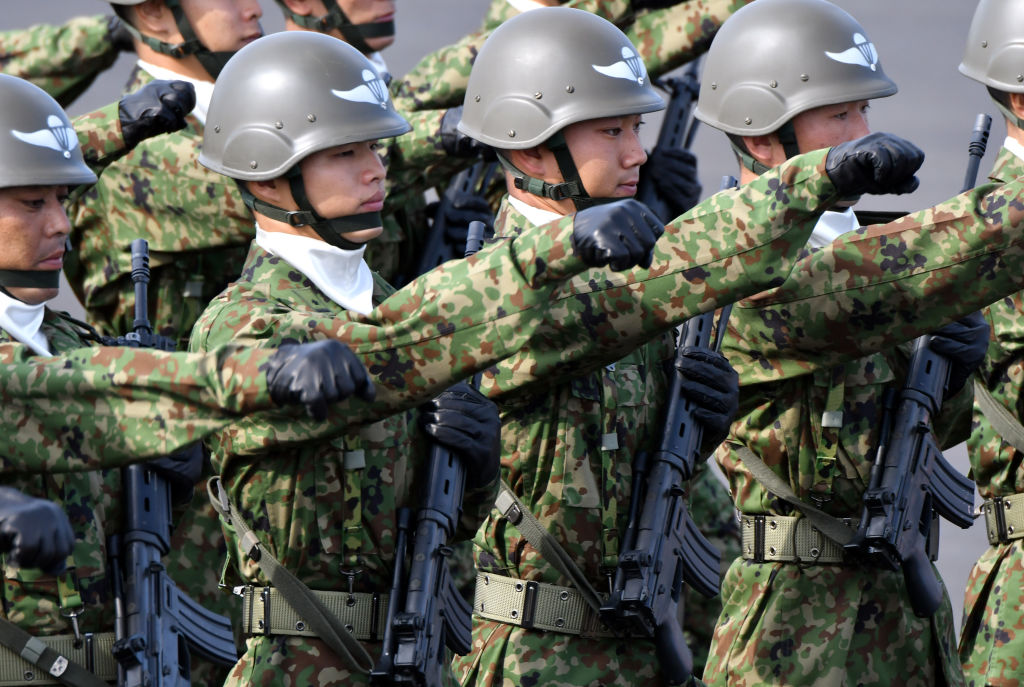
Infantry units of the Japan Self-Defense Forces march during a review at Camp Asaka in 2016. (Katsumi Kasahara / Gamma-Rapho via Getty Images)
In 1983, Prime Minister Yasuhiro Nakasone pledged to Ronald Reagan that Japan was America’s “unsinkable aircraft carrier.” Today those words echo louder than ever. Since 2011, the United States’ pivot to Asia — the reorientation of its military power from the Middle East to the Asia-Pacific region — has escalated tensions between the United States and China and North Korea, and Japan is the tip of America’s spear.
This is advantageous for Japan’s rising far right. Also in 2011, the Fukushima nuclear disaster precipitated an economic slump, which compounded the effects of earlier financial crises and contributed to the decay of Japanese civil society. As elsewhere, reactionary politics have rushed in to fill the void. As China and North Korea loom large, the Japanese far right has finally found an opportunity to carry out its long-cherished project of transforming the Japanese Self-Defense Forces (JSDF) into a fully functional and independent military — with Washington’s encouragement.
As the Japanese far right has established a political presence over the last decade, the curtailing of civil liberties, a swell of nationalist sentiment (articulated frequently in the demand for remilitarization), and even the jailing of dissenters have followed. Other East Asian nations, including China, are understandably concerned about Japanese remilitarization, as the forces unleashed in 2011 threaten to change Japan beyond all recognition.