Colonial Nostalgia Continues to Define France’s Relationship to Africa
At home, French politicians mainstream far-right conspiracies about the replacement of whites by African immigrants. Abroad, they continue to intervene militarily and economically in the continent. Both are signs of a nation unwilling to accept its decline.
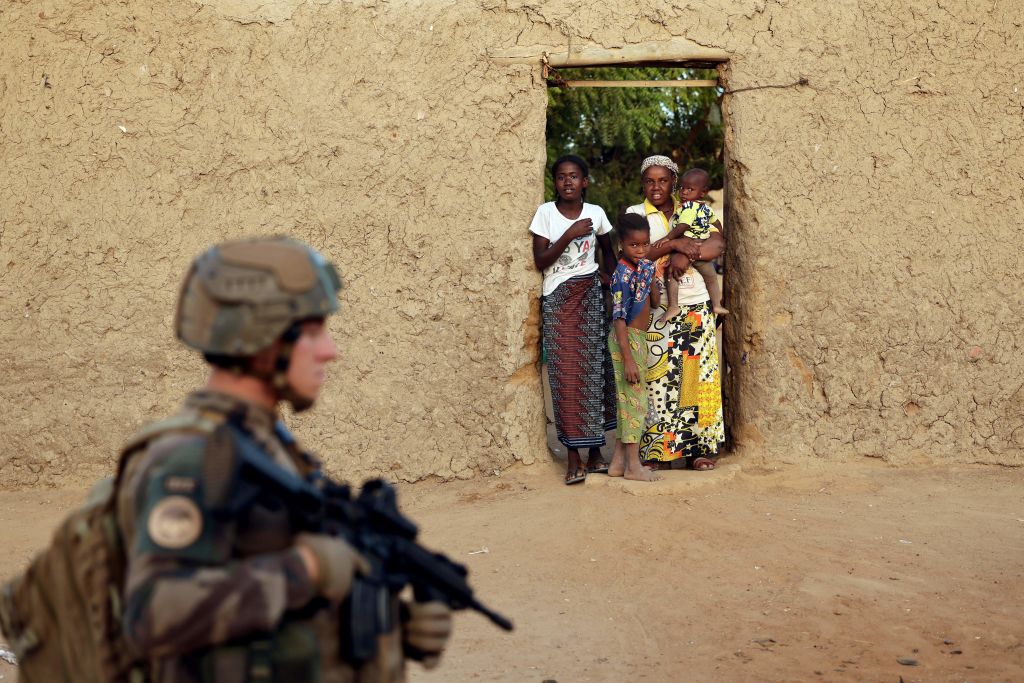
A French soldier patrols the streets of Gao, Mali, December 2021. (THOMAS COEX/AFP via Getty Images)
In 2017, six months after his victory over the far-right candidate Marine Le Pen in the second round of the French presidential elections, Emmanuel Macron delivered a speech in front of a packed crowd in Ouagadougou, the capital of Burkina Faso. “I am from a generation that has never known a colonized Africa,” he told his audience, before promising a new relationship with the continent, one between friends, shorn of the arrogance that has characterized France’s conduct in Françafrique in the half century since formal independence was achieved in 1960.
Macron’s promise of a new relationship with Africa is one trotted out by every French political luminary in recent memory. In 2006, it was the turn of Nicolas Sarkozy, then an ambitious minister of the interior with his eye on the upcoming presidential election. Fresh from sponsoring a restrictive immigration bill, Sarkozy arrived in Benin to be greeted by protests over his racist policies. Unbowed, he gave a speech promising that Franco-African relations would dispense with the informal elite clientelism beloved by previous French presidents, who had conducted foreign policy in Africa through secret agreements made behind closed doors, reliant on a network of elite actors. A year is a long time in politics. After Sarkozy became president in 2007, Françafrique was rife with the sort of personalized elite relationships based on friendships between African rulers and French politicians that he had decried in Benin.
Sarkozy’s reign offers the basic formula of French politics in Africa: a lurch to the right in the metropole, characterized by strident anti-immigrant policies and fearmongering about an endangered — white — French electorate; a promise of a new dawn made in Africa; and a politics of elite connivance and manipulation in what France has long considered a zone of limited French sovereignty, and in which ultimate power has always rested in Paris.