The Aboriginal Tent Embassy Is Still Fighting for Justice
Fifty years ago today, the Aboriginal Tent Embassy was established in Canberra. It successfully pushed Australia’s government to establish indigenous land rights in the 1970s and helped create a model for militant action in indigenous rights struggles today.
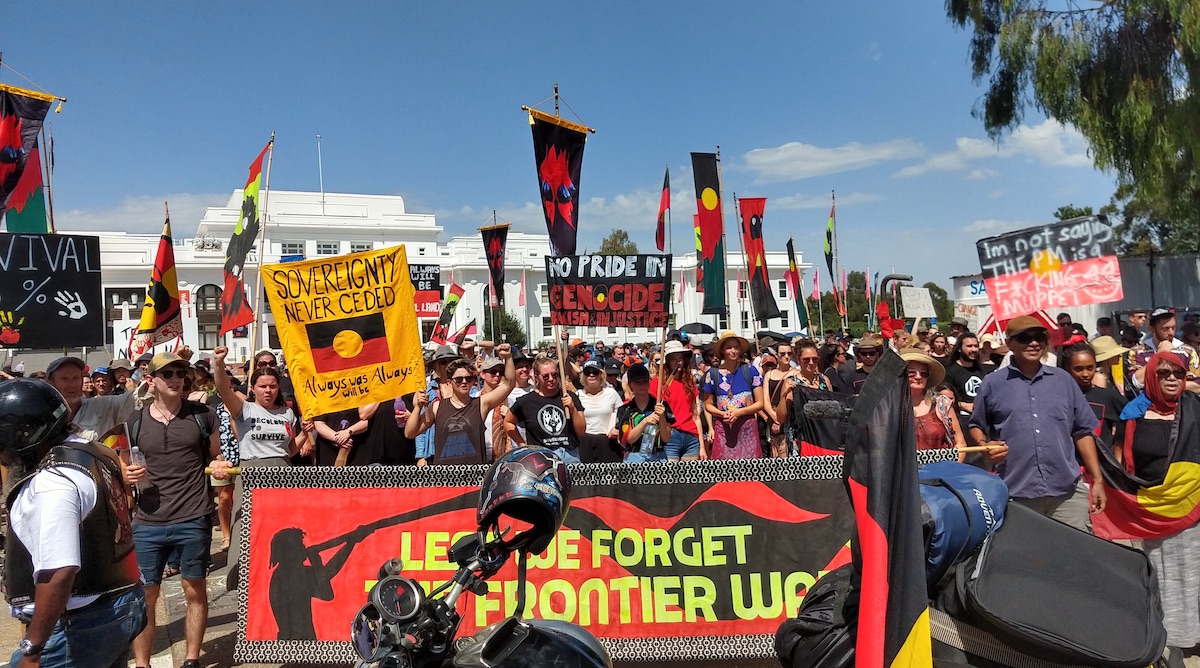
Protesters gather for a march at the Aboriginal Tent Embassy in 2019. (Edgar Crook / Flickr)
On the evening of January 26, 1972, a car of four young men set out for Canberra from Sydney’s inner-city suburb of Redfern. The group considered themselves ambassadors, delegates from a broader collective of radical Aboriginal activists who had been gathering and organizing in the community — and on this occasion, listening to the Australia Day statement just delivered by then conservative coalition prime minister William McMahon.
They arrived in the capital with a statement of their own. Pitching a beach umbrella in the dawn on the lawn outside the Federal Parliament House, they put up a sign with the words “Aboriginal Embassy.” When the group was approached the next morning by the Commonwealth police about their purpose there, their response was, “We’re having a protest.” The protest, they went on to explain, would continue until the government granted land rights to Aboriginal people. “That could be forever,” one police officer remarked.
Today an assembly of tents remains encamped under the same name and at the same site outside the now Old Parliament House in what has become heritage-listed as the world’s longest-standing protest. Despite multiple counts of forced dismantling and relocation, the embassy remains as a visible emblem of resistance.