Australia’s Voice Referendum Is Losing Thanks to the “Radical Centrism” of Its Architects
Later this year, Australia will vote in a referendum on creating an Aboriginal Voice to advise parliament. The Yes campaign is flagging, hobbled by a technocratic strategy and language borrowed from corporate social responsibility values statements.
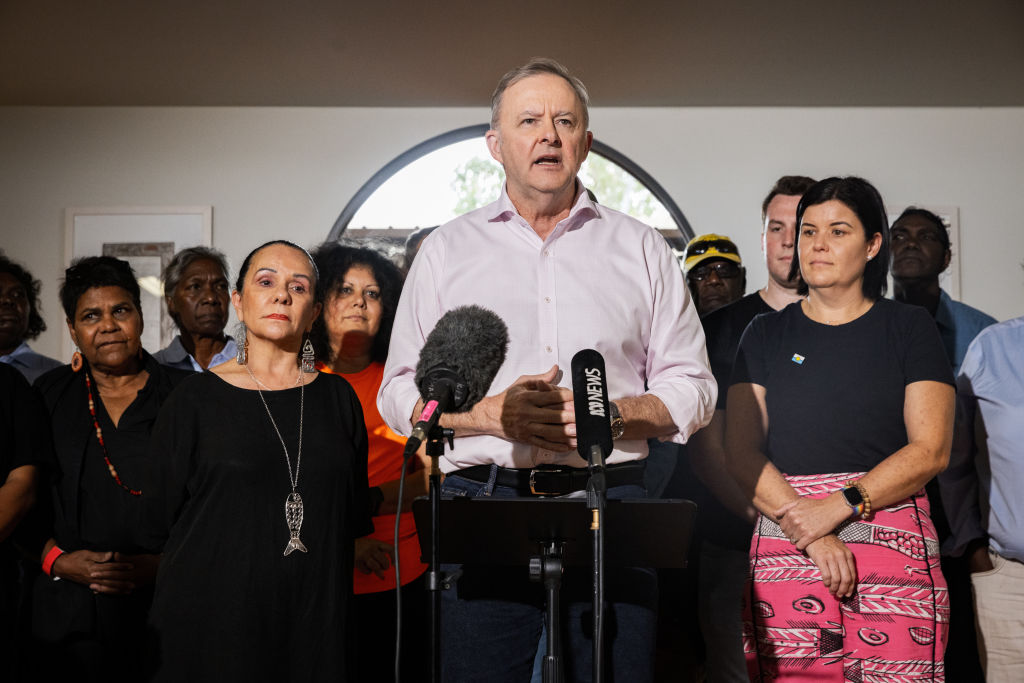
Australian prime minister Anthony Albanese at a press conference during Garma Festival 2022 at Gulkula on August 4, 2023, in East Arnhem, Australia. (Tamati Smith / Getty Images)
Between October and December this year, Australians will vote in a referendum to enshrine an Aboriginal and Torres Strait Islander Voice to Parliament in the Constitution. Championed by Labor prime minister Anthony Albanese, if the voice referendum passes, it will require parliament to legislate for a body of Aboriginal and Torres Strait Islander people to advise the government of the day. As Albanese has stressed, the Voice will have no power to legislate and will remain subordinate to parliament. Rather, its function will be purely advisory.
Opponents of the Voice have described it hyperbolically, as a House of Lords or a fourth layer of government. However, Liberal pro-Voice MP Julian Leeser was probably closer to the truth in a recent op-ed, where he observed that its work will largely revolve around trying to “better direct Federal Government funds” allocated to Indigenous communities and organizations.
Some supporters of the Voice have matched their opponents’ rhetorical excess. Noel Pearson — a Guugu-Yimithirr man, right-winger, and one of the architects of the Voice — has argued that “Australia is an incomplete idea” and that the Voice represents an “opportunity to make it complete.” Cobble Cobble woman and academic Megan Davis has argued that constitutional recognition via an Indigenous parliamentary body is an important step toward self-determination.