Why the Paris Commune Still Resonates, 150 Years Later
The Paris Commune ended on this day in 1871, after just two months in power. How do we explain, Enzo Traverso asks, the longevity and freshness of the memory of a fleeting revolutionary government?
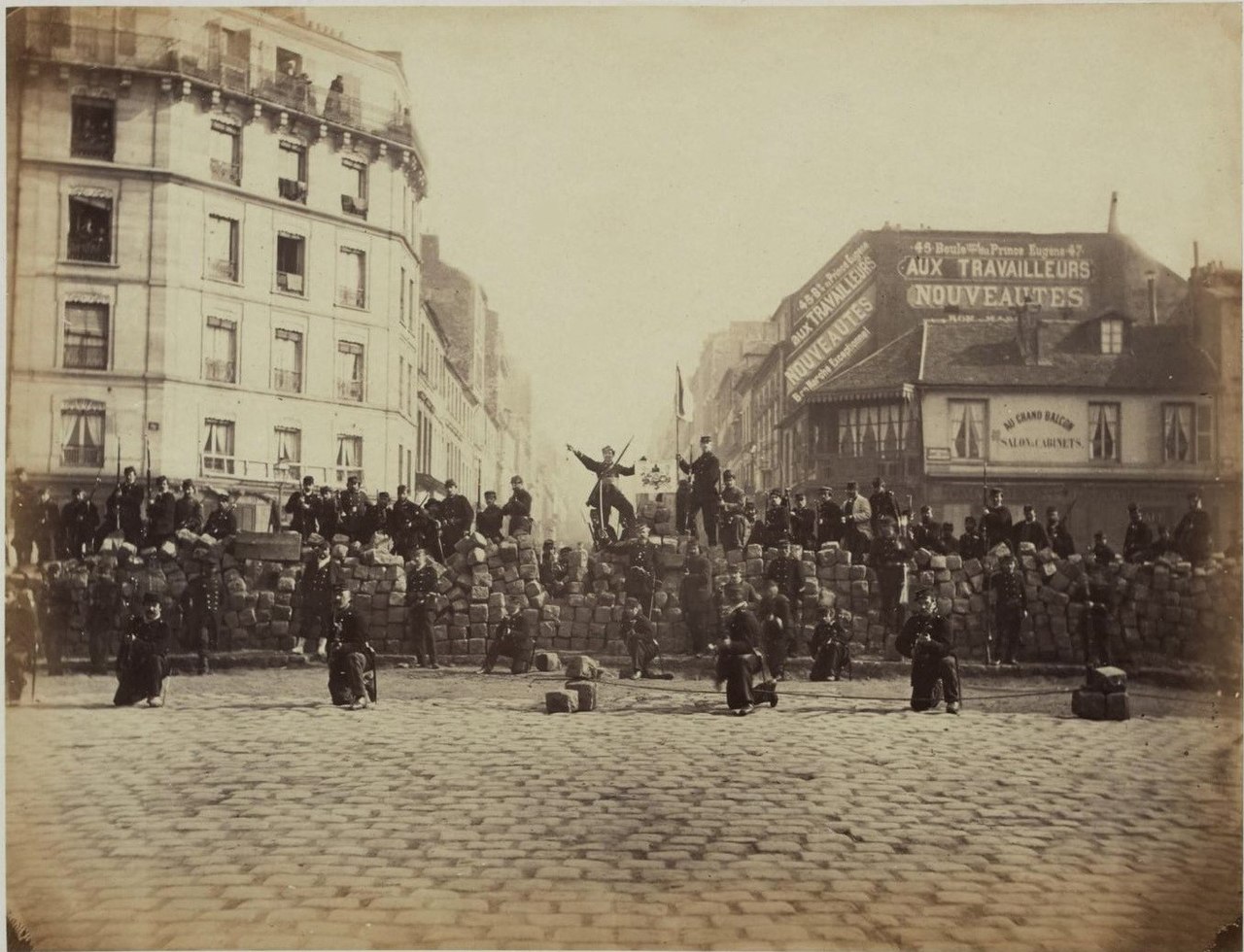
A barricade in the Paris Commune, March 18, 1871. (Musée Carnavalet / Wikimedia Commons)
There is a paradoxical discrepancy between the meteoric rise and fall of the Paris Commune, whose life did not exceed seventy-two days, and its lasting presence as a central experience in the Left’s historical consciousness.
Viewed through the lens of what some scholars call “world history,” what happened in Paris between March 18 and May 28, 1871, is almost insignificant. Most recent historians of the nineteenth century — think of the acclaimed works of Christopher Bayly and Jürgen Osterhammel — just mention it as a minor detail of the Franco-Prussian War. From the point of view of the takeoff of industrial and financial capitalism, urbanization and modernization, the consolidation of colonial empires, and the persistence of the Old Regime in an already bourgeois continent, the Paris Commune means nothing.
Indeed, the Commune was even marginal in the Franco-Prussian War, since it happened seven months after Napoleon III’s capitulation and the proclamation of the Republic, and two months after signing the armistice that transferred Alsace-Lorraine to German sovereignty. At the beginning of March, the victorious Prussian army had already paraded down the Champs-Élysées.