The Communards Were More Than Just Beautiful Martyrs
150 years since the Paris Commune, the militants who built the world's first working-class government are often commemorated as martyrs rather than taken seriously as revolutionaries. Yet in the years after 1871, socialists sought to draw practical lessons from this experience — and build the organizations that could turn the Commune's promise into lasting social change.
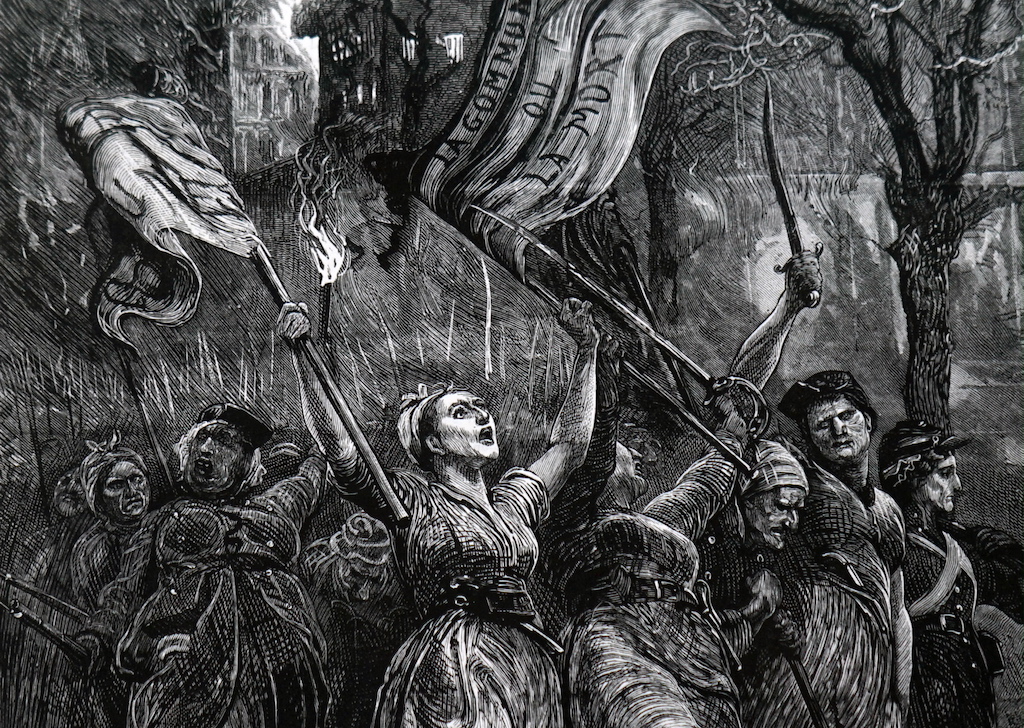
Illustration depicting the women of Montmartre marching to defend a barricade and carrying a banner saying “The Commune or Death” during the Paris Commune of 1871. (Universal History Archive / Universal Images Group via Getty Images)
What to make of the Paris Commune? At the end of the nineteenth century, this was one of the key questions facing socialists. While the Commune had ended in a terrible defeat in May 1871, the executed Communards were celebrated as martyrs who had fallen in the front line of struggle. And in the decades after its crushing, socialists and anarchists reached for lessons from what they took for a unique practical experience.
In late nineteenth-century France, both survivors of the Commune (Louise Michel, Benoît Malon, Édouard Vaillant) and those who supported it from outside Paris (like future Socialist leader Jules Guesde, in Montpellier during spring 1871) played a major role in shaping the multiple tendencies of French socialism. But the Commune’s memory was also kept alive by militants far beyond French shores, with March 18 commemorations each year celebrating the Communards’ glorious actions. From Berlin to Moscow, from London to Budapest, and soon even in Tokyo and Shanghai, the word “Commune” meant the Paris revolution and the heroic Communards who had fallen in combat.
The anniversary of the Commune was marked with particular ceremony in Germany, where the Social Democrats (SPD) had by the 1880s become Europe’s most strongly rooted workers’ party. In fact, this date had a rather particular meaning in Berlin. The Paris Commune’s own history was inextricably linked to the Franco-Prussian War; most Communards had made their patriotism clear, with the call to defend France, and Paris itself, mixed in with more properly social objectives. This international conflict made German displays of solidarity with the Commune — as organized by Social Democracy’s founding fathers Wilhelm Liebknecht and August Bebel — all the more heroic.