Ending Federalism as We Know It
A new book shows how the fragmented American state arrests democracy. What we need is nothing short of a reconstruction.
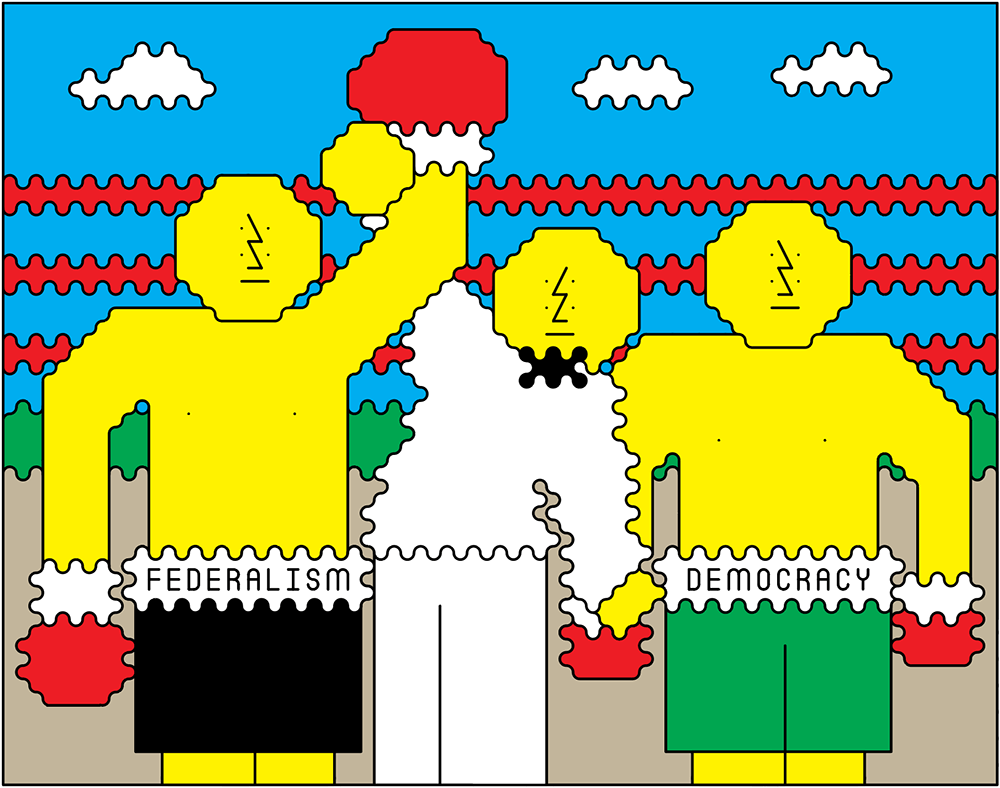
Illustration by Joe O’Donnell
The early days of the COVID-19 pandemic were heady ones for federalism apologists. As the Trump administration dithered, governors took center stage, issuing emergency declarations, holding daily press conferences clad in polo shirts, brandishing slide decks from McKinsey & Company, and outlining their strategies for controlling the spread of the virus while “safely” reopening state economies.
Indeed, to early observers, American federalism — which divides authority between central and regional governments — seemed like a crucial element of crisis management. Across nearly all fifty states, gubernatorial approval spiked. As the political scientist Kathleen Hall Jamieson put it, “A person from Mars observing the rhetoric and actions of our leaders would reasonably assume that Andrew Cuomo is the president.” Some scholars even lavished praise on the decentralized, federal structure of the American state itself. Writing in Foreign Affairs, Danielle Allen — director of Harvard’s Edmund J. Safra Center for Ethics — praised federalism as an essential asset in pandemic response, suggesting that local control “provides flexibility and the ability to tailor responses to the context — just what the United States needed.”
Paeans to decentralized government sit at odds with bleak realities in the states. As recent research has suggested, states’ decisions about social distancing didn’t reflect local conditions so much as the partisan identity of the governor and the state legislature. Moreover, as soon as social-distancing measures were imposed, most states quickly reopened their economies, despite lacking adequate test-and-trace infrastructures. In several Republican-led states, most notably Arizona, Florida, and Texas, new viral hot spots have appeared.