Donald Trump Was a Monster Forged by the American Free Market
Donald Trump is the grotesque embodiment of market principles. In climbing back from his disastrous four years, one of our aims must be to wrest back democracy from the market.
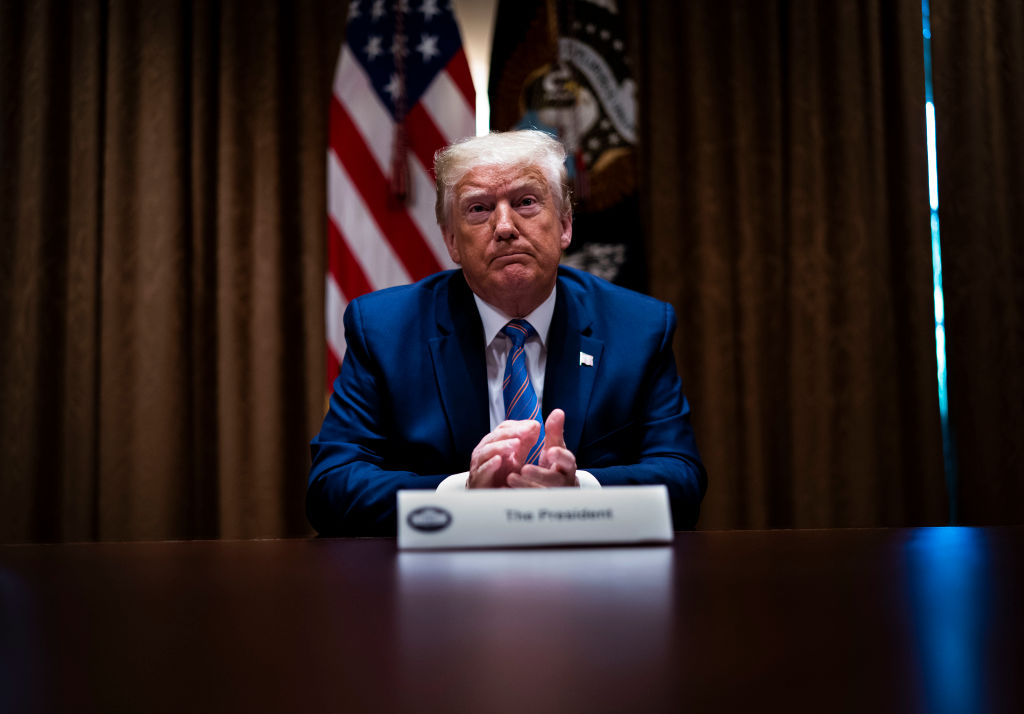
Donald Trump at the Cabinet Room of the White House on June 15, 2020 in Washington, DC. (Doug Mills-Pool / Getty Images)
Donald Trump was everyone’s monster. “Monster” comes from monstre and monstrum, a portent, warning, or revelation — as in “demonstration.” After Trump’s general election loss, everyone wants to know, or thinks they know, what his dishonest, chaotic, and bigoted administration reveals about the country that elevated him.
He has been influentially called the country’s “first white president,” on account of being the first of forty-four white men in the office to be elected, in some sense, as a repudiation of a black president. By that standard, he is certainly the first male president, in that he was the first to defeat a woman for the office. Each formulation captures something about the white grievance politics that Trump fomented on his path to the White House and his efforts to keep it. Each taps into a view about the importance of racial hierarchy and misogyny “in the DNA” of American life, as a strut of other parts of our social order, made explicit under pressure from demographic change and demands for genuine gender equality.
But Trump was also, and in a somewhat more direct sense, the first (late) capitalist president — not the first to celebrate that system, of course, but the first whose claim to the office was based on a story about his power to make money from money, not on any record of political, military, or other public service. Although he was not the first entertainer-president — Ronald Reagan preceded him, and the last century has generally favored presidential candidates who mastered the latest medium — he is the first to have thrived in a new era of fragmented media and splintered publics, in which success comes from a passionate niche, often defined more by an imagined common enemy. Trump is the president of the Twitter–Fox–MSNBC era, when resentment is the political emotion par excellence and everyone feels they are in a potential endangered minority.