Italy Has Finally Shut Down Nonessential Workplaces. We Should, Too.
Last night Italy’s prime minister declared that all nonessential workplaces will be shut down to stem the spread of COVID-19. For two weeks, social distancing has been undermined by employer pressure to keep production going. As contagion soars, other countries would be foolish not to learn Italy’s lesson.
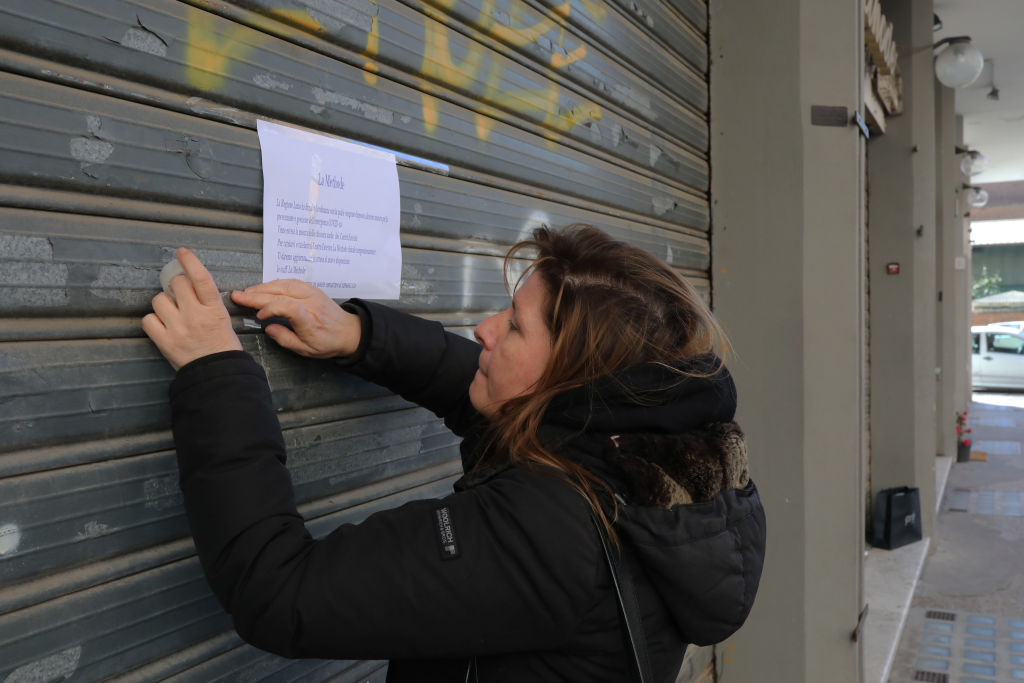
A woman attaches a sign and closes the shutter of her beauty center, which has been closed by government regulations, on March 11, 2020 in Rome, Italy. (Marco Di Lauro / Getty Images)
Lombardy is the heart of the Italian economy, with almost a quarter of national GDP generated in this region surrounding Milan. But it’s also the epicenter of the spread of coronavirus in Italy, which has now surpassed China as the country with the most COVID-19–related deaths. As of March 21, Lombardy accounted for 3,095 of the country’s 4,825 dead.
Yet even ten days after Giuseppe Conte’s government locked down Lombardy to stem the contagion, there were alarming signs of what hadn’t changed. On March 18, Milan’s Camera del Lavoro estimated that as well as six hundred thousand employed in necessary jobs (health, food, cleaning), around three hundred thousand nonessential staff were still heading to work in the city — half by public transport.
Italy’s lockdown measures seem to have somewhat slowed the rate of contagion, with both death and infection numbers rising around 15 percent a day last week. Yet with intensive care capacity overwhelmed, late on Saturday night Prime Minister Conte made a televised address calling for a fuller shutdown of the economy, now to extend to all “nonessential” businesses.