The Labor Movement Must Fight for Medicare for All — Not Employer-Based Plans
Unions have been at the forefront of almost every progressive policy advance for a century. So why are AFL-CIO president Richard Trumka and American Federation of Teachers president Randi Weingarten denouncing Medicare for All by parroting talking points crafted by health care industry lobbyists?
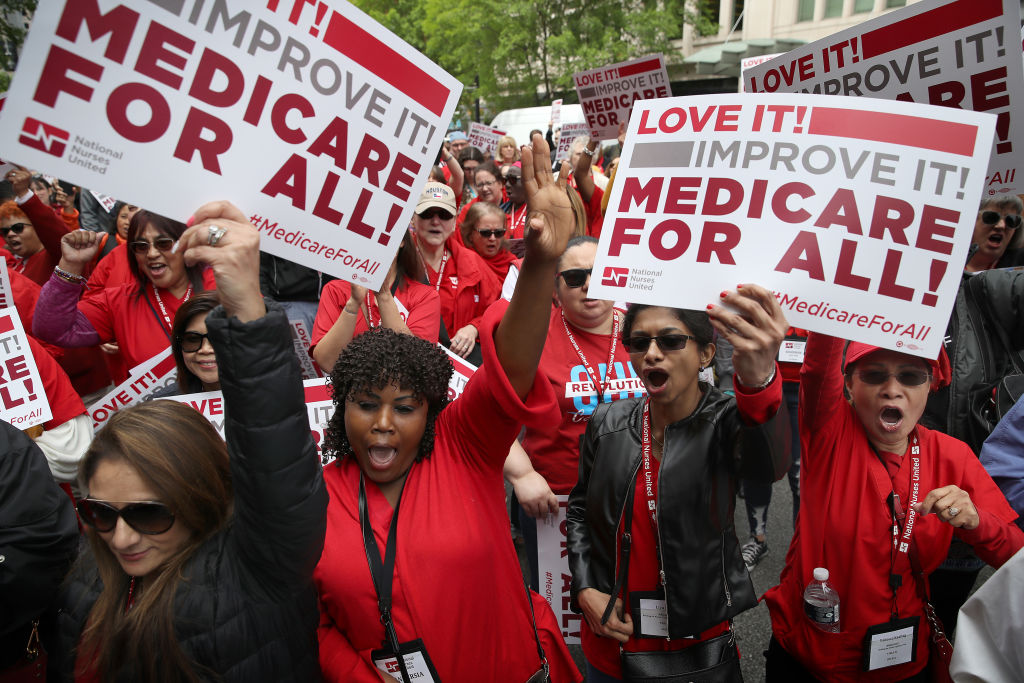
Protesters supporting “Medicare for All” hold a rally outside PhRMA headquarters April 29, 2019 in Washington, DC.Win McNamee / Getty
At the June 2019 House Ways and Means Committee Hearing on Medicare for All, Texas Republican Kevin Murphy lamented, “That great health care plan that your union negotiated for you? It’s gone. Banned under Medicare for All.”
A right-wing congressman with a 7 percent lifetime voting score from the AFL-CIO crying crocodile tears for great union health care plans can be easily dismissed as just another absurdity of the increasingly dysfunctional American political system. But when Joe “the workingman’s friend” Biden repeats the charge almost word for word and when AFL-CIO president Rich Trumka insists — on Fox News no less! — that “if there isn’t some way to have our plans integrated into the system, then we would not support [Medicare for All],” something is certainly happening out there. Talking points, after all, don’t just come out of thin air. They are carefully crafted and disseminated by a coterie of lobbyists and publicists often working on behalf of shadowy corporate and political interests.
Trumka was shortly joined by American Federation of Teachers (AFT) president Randi Weingarten, who just six months earlier had delivered a full-throated endorsement of the Medicare for All Act at a rally celebrating its introduction. In her September 23, 2019, Politico article, Weingarten walked back that support in favor of a fictitious system in which “employer-based insurance would be allowed to exist to the extent that plans met or exceeded the standards set by the Medicare plan.” Such a system “would allow people who like their current employer-based plan — which seven in ten Americans claim to (although it’s likely they like their doctor, not the plan itself) — to keep it, allow for a gradual transition from one plan to another when necessary, and effectively improve on the model originally created by the Affordable Care Act.”