Going Up the Country
The New Left and the “back-to-the-land” movement.
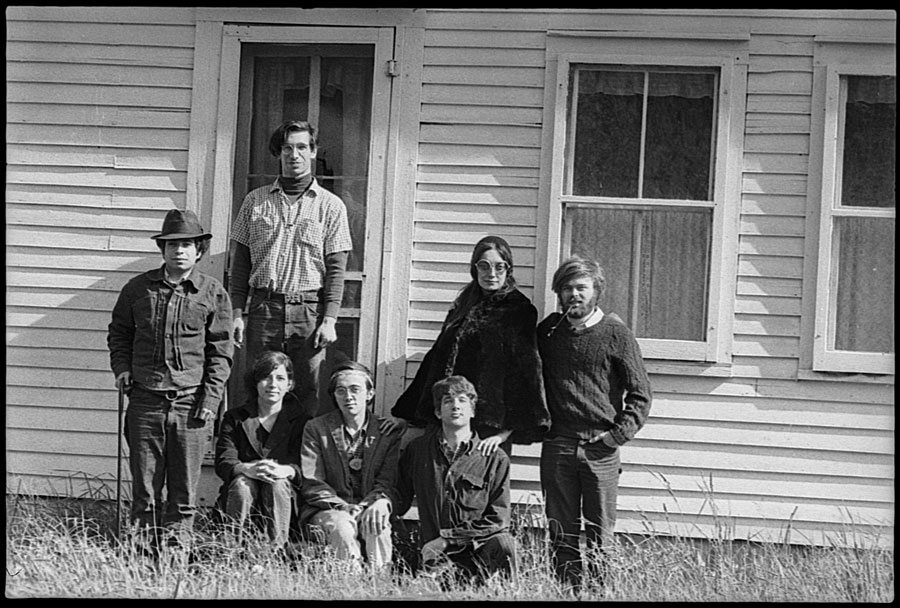
The founders of Total Loss Farm: Sitting, from left: Michelle Clarke, Ray Mungo, and Peter Simon. Standing, from left: Richard Wizansky, Marty Jezer, Verandah Porche, and Laurie Miller. (Photo by Peter Simon)
When Ray Mungo deserted Cambridge for a commune, he absconded with the Liberation News Service’s (LNS) entire printshop. A radical wire service, conceived as the New Left’s answer to the Associated Press, the LNS had been mired in sectarian bickering since Mungo co-founded the organization in 1967 as a Boston University undergrad. By the next year, the young writer had reached his limit. He was going up the country.
After a stop at the LNS office in Washington, DC — where Mungo and his comrades executed a slapdash heist, flinging ink, reams of paper, even whole printing machines into a waiting van — the group eventually wound up with some modest acreage in Vermont, which they christened “Total Loss Farm.” (They weren’t great farmers, but as good left-wing journalists, they were at least unflinchingly honest in their choice of names.)
At first, their plan was to hole up and relaunch LNS from the underground. But the woodsy bunker proved far too bucolic for politics. “The farm in Vermont had fooled us, just as we hoped it would,” Mungo wrote at the time. “It had tricked even battle-scarred youth militants into seeing the world as bright clusters of Day-Glo orange and red forest, rolling open meadows, sparkling brooks and streams.”