Japan Is Rearming and Embracing Nationalism

Amid rising nationalism, Japan is accelerating its military buildup. Troublingly, as Japan abandons its postwar pacifism, its leadership is also pushing revisionist ideas about the atrocities that made the stance necessary to begin with.
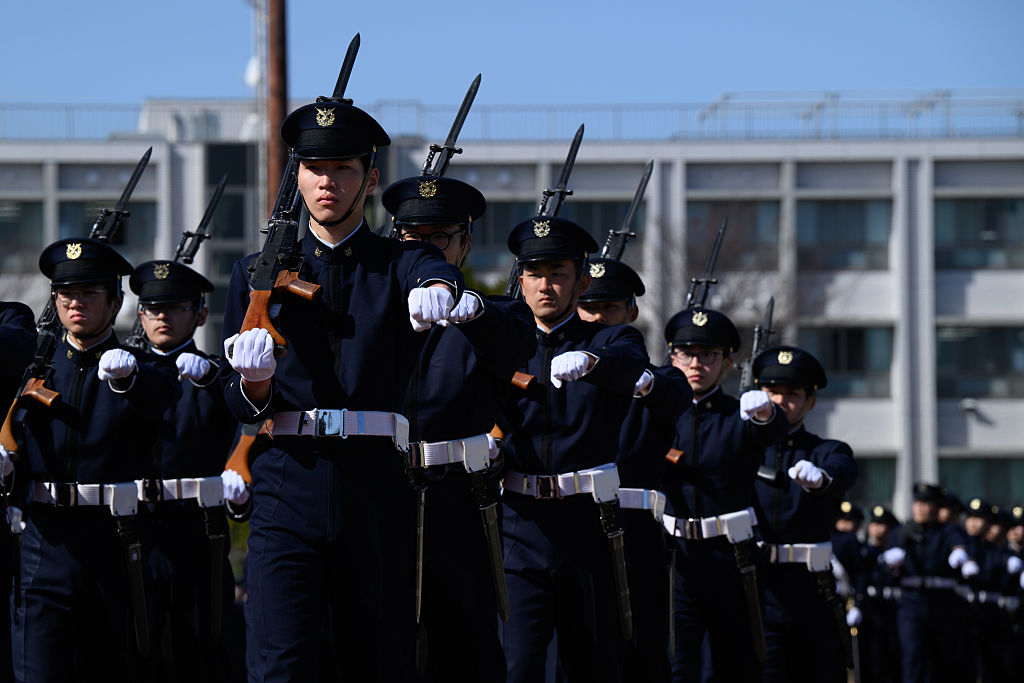
A line of Japanese soldiers stands in formation with rifles pointed upward.

Japan’s rapid rearmament push is driven by surging far-right and nationalist sentiment in the country. (Akio Kon / Bloomberg via Getty Images)


On April 21, Japanese Prime Minister Sanae Takaichi officially announced that Japan had lifted a decades-old ban on exporting lethal weapons. The new offer concerns at least seventeen countries as potential buyers for Japanese fighter jets, missiles, and warships.

The move came in a period of strongly rising militarism. Japan and Australia had only days before signed a $7 billion deal for Mitsubishi Heavy Industries to build eleven warships for the Royal Australian Navy. That same week, Japan’s Self-Defense Forces (SDF) began participating as combatants in the US-Philippines Balikatan 2026 exercises for the first time, during which it has since tested its Type-88 surface-to-ship missile, marking the first time Japan has launched an offensive weapon abroad since the end of World War II.

Takaichi’s April 21 announcement also coincided with reports that she had sent a ritual offering to the Yasukuni Shrine, which honors Japan’s war dead, including over a thousand convicted war criminals from World War II. This number includes former Prime Minister Tojo Hideki and general Matsui Iwane, who explicitly ordered his soldiers to carry out mass executions of civilians across Nanjing as the Imperial Japanese Army laid siege to the Chinese city from December 1937.

These are chilling developments. Today’s rapid rearmament push is driven by surging far-right and nationalist sentiment in the country, which harkens back to Japan’s ethnonationalist militarism and domination of East Asia, a time of great violence and brutality. These rapid shifts away from pacifism do not suggest a return to the horrors of Imperial Japan, but are nonetheless troubling, especially because they are buoyed by rising reactionary currents and historical revisionism.

Policy Shifts and “Counterstrike Capability”

These changes are only the latest steps in a series of developments underpinning a structural shift. In late March, Japan deployed long-range missiles to Kumamoto Prefecture on the island’s southwest coast, systems capable, for the first time, of striking mainland China. This is not defensive posturing in any conventional sense but rather reflective of a strategic reorientation in which Beijing has, since 2019, been identified as Tokyo’s primary national security threat, overtaking both Pyongyang and Moscow. The result is a steady militarization of Japan’s southwestern island chain, from Okinawa to Kyushu, where new bases and missile installations are being constructed despite sustained local opposition.

Japan’s postwar constitution formally renounces and bans the country’s capacity to wage war. Yet Japan’s evolving defense doctrine has been formalized as part of a loosely defined “counterstrike capability.” What on paper is a limited right to respond in the event of an attack is in practice essentially indistinguishable from the framework of any conventional military. This stretches the meaning of self-defense beyond recognition.

Under the expanding legal framework established by successive Liberal Democratic Party governments, Japan can now intervene militarily in the name of “collective self-defense” even when it is not directly attacked, so long as an ally is deemed to be under existential threat. Again, there is no rigid definition of what constitutes an existential threat, which allows Japan to construe virtually anything as such. It is a formulation elastic enough to accommodate almost any contingency, and vague enough to invite escalation.

Geopolitically convenient interpretations of the pacifist Article 9 of Japan’s constitution, which Takaichi’s right-wing government wants to formally revise, are not new. The very existence of the SDF, established in 1954, and its expansion since then, have depended on a series of careful reinterpretations and legal contortions that have allowed the state to maintain what is, in effect, a modern military under a constitution that explicitly forbids one.

The SDF — legally classified as “special national government employees” — have, over the past three decades, been transformed from a largely symbolic and humanitarian institution into a comprehensive operational military force. One turning point came in the aftermath of the Gulf War, when Japan’s inability to provide direct military support to the US-led coalition was widely perceived by political elites as a national humiliation. Since then, each successive crisis — North Korean missile tests, maritime disputes in the East China Sea, rising tensions over Taiwan, etc. — has been used to incrementally expand the scope of what the SDF can do and where it can do it.

Takaichi has already framed a hypothetical Chinese attack on Taiwan as a potential “existential crisis” for Japan. This interpretation would permit military intervention under existing security legislation, despite the absence of any direct attack on Japanese territory. Now those legal contortions are being actively standardized in favor of formal expansion.

None of this is occurring in isolation. Japan’s rearmament — the acquisition of hundreds of US-made Tomahawk missiles, the rise in defense spending to record levels, and now the lifting of restrictions on lethal weapons exports — is unfolding in close alignment with the strategic priorities of the United States, whose efforts to contain China have increasingly relied on the remilitarization of regional allies. But the consequences of this alignment are Japan’s own to bear. And as the country moves further away from the constraints that once defined its postwar identity, it does so without ever having fully reckoned with the last time it embarked on such a path.

Imperial Violence

To understand the stakes of Japan’s present trajectory, it is necessary to confront the scale and character of its past. Between 1931 and 1945, the expansion of the Japanese Empire across East Asia was marked by systematic brutality that left millions dead across China, Korea, and beyond. Estimates vary, but even the most conservative death tolls suggest many millions of civilians were killed. Yet what distinguishes this history is not only its scale but the forms that violence took.

The cruelty of the Imperial Japanese Army is well-illustrated by the Nanjing Massacre. In December 1937, as Japanese forces captured the Chinese capital, soldiers embarked on a weeks-long campaign of killing, rape, and destruction. Between 100,000 and 300,000 civilians were murdered over the course of just six weeks. The higher estimates suggest that almost everyone who was unable to get into the Nanjing Safety Zone, a demilitarized zone created by a group of businessmen, missionaries, and journalists, was killed. Tens of thousands of women were raped. Entire neighborhoods were emptied through mass execution, often for sport, with bodies left to rot in the streets.

These were not the chaotic excesses of undisciplined troops but acts carried out systematically with the knowledge and encouragement of commanding officers such as General Matsui Iwane, who is honored at the Yasukuni Shrine. The utter scale and brutality of this violence are explored in meticulous, harrowing detail by the late Iris Chang in her powerful, moving book The Rape of Nanking. Although perhaps the most well-documented of the Japanese massacres in China during the Second Sino-Japanese War, the slaughter of Nanjing was merely one of many.

Similarly, Unit 731 exposed the depths of the dehumanization that defined Imperial Japan. Established in the mid-1930s under the leadership of Shirō Ishii, the unit conducted biological and chemical experiments on thousands of prisoners, most of them Chinese civilians. Victims were infected with plague and cholera, subjected to vivisection without anesthetics, frozen, dismembered, and used in weapons testing. Children born in captivity were not spared, either. Though the exact number of victims remains uncertain, the scale of suffering and the institutional support for it place Unit 731 among the most grotesque programs of human experimentation in modern history. Shirō Ishii was granted immunity from war crimes prosecution by the US government in 1948 in exchange for detailed data from Unit 731's human experiments, which the United States, at the time, deemed invaluable for its own biological warfare program. He died a free man in 1959, in Tokyo.

Alongside these acts ran the organized system of sexual slavery euphemistically referred to as “comfort women.” Across occupied territories, an estimated tens to hundreds of thousands of women, primarily from Korea, China, and the Philippines, were coerced, trafficked, and imprisoned in military brothels, where they were subjected to physical and sexual violence by Japanese soldiers. For decades, survivors’ testimonies were denied, minimized, or ignored entirely by the Japanese state. Even today, some nationalist politicians and revisionist groups continue to contest the very existence of these trafficked victims of empire.

The attitudes that enabled the Nanjing Massacre, Unit 731's human experimentation, or the systematic mass sexual enslavement of women formed part of a broader imperial project that treated entire populations as expendable. And yet, despite the enormity of these crimes, Japan’s reckoning with this past has remained partial and sometimes deliberately obscured.

Cold War Impunity

In the aftermath of Japan’s surrender in World War II, accountability was never allowed to run its full course. While the International Military Tribunal for the Far East prosecuted several high-ranking officials, the process was deliberately partial. As early Cold War tensions hardened, the United States shifted its priorities from justice to containment. As a result, Japan, which had very recently been an imperial aggressor, was rapidly recast as a strategic ally in East Asia — a bulwark against communism and, increasingly, against China.

Political dynamics further diluted the possibility of reckoning. In the years following Japan’s surrender, both the People’s Republic of China and the Republic of China were locked in a struggle for international legitimacy, each seeking recognition as the sole representative of China. In this context, Chinese relations with Japan took on a new strategic importance, and pursuing extensive reparations or sustained confrontation risked undermining diplomatic goals. Therefore, even as the horrors of Japanese occupation never escaped the national conscience, demands were softened, deferred, or renounced.

The result of this postwar order, in which Japan was neither fully absolved nor meaningfully held to account, was a framework in which the acknowledgement of wartime atrocities became inconsistent. And it was within this space that a different kind of transformation also began to take root.

Soft Power and Historical Amnesia

In the decades that followed World War II, Japan was, in many respects, allowed to reframe its history. As Cold War dynamics stabilized its position within the Western bloc, a parallel transformation took place at the level of image and perception. The Japan that emerged in the global imagination was no longer an imperial power defined by conquest but a postwar success story.

Central to this shift was the rise of cultural export as soft power. Through the global spread of anime, manga, video games, and an entire aesthetic economy, Japan has cultivated an image of accessibility and creativity that has proved enormously effective, particularly in the West. For most of the world, Japan now appears less as a former aggressor than as a hub of innovation and cultural production. In this pixelated rendering, history has been pushed to the margins of global consciousness by a steady stream of more palatable imagery.

Similarly, for many, Japan’s World War II history is limited to the attacks on Pearl Harbor and the indefensible crimes of the atom bomb being dropped on Hiroshima and Nagasaki, which have broadly superseded the horrors carried out by Japan in Southeast Asia and the Pacific.

This softening is not limited to international audiences. Within Japan, too, right-wing factions have long pushed for textbook revisions that downplay or omit the country’s wartime atrocities. And as the past is contested or minimized at home, it becomes easier for it to fade abroad.

Rearmament Without Reckoning

The steady dismantling of Japan’s pacifism is happening within a political climate increasingly shaped by nationalism, historical revisionism, and a hardening hostility toward China. Under Takaichi and the long-dominant Liberal Democratic Party, this shift has been both ideological and material: a reassertion of military power paired with a narrative that frames China not only as a rival but as an existential threat. This rhetoric normalizes expansion, justifies legal reinterpretation, and cultivates a public atmosphere in which confrontation appears inevitable.

In recent years, ethnonationalist currents have also grown more visible and confident. The far-right party Sanseitō, led by Sohei Kamiya, has gained ground. In the 2026 elections, in which national security and immigration were major issues, it more than doubled its vote share, becoming the fifth-largest political party in Japan, espousing openly revisionist positions and denying atrocities like the Nanjing Massacre while advancing a “Japan First” nationalism rooted in exclusion and historical erasure.

At the same time, the boundaries between rhetoric and action are also fraying. This March, a man claiming to be an active member of the SDF forced his way into the Chinese embassy in Tokyo, threatening to kill diplomatic staff “in the name of God.” This incident emerged from a broader environment in which militarism is rehabilitated and the language of existential struggle against a Chinese enemy is increasingly commonplace.

All of this is unfolding less than a century after the collapse of Japan’s imperial project — a period marked by some of the most brutal crimes of the twentieth century, and one that, as history shows, was never fully reckoned with. Today as Japan expands its military capacity, loosens long-standing constraints, and aligns itself ever more closely with US strategic priorities, it does so not as a nation that has confronted its past but as one that has, in many ways, moved around it.

The distance between past and present is never as great as it appears. As Japan again edges toward a more assertive military role in the region, the question is not whether history will repeat itself in identical form, but whether the conditions that once made such violence possible are steadily returning.